Wait—That’s Bad?

In the post about Martin’s disastrous Disney morning, I also mentioned buying him a black coffee, hoping it would help.

In my effort to present an honest picture on this blog, I keep my readers abreast of my application for Autism Parent of the Year. Remember when I started my kid on glasses and Heilkunst the same day, then couldn’t figure out which made him puke? Or when I denied him the chance to connect with a boy at church? How about when I vacationed in Jerusalem while Martin pined and threw tantrums at home? Way to go, me!

Let’s add coffee to the list. Months ago, Martin asked to sample an iced coffee I was drinking. I drink my coffee black: There wasn’t any soy milk or commercial almond milk or carrageenan or whatnot to worry about, so I let Martin try a sip. I thought he would hate the taste. Instead, a practice began, wherein Martin drank my coffee. More and more coffee each time, until finally I was buying him his own black iced coffees and giving him hot coffee at home.

My reasoning? Brewed coffee is GAPS-legal, and the stimulant effect seemed to do Martin well. He seemed more focused. No harm done, right?

Not so much, is MAPS doctor informed me when I mentioned the coffee habit (and convinced her to believe me). A stimulant isn’t really so good for Martin, and I should stop with the coffee, ASAP.

Which was my honest intention, until things ran amuck at Disney. Coffee! I told my brother Rudy. Grab some coffee! It helps!

Except when it doesn’t.

Want to Know What Terrifies Biomed Parents?

In my last post, about Martin’s disastrous Disney morning, I mentioned a nasty insect bite on Martin’s foot that’s had me worried.

I suppose many parents worry about insect bites. They’re itchy. They can become infected. Some folks have allergies; I myself react so badly to mosquito bites that I have to rely on antihistamines. There is West Nile Virus to worry about and, elsewhere, malaria.

For many of us in the autism-recovery community, I think, bites provoke a special, heightened fear: Lyme disease.

Lyme disease, which is transmitted by ticks, primarily deer ticks, has become endemic in many parts of the United States. Lyme disease is also implicated in the issues that many children on the spectrum have. Worst of all, because Lyme disease is so hard to diagnose, and can mimic other problems, it is difficult to get proper treatment.

In November 2012, a test showed Martin slightly positive to Lyme and one of its common co-infections, bartonella. We treated him with a course of takuna and other antimicrobials, and later tests showed no indicators for Lyme. But who knows? I dread/fear another infection, or one already present and unable to be diagnosed. When Martin plays outside, I spray him with a combination of essential oil in witch hazel or apple cider vinegar. I’m not going to use the chemical repellants, and I need something to keep the bugs away.

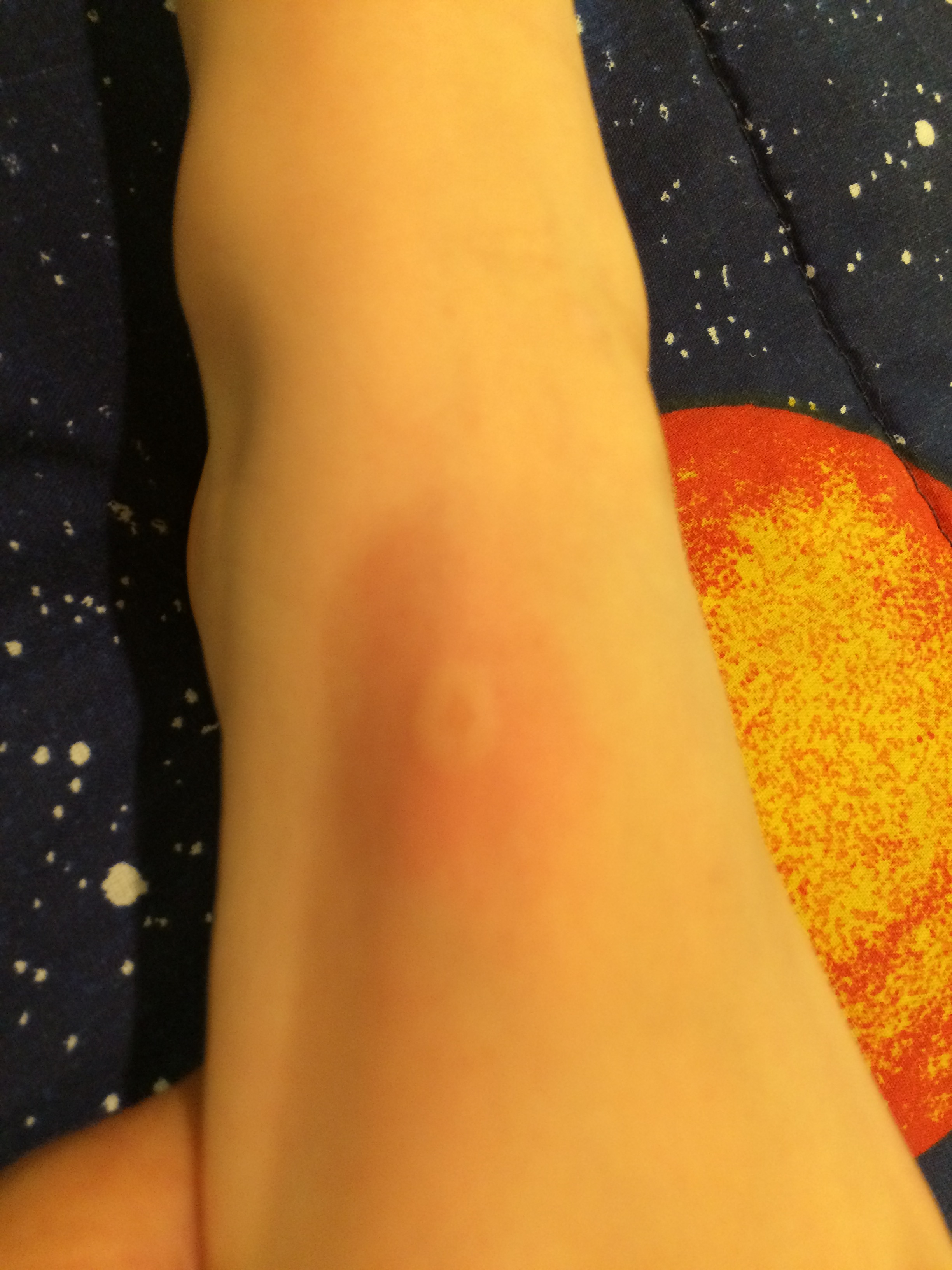
When Lyme disease is transmitted, a tick bite often will form a “bull’s eye” rash, a spot surrounded by a red circle. Can you imagine how I freaked out when Martin’s babysitter, Samara, sent me this picture of Martin’s foot, accompanied by a note that the bite seemed to be bothering him?

IMG_8106

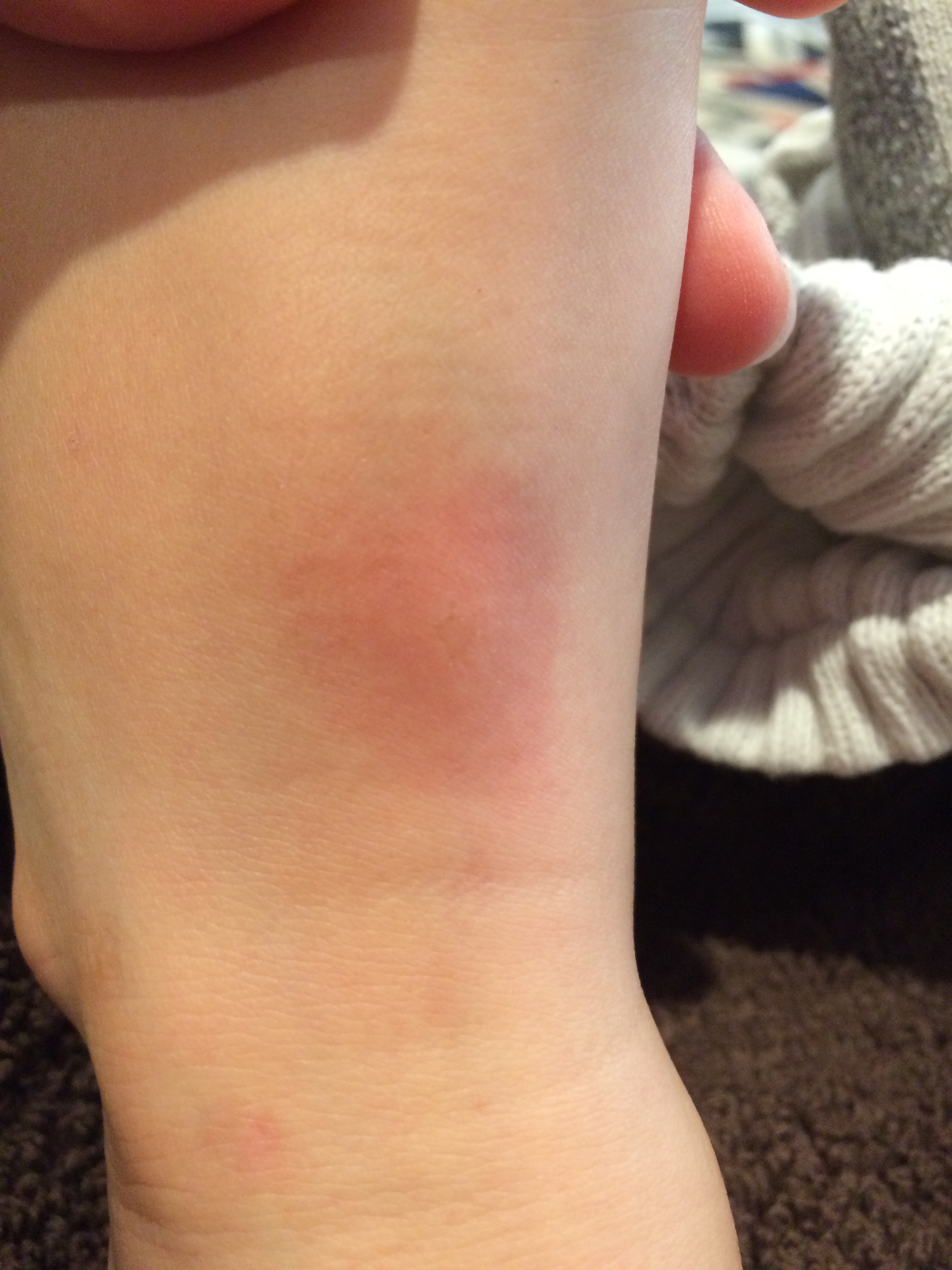
In retrospect, “freaked out” might be an understatement. I exited a business meeting to research Lyme onset and how long the rash should last. I posted the picture to an ASD group on-line, seeking advice. Within ten minutes or so, Samara sent another picture indicating that the bull’s-eye-like rash had faded already into a more traditional insect bite.

IMG_8107

That seemed to be good news; from my quick research, a true bull’s eye would last longer. Also, Samara reported that the bite was now itchy; according to the moms who weighed in on-line (sometimes trustworthy, sometimes not), a bull’s eye usually doesn’t itch.

These developments calmed me enough to stay at work and not demand that Samara bring Martin to meet me at the pediatrician’s office. I did email the photos to Martin’s MAPS doctor, who recommended additional anti-microbial drops as a preventative measure, and told me to visit the pediatrician or emergency facility, for antibiotics, if we noticed any other symptoms. We didn’t, thank goodness. We stayed on the extra anti-microbial drops, in case.

When the Disney morning from hell rolled around, my mind returned to the bull’s-eye-cum-mosquito-nibble. Sometimes ASD recovery feels like a continual series of freak-out moments.

Or maybe that’s just what parenting feels like.

Passing Storm

Last Wednesday, my brother Rudy and I took Martin to Disney in Anaheim. Rudy and I talked the day up: the characters we would see, the rides we would ride. Because one of Martin’s current interests is marching bands, and Martin always has enjoyed live music, Rudy mentioned that we might see a marching band too.

When Martin woke on Wednesday morning, at my brother’s home in Laguna Beach, he seemed—okay. Not great. Not particularly enthusiastic about the daytrip to Disney. Just okay. I fed him Treeline cashew cheese on flax-seed crackers for breakfast, and then we stopped for second breakfast at the Penguin Cafe, where Martin ordered a hamburger patty, fruit, and “bubbly water.” He ate slowly and seemed distracted. His voice modulation was subpar. “Indoor voice, bunny rabbit!” I reminded as he shouted his order at the waitress. “Use your indoor voice!”

The real trouble started in the parking lot when we got to Anaheim. “I don’t want to go to Disney,” Martin said when we exited the car. “I just want to go back to Uncle Rudy’s.” I wasn’t sure how seriously to take his words; Martin often reverses what he wants to do and doesn’t want to do, and his hesitations can be fleeting. I persuaded him to get on the shuttle from the parking lot to the park. On the shuttle Rudy engaged some kids who presented themselves as experienced Disneygoers and gave advice on rides and performances. Martin sat silently. He opened his mouth only to answer, with additional prompting, when someone asked him how old he was.

On the plaza outside the park, Rudy picked up a schedule of events and, trying to rouse excitement, told Martin that he would be able see a marching band (parade) at 4:30. Martin completely freaked. He did not want to see a marching band. He did not want to go to a park with a marching band. I took him to the restroom, had him sit on the plaza with Rudy, and finally negotiated an agreement that we would enter California Adventure, Disneyland Park’s companion. We would not see a marching band, I said. We would not enter Disneyland.

We made it inside California Adventure. I headed straight to the “Chamber of Commerce” to request a special-needs speed pass. The agent who helped us with the pass also put us on a list for the Monsters, Inc. ride ten minutes later. We didn’t make it, because Martin panicked at the idea of attending any attraction. He was full of anxiety. He walked aimlessly, crying and not crying and crying again. He couldn’t stop asking about the marching band, whether we would hear the band, whether we would go to the other Disney park. He fixated on 4:30, the time when Rudy had said the marching band would play (in the other theme park). He didn’t want this. He didn’t want that.

“Hey, I’m happy just to be here, walking around with you guys,” said Rudy, who had taken the day off work to accompany us. “Let’s go with it. Maybe he’ll find something he wants to do.”

Alas, Martin didn’t find anything he wanted to do, at least not then. I bought him a black coffee, hoping that might help. Nope. I bought him a box of organic apple juice as a treat, hoping that might help. Nope. Martin couldn’t bear to be still, couldn’t be held. He moved, whined, and panicked. As the situation became ever more challenging—“Mommy, will we see the marching band? Mommy, what time is it? Mommy, I don’t want to go to the Disney park. Mommy, can we hear the marching band? Mommy, is it 4:30?”—I considered throwing in the towel. I wondered if I should return to the “Chamber of Commerce,” explain that my usually stable son was having anxiety meltdowns that precluded our enjoyment of the park, and ask to return and use our $300 tickets the next day. Finally, when I ran out of ideas, Rudy saw openings at a nice in-park restaurant, asked about special-diet options, and guided us inside.

Martin managed to listen to the food options and order, interspersed with getting up to run around. Then he sat long enough to eat an entire order of boiled calamari, followed by a plate of gluten-free pasta with clams. (It was barely noon. Remember, he’d had two full breakfasts before we left Laguna Beach.) Rudy and I drank wine with our lunches. By then, alcohol was necessary.

By the end of lunch, Martin seemed a little better. He still was having trouble sitting still, but the crying eased. He went to the men’s room by himself. He didn’t get upset when I couldn’t find a dessert that he could eat.

After lunch he asked to enter one of the eight million stores. Thinking that something to clutch would ease the anxiety, I told him he could pick out a stuffed animal, and he chose an eight-inch Donald Duck. When we exited the store, Martin seemed calmer. He looked at a ride, a kiddie attraction with jellyfish that rise into the air. I asked if he’d like to go on the ride, and to my surprise, he agreed.

From then on, the situation turned. The anxiety didn’t disappear completely, but Martin asked about the marching band only every 10 or 20 minutes. The restlessness decreased. He tried half a dozen rides, including the Goofy’s Sky School roller coaster, despite his professed dislike of roller coasters. He asked to enter a courtyard and listen to a Raggae-style band. Rudy and I exchanged what-on-earth-is-happening? glances, and when Martin was out of earshot, verbalized those glances. In the end, we stayed at California Adventure until nearly 7:00 pm, and finished off the day waiting patiently in a long line, at Martin’s request, to meet Minnie Mouse. Once we were headed back to Laguna Beach, Martin skillfully introduced Donald Duck to his friend Chicago Bear, who had spent the afternoon guarding Rudy’s car.

We had one kind of morning, and a different kind of afternoon.

I’ve asked myself repeatedly what could have caused Martin to have such a disastrous morning. The full moon? Traveling? Lack of sleep because of jet lag? A nasty insect bite on his foot that’s had me worried? A healing reaction?

I suppose I will never know, which is unnerving. I’m glad it didn’t last.

When Martin, feeling better, said he doesn’t want to go back to Disney anymore, I decided to honor his wishes.

Who Gets to Join This Fancy Club?

Last night I had the pleasure of dining with an old friend from law school. Our discussion turned to Rachel Dolezal, the woman who resigned as president of Spokane’s NAACP chapter after it became known that she was born white, not black. My old friend is now a law professor; her research includes issues of race. She talked about three ways of identifying with a community (in Dolezal’s case, identifying with the African-American community): documentary, like checking the box that says “Asian-Pacific Islander” or “Hispanic” on a form; biologically, like asserting, “My grandparents came from Ukraine, so I am Ukrainian”; and aesthetically, like adopting traditions, tastes, customs, &c. commonly associated with the group. My friend opined that a person who chooses to claim a social identity, even if s/he does so only aesthetically (say, in hairstyle, language patterns, and manner of dress), should not be rejected if s/he also assumes the burdens associated with that identity: If Dolezal claims blackness, and willingly endures the discrimination that black women in the United States face, then her lack of biological identification does not disqualify her from the African-American community.

My friend the professor owns that theory: Any flaws in articulating it are mine alone.

We also spoke about Martin. I am sometimes asked why Martin—remember, that’s not my son’s real name—has a Spanish name. He is pale and blonde like I am and doesn’t otherwise “look” Latino; moreover, although Adrian, my husband, comes from South America and speaks English with an accent, he does not participate in “Latino culture” as we have (or imagine) it in the United States. (Excuse my sweeping generalizations; a blog post admits only so much depth.) My friend noted that Martin already identifies with the Latino community biologically and documentarily (we check both the “white/Caucasian” and “Hispanic” boxes), and to some extent aesthetically, because he is Spanish-English bilingual and has a Spanish name. Someday, my friend observed, Martin will have to decide for himself how much more he will identify aesthetically with United States Latino culture.

I enjoyed this conversation so much. It was personal, thought-provoking, and invigorating. Even better still, we were discussing Martin, and his future, and the topic was entirely unrelated to autism. I don’t know whether my friend is aware that Martin has autism. Martin was there, present, at my friend’s apartment. As we talked, Martin was playing, awkwardly but more or less appropriately, with my friend’s four-year-old daughter. Adrian and I are not public about Martin’s diagnosis, and I’ve never had occasion to tell this friend. Maybe she knows via the friends-in-common grapevine. Maybe not. Autism isn’t really the elephant in the room when I have Martin with me, not anymore. These days it’s sort of the toy elephant in the room. I can shove it in a pocket or tuck it behind a knickknack and hope no one notices.

That being said, as I sat with my friend and (especially) thereafter, my mind drew connections to autism. Martin has autism. I am part of the autism community. My family is part of the autism community. In terms of biological identification, we did not choose membership. Martin developed autism. It happened. Our entry tickets appeared. In terms of documentary identification, I suppose we do choose to join, out of necessity. If we want special education and other services, we have to check that (sometimes metaphorical) “autism” box.

Yes, I also check the metaphorical box to pre-board airplanes. Guilty.

Which leaves aesthetic identification. As an aesthetic matter, do I identify as a member of the autism community? Yes and no. No, insofar as we are not public about Martin’s diagnosis, insofar as we share on a mostly need-to-know basis. Our primary motivation for keeping Martin’s autism private is that he is getting better, and that one day he will recover, and then we don’t want him seen as “the kid who had autism.” In that regard, we refuse to assume one burden of the autism identity: We try to insulate Martin from the negative stereotypes associated with spectrum disorders.

Yes, however, insofar as autism has worked infiltrated the way I navigate the world, and any insult to the autism community feels like an insult to me personally, and by derivation to Martin. Remember when an ignoramus in an elevator called my friend Natasha’s pre-verbal son a thing? The offense hit me exactly as if he had called my son a thing. Two weeks ago, in a Brooklyn market, a minister—a minister by profession and not, I daresay, by vocation—yelled at my friend Stacey’s sensory-seeking son and then told Stacey to “get [her] son under control before he hurt[] someone.” Though I heard the story only afterward, from Stacey, I felt myself there present, as if the alleged minister had yelled at Martin and said those awful words to me. I identify with every report of a spectrum kid getting bullied, family who can’t afford biomed, or student whose school district denies appropriate special-education services. Regardless of whether we speak out or advocate, I am part of the autism community psychically.

I wonder what will happen when, for the most part, we lose Martin’s biological identification with autism, when he recovers? (I say “for the most part” because I envision him always having some level of immune sensitivity that requires special care.) I remember the episode of Curb Your Enthusiasm, when Larry David’s Los Angeles character, who’s always believed himself the son of Jewish parents, discovers he’s adopted and was born to Protestants. Immediately he begins doing stereotypical things like wearing a fanny pack, hunting, slamming beers. When we lose Martin’s biological connection to autism, will my aesthetic identification fade too? Will I ask, “Is autism bullying a problem?” or, “They have adequate social services for persons on the spectrum, don’t they?”

I won’t. I think once a person has experienced what it means to reside with autism, that feeling never goes away. Maybe it’s comparable to PTSD; I once saw a report indicating that mothers of adolescents and adults with autism experience chronic stress similar to combat soldiers. Martin is young still, his autism has never been “severe,” and shortly after we started biomed, he started sleeping regularly (other than stress, lack of sleep was the big threat to my own health), so maybe in my case the PTSD comparison is too dramatic.

Does Rachel Dolezel have a place in the black community? Not for me to say, because it’s not my community.

My old friend from law school has me thinking this: I’m really not interested in policing the membership of the autism community, either. If a person who is biologically and documentarily unconnected to autism wants to assume the burdens of autism, wants to internalize every insult the way I do now, then I welcome that person on board. We biomed parents are striving to reduce the biological autism community. Growing the aesthetic autism community can only help those who remain biologically connected to autism to fare better in this world.

Those Doubts Are Gone. From a Mainstream Perspective, I Get Crazier by the Day

Remember my doubts about Heilkunst homeopathy?

Heilkunst is about supporting the body’s natural healing power, allowing its own return to health. I had to go through the dreadful process of enumerating, in reverse chronological order, the many insults to Martin’s immune system, from medications and illnesses to vaccines to home remodeling while I was pregnant. For eight months we’ve done a “clear” every two or three weeks, working backward through what might be hampering Martin’s recovery.

Immediately after we began the first clear, which addressed coxsackie, Martin vomited and woke the next morning with a mild coxsackie-like rash on his hands. Since then we’ve seen what appear to be “healing reactions” of all sorts. Itchy neck. Inner-ear swelling. Tired allergy eyes. More vomiting. ROOS. Ugh, ROOS.

At the same time, Martin has been getting better and better. Seriously, he’s having a homerun 2015. I’ve been “reasonably convinced” the Heilkunst is doing what it’s supposed to.

Time to scratch the “reasonably.”

Our last three clears have been MMR, the H1N1 vaccine, and antibiotics we used when addressing SIBO. The antibiotics actually should have been addressed much earlier, in terms of chronological order; I realized only recently, from reading comments in an on-line group, that antibiotics need to be cleared.

I had a hunch that H1N1 clear would be a tough one. The H1N1 vaccine—why on earth did I fall prey to the unnecessary frenzy over that illness?—was the only injection from which I saw a noticeable difference in Martin, beyond the fever-crying-and-blues we are supposed to accept in a recently vaccinated child. He received the H1N1 shot in November 2009, when he was almost 17 months old. (According to his medical records, a “second” H1N1 shot was administered in January 2010. I have no recollection of that.) The shot was not a bad one, in terms of Martin crying or acting out. Instead, he became very quiet and withdrawn, and then, the same afternoon, I noticed him engaging in repetitive behaviors: moving toddler chairs into formation, stacking them, moving them. It was the first time I’d ever noticed such behaviors. Do I know that the onset of repetitive behaviors was tied to the H1N1 vaccine, instead of coincidental? No. But the timing raises red flags. Plants a whole row of red flags.

So I went into Martin’s Heilkunst H1N1 clear with trepidation. The clear involves three wafers given over three days, and then a two-or-three-week waiting period while Martin’s system works through the effects of the H1N1 shot.

As to what happened, here is the update I sent to Martin’s Heilkunst practitioner following the H1N1 and MMR clears:

With the H1N1, Martin was crabby for more than a week. He also had trouble sleeping and reverted to some behaviors we haven’t seen in a long time, such as uncontrollable perseveration and also verbal stimming (he says “goo-HEN-duh-may” repeatedly, and tries to get others to say it also, by asking, “What did I just say?” or, “Is ‘goo-HEN-duh-may’ a word?”). One afternoon he was super crabby and tired, and at dinner he said abruptly, “Mommy, I need to throw up.” (I feel bad: I didn’t believe him, because he frequently says that when he just doesn’t want to eat, doesn’t want to go to school, &c.) Then he vomited, twice, all over the dinner table and floor. After I got him cleaned up in a bath, he seemed to be feeling much, much better. He asked if he could have dessert even though he didn’t finish dinner, and then he went to bed and slept more peacefully. No trouble after that.

I waited another week and then did the MMR. Martin did not get as crabby, but one night after I bathed him, I noticed a bright red, raised rash on one half of his backside. By morning the rash was gone. Also, one day later he was covering his ears and saying they hurt. I put some Hyland’s earache drops in them, which seemed to help.

Overall, Martin is doing very well right now, with a big increase in conversation skills and some in attention. Socialization remains tough.

I should add that the rash I saw on Martin while we were clearing MMR was a mild measles-like rash. I know, because I had measles when I was 12. (I lived in a semi-rural area where, as far as I know, vaccination rates were near 100%. I caught measles despite being initially vaccinated, and later hit with a booster shot. I’m resisting the urge to make this post about vaccines.) In regard to looking like measles, Martin’s rash was clear and distinct.

Let’s agree on this: I don’t have my doubts about Heilkunst anymore. These wafers are doing something.

Let’s follow up with this: I don’t know how Heilkunst is working, or exactly what these wafers are up to. I know that the principle is “energy medicine.” Each wafer delivers a minimized, harmless form of what insulted the immune system, to help the body recognize and expel the toxin. But how does the wafer acquire that energy? At AutismOne, out of lingering curiosity, I crashed the Homeopathy Center of Houston panel discussion and asked questions. We don’t use the Homeopathy Center of Houston, buy hey, same idea as Heilkunst, right? Or close? The lovely ladies of Houston explained about dilution and formulas and administration and many other procedures, and my little brain left the room as uncertain as ever. I may be violating my own policy of comprehending any treatment before we begin; in the case of homeopathy, I consulted as many parents as I could find and also searched online for reports of negative or adverse reactions to sequential homeopathy. Having found nothing substantial or substantiated, I proceeded.

My online searches did yield studies (and straight-up arguments) concluding that homeopathy in general is bunk, just so much ineffective snake oil peddled at high prices. I took those accusations under advisement.

And now I feel comfortable saying: They’re wrong.

Closer?

Time for another dispatch about church. I write a lot of dispatches about church, because (1) we’re there once a week (or so), giving me a convenient, less-than-daily forum to mark progress; (2) I see Martin with other children, and with adults; and (3) Martin always seems to be engaging in adorable antics at church.

The scene: Pastor has called the children to the chancel for their sermonette before they head to Sunday school. The dialogue: I wasn’t recording, so I’m going to do my faithful best to recreate:

Pastor:            “Good morning, children.”

Children:        “Good morning, Pastor!”

I distinctly hear Martin’s voice amidst the half dozen children. He calls out clearly, “Good morning, Pastor!”

Pastor:            “Today’s lesson was about a mustard seed, a tiny mustard seed. Do you know how some people always think bigger is better?”

Martin:           “No, bigger isn’t better!”

The same clear voice, calling out. The entire church can hear him, I’m sure.

Pastor:            “You don’t think so, Martin?”

Martin:           “No, I don’t like bigger.”

Pastor:            “I suppose when I was your age, I also liked smaller better.”

Martin:           “I’m six years old, but I’m almost seven.”

Now he’s monopolizing children’s time, still clear as a bell.

Pastor:            “When is your birthday?”

Martin:           “It’s this month! It’s the last Tuesday of this month.”

Pastor:            “So you’ll be getting bigger, like this mustard seed.”

Martin:           “Um, look at my new shoes!”

Whoops. Nonsequitur. I suppose Martin wanted to keep the floor but didn’t know how to follow the mustard-seed thought. By now members of the congregation are tittering good-naturedly.

Pastor:            “Where did you get those?”

Martin:           “At the store.”

Pastor:            “It must have been Stride-Rite. Your shoes say ‘Stride-Rite’ on them.”

Martin:           “Yes, of course it was Stride-Rite!”

The congregation laughs. The pastor manages to squeeze in another sentence or two about the mustard seed, then dismisses the children to Sunday school. As their little procession passes down the aisle, Martin looks at me, waves, and calls out, “’Bye, Mommy! I’m going downstairs now,” to the ooohs and aahs of those around me.

After the service, as the pews are emptying and then during coffee hour, I am approached by four different parishioners, each calling Martin “adorable” or “cute.” Even better, one woman who knows Martin has autism comments on how much he’s coming out of his shell. Best of all, an older woman with whom I’ve never shared the diagnosis says, “Your son is so articulate!”

Wait. She doesn’t just say that Martin is articulate. She swoons.

Martin, articulate? My son? Glad I happen to be standing in church, because I’m doing a lot of praising God.

Last month at the AutismOne conference, I met this amazing Supermom from Minnesota, who is working to recover her not-yet-verbal 12-year-old son. At lunch one day with other moms, we started sharing pictures and videos of our kiddos. I called up out a particularly strong performance—a video Adrian and Martin taped from bed that morning, telling me what they planned to do with the day—and handed the Minnesota mom my iPhone.

She watched the video, handed back the phone, and said, “I don’t want to diminish the struggles I know you have, but if I watched that video without knowing more, I would think your son was typically developing.”

Right there, at Maria’s Mexican Restaurant behind the Loews Chicago O’Hare Hotel, I started to cry.

Whatever Gets You Through the Night

I have coined a new syndrome: My Kid Is in Special Education But It’s Not the Same Way Your Kid Is in Special Education and Mine Isn’t Staying in Special Education So Why Bother Being Friends Syndrome, or MKISEBINSWYKISEAMISSESWBBF Syndrome. I know that’s a cumbersome, but I really think it could catch on.

I encountered MKISEBINSWYKISEAMISSESWBBF Syndrome four years ago, on Martin’s first day in a preschool for children with special needs. Half a dozen parents and caregivers were in the waiting area before school ended. Some seemed to know each other already. I saw a woman alone, as I was alone, so I introduced myself and said it was my son’s first day at the school.

The woman checked me out sideways, without facing me. She wore gigantic diamond-stud earrings, and honestly, her hair looked much better than mine. She was picking up her daughter, she said. Also first day here.

Did they live near the school? I asked. Was it a long trip like we had, coming from another borough?

The woman didn’t answer that question. Instead, maybe thinking that I wanted to follow up personally, instead of just make small-talk, she said that her daughter had spent the previous year in regular private preschool, and that really everything had been fine there and her daughter had no trouble socially or academically, and had many friends, and was now going to this school temporarily to help with some mild dyspraxia, and as she and her husband expected their daughter to return, by next year at the latest, to her regular private school, they were planning to keep her friends and social peers in that school, not this one.

Oh. Okay.

Yesterday, at Martin’s last day of gymnastics, MKISEBINSWYKISEAMISSESWBBF Syndrome struck again. Martin is one of the few kids who doesn’t participate in the JCC’s afterschool-busing program, because that program is offered only to the school district immediately surrounding the facility. He’s jealous of the kids who come directly from elementary school to the JCC by bus, with no mommies or daddies. This week he asked to bring his backpack to gymnastics class and put it with the other kids’ backpacks, I guess so he would look more like them.

“What district do you live in?” the assistant instructor asked when I explained why Martin had his backpack. We had arrived five minutes early, so we had time to chat. I told her our school district and that, right now, Martin has an out-of-district placement and attends a private school in another town. In another year or two, he might transition back to the district school, either to a self-contained special-education classroom or to a mainstream classroom with an aide.

“We’re in that district, too,” the assistant instructor replied. “Actually, my son, Andrew, is just changing schools. He went to first grade at D elementary school, but for next year they’ve just placed him into the self-contained second-grade class at G elementary school.”

This was quite a coincidence. Our district had been trying to convince us to place Martin next year into the self-contained second-grade class at G school—Adrian and I disagreed with the recommendation, thinking it is too early to pull Martin from his very successful current placement—but the district officials had abruptly stopped pushing us a couple weeks earlier, when the last spot in the G school class had been taken. Now I realized that the student who had filled that last spot was this assistant instructor’s son, Andrew.

I like the assistant instructor a lot, and she seems to have a good connection with Martin, knowing when to give him those bits of extra help that make possible his participation in a non-adapted class. I said, “Martin has friends in the self-contained class the year below him and the year ahead of him, and his mainstream friends attend S school and M school. I would love for him to know another student in the self-contained class for his year, so that he’ll have a friend if he moves into that class in third or fourth grade. Do you think Andrew would like to do a play date sometime?”

“Sure,” the assistant instructor said. “I mean, I guess. Actually, Andrew’s trouble is really just remembering what he’s been taught. Just an academic issue. He’s probably not going to be in the self-contained class for more than a year.”

Memory problems. Remembering what he’s been taught. Not like your kid. Not all that autism stuff.

I didn’t bother to get her number for a possible play date, and she didn’t ask for mine.

This post must sound like I’m judgmental toward those moms who suffer from MKISEBINSWYKISEAMISSESWBBF Syndrome. I’m not. Looking at the big picture, isn’t my approach to Martin’s autism a lot like MKISEBINSWYKISEAMISSESWBBF Syndrome? Even if I don’t say it to other parents, I’m constantly thinking, sure, Martin has autism now, but he won’t have it forever. Soon he’ll look more typical. Soon we won’t be in this spot.

And even if I couldn’t relate MKISEBINSWYKISEAMISSESWBBF Syndrome to my own actions, still I wouldn’t judge. As I recently wrote on a friend’s Facebook page, isn’t survival just the art of balancing what’s healthy against whatever gets you through the night? If another mom needs to think her kid isn’t the same kind of special-ed student as my kid, I’m willing to let that be her reality. Whatever gets her through this night.

If Only I Had Decent Answers

Is Martin curious?

When Martin was a toddler, when his autism had emerged but Adrian and I did not yet recognize it, I thought he was curious about mechanics. He spent hours staring at mechanical devices. I don’t mean that as hyperbole; unless someone intervened, Martin would stare without stopping, for however long we left him. If I wanted to make dinner, I could push the upright vacuum into the middle of the living room and count on Martin to remain, indefinitely, within 36 inches of the appliance, circling to see from different angles, lying down with his head by the wheels. On the street, the only time I could be confident that he wouldn’t bolt was when we had an excavator or backhoe or other piece of heavy equipment to look at. Then he would stare. Stare. Stare.

You ask, How did we not recognize autism? I answer, First-time parents. Give us a break.

After we started autism recovery, Martin stopped gazing at mechanics, and his echolalia (which had been his lone form of spoken language) eased into perseveration. At that time, I probably would not have called Martin curious. His mind got into ruts, and he asked the same question repeatedly. He seemed uninterested in what was new. How could a boy who stuck to one topic, for weeks, be called curious?

Still, we were grateful for what we’d got. At least he put together the sentences, and later questions, on which he perseverated. That’s a step up from echolalia.

Martin still perseverates today, though less. He cycles through topics of interest. We’ve spent the last couple months on street signs. He wants to know everything about street signs. Why does the sign for “playground ahead” have only a see-saw on it? What is a shoulder? Why can’t you drive on it? Mommy, slow down! There’s a speed zone ahead. Before street signs, Martin was into phases of the moon, and facts about the moon. Before that, musical instruments.

Despite the perseveration, Martin’s real, natural curiosity is starting to make itself known, through his ever-increasing language skills. In the last few weeks, I’ve heard questions like these:

In the car, as “Fire and Rain” comes on the radio: “Mommy, what is James Brown signing about?”

Upon finding out that I would be gone for four days to attend a conference (A1!) in Chicago: “What is the conference about?”

Looking around my home office, and realizing that I have portraits of three deceased cats on the wall, when in fact I’ve had not three but four pet cats who’ve died: “Why don’t you have a picture of Tiny Rachel on the wall?”

On a lazy weekend morning, after he climbed into bed with me and Adrian: “Mommy, why did you decide to marry Daddy?”

I’ve been ecstatic about each such question. I do, however, need to add a caveat: Sometimes Martin doesn’t really listen to the answer I give him. Sometimes he poses the question, then interrupts my answer to ask another question or introduce a new topic. When that happens, I wonder whether he’s actually being curious, or whether he’s just trying to control the situation (this happens) by having me answer his choice of question. Ah, well. It is what it is.

Hey, are you wondering why I don’t have a portrait of Tiny Rachel in my home office? Tiny Rachel was my first cat. I adopted her, all five pounds of her, just after I graduated college. She saw me through my first master’s degree, law school, a total of 13 apartments, work, cohabitation, marriage, my second graduate degree, and finally, pregnancy. Tiny Rachel was whip-smart, and full of piss and vinegar. She hated everyone but me. She died three months before Martin was born, and I think she surrendered some of her spirit to him. I’ve never really been able to admit that Tiny Rachel is gone. It’s been seven years. I need a few more before I can hang her portrait.

I See Your Napkin Hand-Off, and Raise You a Call for Pajamas

Sunday morning, I lay clothes upon Martin’s bed and told him to get dressed while I showered.

Ten minutes later, after my shower, I found Martin his room, fully dressed except for socks. “Hey, what about these?” I asked.

He grabbed the socks and scampered away.

“Wait!” I called after him.

He had left his dirty pajamas on the bed. He knows that dirty clothes belong in the blue laundry basket in his bathroom. I gathered the pajamas and stepped into the hallway. Martin was 15 feet down the hall, on the floor outside his bathroom, pulling on his socks.

“You left these dirty pajamas on the bed,” I said. I wanted him to get up, walk back to me, and take the pajamas.

Instead, he kept his butt on the hardwood floor, reached his hands toward me, and danced his fingers in the air. All the while, he kept his eyes on me.

His request was obvious. The gesture was obvious. Throw them to me, he motioned. Throw me the pajamas.

Straight-up, flat-out nonverbal communication. No doubt about it.

Right away I remembered the day four years ago—before Martin could follow eye gaze or pointing, before a nick of the chin one direction or another meant anything to him—when Martin comprehended a nonverbal cue and dropped his napkin into my hand. We were a year post-diagnosis, then, and I was so pleased that he’d understood what I wanted.

Look at him now. Sitting there (literally) and motioning for me to throw him pajamas, as if it’s nothing. As if nonverbal communication is nothing at all. Sure, we may be five years into the arduous recovery, we may have our ups and downs, we may be clawing our way out of quicksand into fog, but look at him now.

I threw the pajamas at Martin. They hit him in the face. (Catching skills? Not quite there yet.) He giggled and still didn’t get off the floor. He kind of scooted and crawled into his bathroom, dragging the pajamas, and deposited them into the blue laundry basket, then returned to the task of pulling on socks.

’Atta boy.

Martin behind Adrian, on a walk near our home. Learning, I suppose, to follow.

Martin behind Adrian, on a walk near our home. Learning, I suppose, to follow.

Autism One Take-Away II

In my last post, I enumerated my “for discussion” points from Autism One, the ideas that caught my interest but that I need to discuss with Martin’s doctor before I take any action.

In this post, I address two plans for immediate implementation: composting and EMR control.

I’ve had composting on my mind since we moved to the suburbs two years ago. Composting never made it past the good-intentions stage because I wasn’t planting. Composting may be generally beneficial, from an environmental standpoint. From a realism standpoint, I’m not going to do it unless I have a use for the compost. I mean, I’m not going to compost and donate the result. At least, not while I’m in the thick of fighting autism. Maybe someday, when Martin has recovered.

This spring, for the first time, I planted. I assembled an elevated, cedar garden box, in which my arugula, kale, and marigolds (co-planted for natural pest control) are thriving. I also started three “Grow Boxes,” which I’ve had since before we moved from the City and never used. (Trepidation. I haven’t been able to discover exactly what goes into the grow-boxes’ built-in fertilizer, and I have a bias against the boxes being plastic. So far, in any event, the crops in the cedar box are doing much better than those in the plastic grow-boxes.) All the seeds were organic, of course, and I also purchased (not cheap) organic soil.

In one of his A1 presentations, Dr. Zach Bush talked about the introduction of nitrogen fertilizer after World War II, the more recent introduction of glyphosate and other pesticides and herbicides, and the resulting loss of soil biome. I think a lot about human biome, especially since Martin was born by unplanned Caesarian-section and then given antibiotics. I’ve never really thought before now about the soil biome. During his presentation on The TDOS Syndrome, Peter Greenlaw argued that food, as we have altered it, is not longer “enough” to nourish us. Tomatoes have less lycopene, spinach has less iron, carrots have fewer vitamins, and so forth. We eat all the calories and then, still missing nutrients, we crave more, leading to obesity. These ideas clicked. Since I’m growing vegetables on the homefront now—I’m about to step outside and harvest a salad for dinner—I ought to insert as much nutrition into them as possible. Won’t my organic vegetable waste make ideal compost for that purpose? Plus, the very cool plumber who came recently to fix a burst pipe told me that my township offers outdoor composting kits to residents for just $50. Composting, here I come.

As to EMR, we have taken precautions already. EMR, or EMF’s, were a primary concern when we decided to move out of New York City. In our old apartment, in the city, when I ordered my computer to search for wi-fi, it routinely found two or three dozen networks. Two or three dozen! That means Martin, at home, playing, or sleeping, was bombarded by wireless frequencies. And when you live in a building with seven other families, surrounded by more buildings with more families, those signals come through pretty strong. We resorted to draping a tent of EMF-blocking fabric around Martin’s bed, with yards of the same fabric under his bed. Also, his bedroom was so tiny that his bed fit only against a wall with electrical outlets near his head and feet, or else alongside a floor-level window through which came the room’s highest EMF levels. We covered the window with clear EMF-shielding film and put the bed there. That was the best we could do.

In our new (not so new anymore) suburban homestead, we are less constrained. We have more than an acre, on a shoreline. As a result, when my computer searches for wi-fi, it finds only two networks, ours and the weak signal of one neighbor. Before we moved in, our contractor—who is the husband of Martin’s nanny, Samara, and knows why we do the things we do—applied grounded, EMF-shielding paint underneath the regular paint and even the floorboards (basement modem) in Martin’s bedroom. That bedroom is large enough that we can situate his bed away from wall outlets. We bought this house, instead of another we considered, after an environmental review of each showed the winning house to harbor lower EMR. (The other house was near a water tower; EMR travels along water pipes, and higher pressure means more EMR. Also, the main water line into that house ran diagonally under most of the main floor, creating an unavoidable field.) Along with those precautions, we don’t have cordless phones at home. So we’re off to a good start.

Here’s what more I can do:

* I never had Martin’s current bedroom windows coated with clear EMF-blocking film, even though we still have a supply of the product. I suppose I haven’t wanted to mess with his room’s view of our yard. Well, tough. For the time being, recovery trumps view.

* We have one basement water main that our consultant recommended wrapping to offset EMR transmission. With the other renovations and general chaos of moving, that never happened. It’s time.

* Adrian loves giant televisions. He is, after all, a guy. In our family room is a 65” LED television that gets turned on, maybe, twice a week, for Adrian to watch news or historical documentaries. (With my hockey and soccer and tennis and football, I am the bigger TV-watcher. I watch mainly in the kitchen, while I cook.) Once upon a time, back in the City, I turned off the power strip that fed our TV, cable, and stereo system, trying to cut ambient radiation when the devices weren’t in use. Then I discovered that if you cut power to a cable box, it takes five minutes or more to reset when you reconnect the power. On those rare occasions when Adrian wanted to watch TV, he faced a frustrating delay. So I devised a system by which everything except the cable box was fed by one power strip, and cut that power strip unless we were using the TV or stereo. Now we have “Smart TV” in our family room. I need to experiment and find the best way to cut power when not in use, without much delay upon restarting. Bonus: Savings on our electric bill.

* That stupid microwave. Years ago I stopped microwaving. Since then I’ve read conflicting information on whether microwaving really affects food properties. But nutritional value notwithstanding, microwaves emit EMR’s. I’ve still got one in my kitchen. It’s a built-in model that will leave a hole if removed. Mostly, I use it as a timer, because its timer feature is more convenient than my oven’s. Occasionally, I give in to temptation and nuke food: lentil stew for Adrian to take to the office, a vegetarian sausage for me to when the others are eating fish, even Martin’s broth when he’s let it go cold and the fat has coagulated. Why? No good reason. I’m going to find a way to unplug the thing. I will leave it in the custom cabinet, or ask our handyman if he could convert the space to something useful and attractive.

Ÿ* Get this: More often than not, I leave my computer on overnight. At some point in the evening, I abandon my laptop in order to attend to something else, like preparing meatballs or Adrian’s lunch, or driving home from the pub where I blog. (Ahem.) I think, I’m not going to shut down. Maybe I will want to use my computer later and accomplish many amazing feats. Which I never do. I go to bed, and my laptop sits unmolested, shooting and receiving EMF’s. Nice.

Ÿ* Did you think that was bad? My computer? Wait for it: Adrian leaves his iPhone—charging—powered on—next to his pillow. Just like that, he earns infamy as worst household EMF offender. He likes to use the iPhone as an alarm. He likes to be completely up-to-date on work email if he checks during the night or first thing in the morning. He likes to melt our brains. This doesn’t affect Martin, at least not as much as other household wi-fi crimes. But still. I’ve got some needling to do.

Ÿ* Overall, I may be able to make the biggest difference in Martin’s classroom. As luck would have it, two other mothers from Martin’s class—he attends a school for children with speech and language delays, many of whom also have autism—were with me at A1 and share this sentiment: We need to convince the school to do better with wi-fi. The entire school is wi-fi enabled, and every classroom has a SMART board. We probably can’t change either of those facts. Maybe we could fundraise and get EMF filters into the classrooms, or implement a policy for teachers and assistants to shut off mobile phones while inside.

We also considered trying to get the school to do better with food, but that seems more challenging. Because so many kids have food allergies, students may eat only what they bring from home, except during parties and special events. During parties and special events, no home-baked goods or even fruits are allowed. The choices are plain pizza (which I like to call “one dish with everything an ASD kid shouldn’t eat, plus almost no nutrition whatsoever”) or items from the “Snack Safely Guide” (“sugar-laden processed crap”). Ergo, during parties and special events, Martin and the other boys whose moms were at A1 have to bring their own snacks. We would love to convince the school to let us bring healthy treats for all the students. We’ve tried before. Regrettably (in my opinion), paranoia over food allergies wins the day.

Referring to “paranoia” over food allergies is in no way meant to minimize the challenges faced by our friends in that community. I know that we need to take precautions to ensure the safety of those who risk anaphylactic shock from accidental ingestion of allergens. On the other hand, it appears sometimes that, rather than doing the hard work of tailoring policies, schools prefer to blanket the food supply. Not one student in Martin’s class has an allergy to peanuts or nuts, and because of the lunchroom’s small size, his class eats together with only one other class. Yet I cannot send sprouted almonds as a snack, because the entire school is nut-free. I would much rather work with the school to devise a plan that meets the students’ actual needs, and addresses the non-nut allergies that some of them do have.

How about turning our own wi-fi system off at night? That’s usually the first step holistic doctors and EMF consultants suggest. Yet it would be the hardest for me to take. Adrian works long hours. Now that we live outside the City, we wanted to make provision for Adrian to work some days from home. He hired a network expert to enable his home office, complete with phone tied to his Manhattan office line, cable phone, and wi-fi portals. The system is so complex that it doesn’t lend itself to being shut off without significant warm-up time upon restarting, along with the chance for snafus. It’s becoming a pick-your-battles issue for me. The EMF-blocking paint in Martin’s bedroom helps. What trace EMF’s still hit him at night are offset by Adrian’s ability to work conveniently from home.

Gotta go. Lots to do.
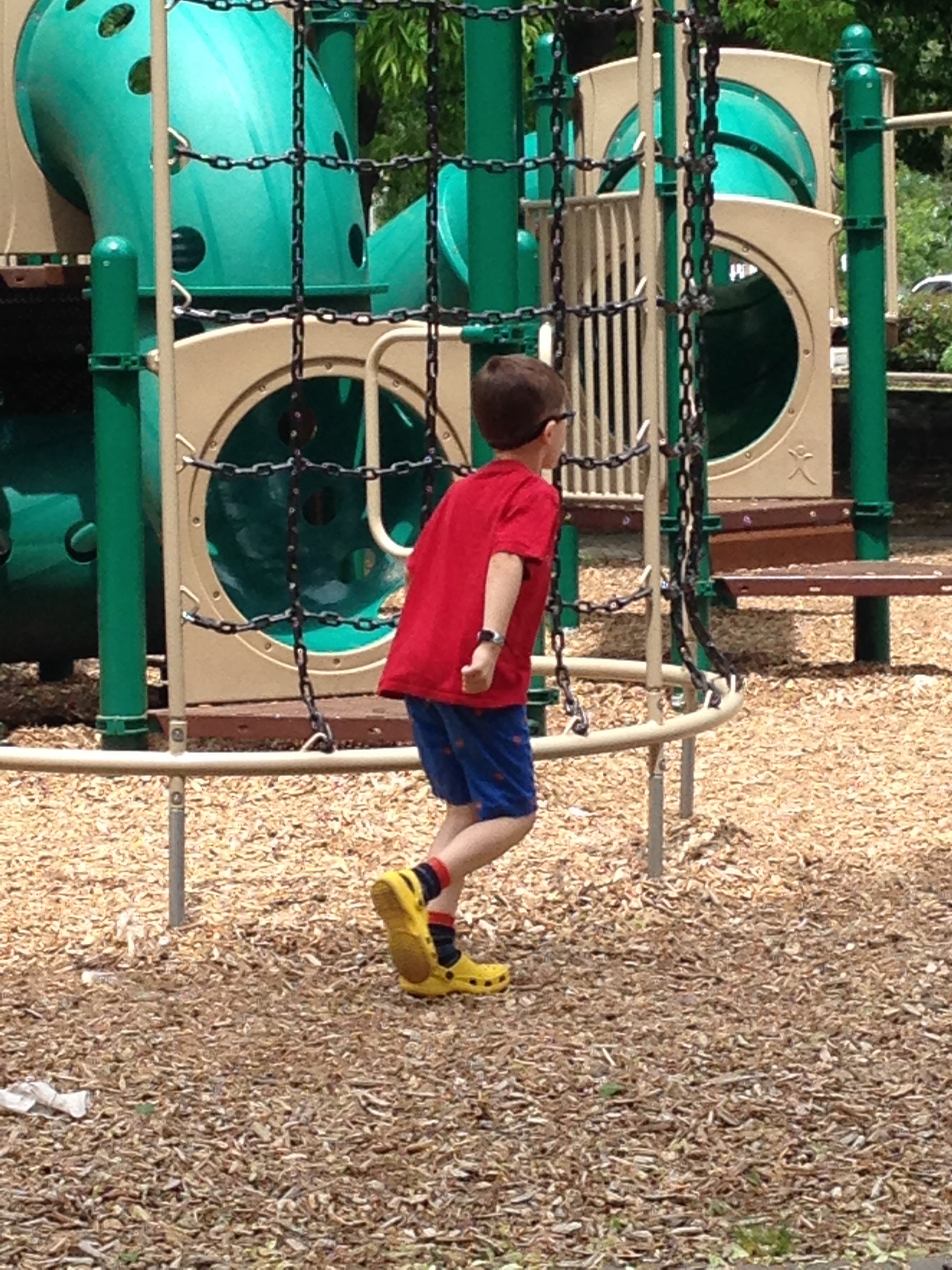
Martin doing his thing at a playground. I look at this big, big kid and think, "Is he really mine?"

Martin doing his thing at a playground. I look at this big, big kid and think, “Is he really mine?”