Polar Bear Under Siege

Studies have found widely varying rates of other psychiatric problems among people with autism, depending on the population studied and the methods used. Those co-occurring conditions include: depression (affecting 2 to 30 percent), ADHD (affecting 29 to 83 percent), OCD (1.8 to 81 percent), and other anxiety disorders (2.9 to 35 percent).

Look at the foregoing paragraph. Again, please. Now keep those statistics, disparate and divergent as they are, in mind as you read this post and the two or three posts that will follow.

Martin is in a general-education classroom for the first time. The other pupils don’t like him. We know.

Remember when I forecasted that language would come last? I was wrong. Aside from a lingering habit of pronouncing “th” as “f,” Martin’s phonology is solid. Semantically and syntactically, Martin comprehends and expresses himself at or above an age-appropriate level. His language is caught up, except for social/pragmatic language. What actually come last, it turns out, are social skills.

Adrian and I have been worrying about how the gap in social performance is affecting Martin’s self-esteem. Last month, we decided to have Martin start seeing a psychologist, to help him deal with feelings of rejection. I made the relevant inquiries with parents in town, and we were able to find a local practitioner who has significant experience with social anxiety and ASD/ADHD. Adrian and I met her first. We charted Martin’s course from birth (and outrageous unnecessary NICU) to present. We said Martin acts upbeat but we know he’s masking other emotions. I told her about the night Martin asked me whether it’s okay if no one likes him. The conversation with the psychologist made us sad, both me and Adrian. I’m pretty sure, because later I asked Adrian, “Did that conversation make you sad?”, and he replied, “That conversation made me sad.”

Martin visited the psychologist for the first time on a Monday evening. I brought him, and worked in the waiting area while he and the therapist met. At the end of the session, the doctor invited me in and showed me what Martin had created: A castle scene in which a hapless polar bear was beset by a crowd including dragons, knights, and several kitty-cats. The doctor made several statement/questions like, “The horse is the leader, and the unicorn is following, and the polar bear wants to go back inside?” Martin agreed with her. I surmised that her comments were made, at least partly, for my benefit, but if I was supposed to be following along, the doctor had wildly overestimated my powers of intuition.

The whole shebang, to me, seemed like get-to-know-you play, but—something happened. The psychologist unleashed a force. What it was, I don’t know. (Relatedly, who the hell was the polar bear supposed to be?) The next day, Tuesday, this ensued:

I met Martin at the school bus stop at 2:45 pm. He exited the bus and walked directly to me, without engaging other kids. That was usual. He also looked depressed. Really, really in the dumps. He stared at his feet as he walked. I asked, “Are you okay? Did something happen?” He replied, “Oh no, I’m fine,” and followed up with, “I had an excellent day at school. Let’s go home.” On the brief trip from the bus stop to the house, I asked a few more times whether he was upset. Martin continued to deny that anything had happened. I took him to taekwondo and to church Kids’ Klub. No mention of anything.

Adrian arrived home in time for dinner, so we three ate together. Adrian finished first, and then left the table to take a business call.

Martin asked, “Do you and Daddy think I’m weird?”

I replied, “I guess everyone is ‘weird,’ in some ways. We all do things in our own way, and that can seem weird to other people. What makes you ask?”

“Do you and Daddy think I’m stupid?”

“Good heavens, no! What makes you ask that question?”

Martin started to cry. He said, “The kids on the bus think I’m stupid.”

And then—whether because the psychologist unlocked a vault within Martin, or otherwise—stuff got real. Through his tears, Martin described his current social situation:

  • The kids in his class call him weird and unfriendly.
  • No one will play with him at recess.
    • Robert, whom Martin knows from church, was playing a game with friends. Martin asked Robert if he could join. Robert said no.
    • Kids run away when they see him coming.
    • A second-grader from another class seemed like he was going to accept Martin’s invitation to play, until one of Martin’s classmates ran over and said, “Don’t play with him! He’s the weird kid!”
  • Some weeks ago, when Martin got in trouble for telling a girl he was going to “kill” her (at the time, he provided no explanation why), it was because the girl had just said, “Martin, no one likes you.”
  • Even the young parishioners at church Kids’ Klub refuse to play with him.
  • As bad as all that is, the school bus is still worse. Every day the kids make fun of him, for months now. Even the kids he knows from bus stop participate in the bullying. The twins across the street participate. Kids from other classes and grades participate. The only kids who don’t tease him are kindergartner Marcus, third-grader Alice, and fifth-grader Stephanie. The only kid who ever will step in to stop the bullying is Stephanie.
  • This very afternoon, before Martin alit the bus looking so dejected, the kids had invented a chant: “Stu-pid! Stu-pid! Martin is so stu-pid!

Never before had Martin said any of this directly. As realities were pouring out, Adrian realized from his office what was going on and returned to the kitchen. He found me squatting next to Martin’s chair, with my hand on his arm, withholding my own tears as I tried to reassure and let him continue. Martin held court for more than 15 minutes. Twice Adrian tried to hug Martin, but Martin resisted, pushing Adrian away gently because he wanted to keep talking. The conversation was extraordinary. Martin held eye contact, consistently. He spoke clearly. He answered my questions: No, his aide didn’t hear mean things kids said; no, the bus driver never intervened; no, Stephanie hadn’t been able to stop the stu-pid! chant because she wasn’t on the bus this afternoon. Martin also expressed a shocking degree of self-realization and profundity. “They say I’m unfriendly,” he said, “but it’s not true. It’s just that I’m still learning how to be friendly.” “I know those kids are wrong. They just don’t know me well enough.” “The twins were nice when I first met them, and then they turned mean on the bus.”

Finally, as I listened to what Martin has been enduring, I lost my own composure. At that moment Adrian scooped up Martin and carried him from the kitchen, telling him how brave he was to trust Mom and Dad with these stories and how proud we were. He took Martin to the bathroom and ran a warm bath. I remained in the kitchen, crying.

With Martin calmer and soaking in the tub, Adrian came back and hugged me.

I said, “We’ve got to do something.”

Exceedingly Difficult

I’m typing with my left hand. With only my left hand. It’s slow-going. I am right-handed, dominantly, not ambidextrously one bit.

My hair looks awful today. I managed to wash and condition (in a 20-minute shower, wasting water), but drying with one hand was hopeless. Hold the hair dryer, blow, drop the dryer, brush, retrieve the dryer, blow.

I can barely prepare food, because I can’t hold a knife to chop. Adrian had to buy his lunch yesterday and today, other than his lentils. Instead of mincing vegetables into meatballs, I made Martin’s lunches from buffalo chorizo, which contains high-sal ingredients. Martin had an anxiety-ridden day. I blame myself.

You guessed it: I broke my right wrist. I was playing tag on ice skates with Martin. Despite his protests and refusal to play hockey, Martin is still a better skater than I am, and with a lower center of gravity, and he was wearing hockey skates, while I had ancient rented figure skates. In retrospect, challenging him to a game of tag was—well, you can choose the right word.

I have to wear a bulky cast for six weeks, and the orthopedic surgeon is banning contact sports and weights for three months. B’bye, spring softball season. My personal trainer is designing some “cardio and legs” program to replace my lifting routine. I’m glad ski season is winding down.

I will try to keep blogging. But I’m still not sure even how I will feed Martin, so I can’t make promises.

IMG_5934

This is my arm! Why is the cast orange? Well, I do love Syracuse University.

Knife

We knew when we put Martin in public school that socializing would be problem.

It has been.

Academics: Not a problem.

Speech/language: Fading as a problem, except for social/pragmatic usage.

Behavior: Sometimes a problem (the silly, detox-y days), but his teacher handles the behavior masterfully.

Socializing: Problem alert.

Last month, in the post titled, “I’m the Issue,” I wrote about my concerns for Martin’s self-esteem.

At night, when the reading is done and the teeth are brushed and Martin and his stuffed Minions are tucked under organic linens, I sit on his bed to tell him that he’s a great kid and very, very loved. If he’s having anxiety, I make him repeat: “I am safe. My mom is in the house. My dad is in the house. My mom and dad will keep me safe, and I will keep my Minions safe. I can sleep well tonight.” Sometimes we talk about the day he’s had, or the next day he will have.

“Is it okay,” he asked me two weeks ago, during this intimate time, “if people don’t like me?”

I said, “Of course it is. Everyone has some people who don’t like him or her. There are people who don’t like me. There are people who don’t like Daddy. You can’t make everyone like you.”

“But is it okay,” my beautiful eight-year-old son continued, “if no one likes me?”

I am a failure.

Feeding Them Both

Forgive me another post on food. I don’t usually hit food twice in a row—I’ll make this one quick.

Many are the challenges to feeding a three-member family when the child is mostly Paleo/low-sal/meaty, the mother is vegan, and the father is primarily pescatarian and prefers salads.

The vegan, who prepares the food, comes last. I’ll pretty much forage the (vegan) scraps of what the other two eat, so let’s take me out of the equation.

Sometimes I can feed Martin and Adrian the same meal, as with the “anything” pasta. Other times, I make a main course for Martin and repurpose it into a salad dish for Adrian. I’ve got quite adept at this repurposing. Add sliced avocado, maybe some fruit and nuts, and voila!, fancy salad.

Yesterday I made the promised white-bean skordalia. (Remember? The cannellini beans I forgot to soak?) For Martin, I scooped a heap of skordalia onto a plate and inserted two dozen raw carrot sticks, which poked out in all directions. I called this creation (which I forgot to photograph) a “moon flower.” Martin removed and ate the carrot sticks, then finished the skordalia with a spoon.

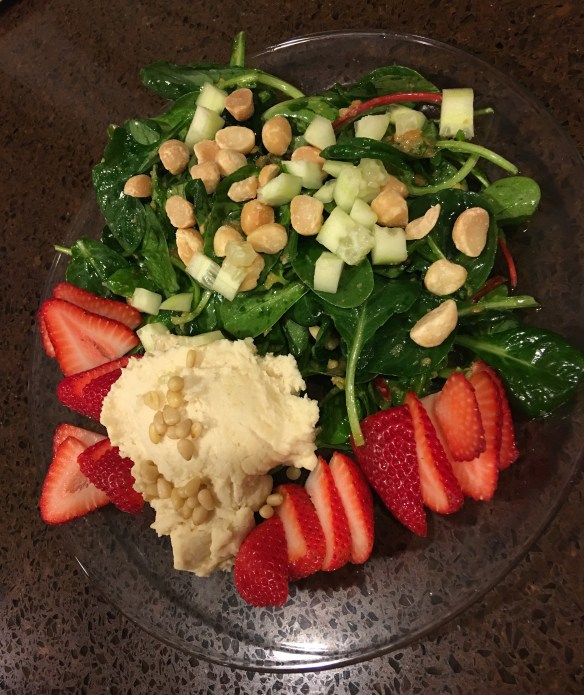
For Adrian, I made the skordalia the major protein in a salad, with pine nuts for flair. I added mixed greens with his favorite dressing—olive oil mixed with chickpea miso—and macadamia nuts and diced cucumber on top. I had fresh strawberries, so I finished dressing the plate with fresh strawberries.

Happy kid. Happy husband.

FullSizeRender 9

ASD Recovery Recipe: Anything Pasta

So I’ve discovered that I can make a decent pasta meal out of anything “vegetable” in my refrigerator. Like, virtually anything.

Last night I planned to make white bean skordalia. By the time I discovered that I forgot to advance-soak the cannellini beans, I had only minutes to devise another dinner. I surveyed the kitchen and assembled these ingredients:

->Carrots, with their green tops. I always cook the carrot greens. Once when I was checking out, the supermarket cashier casually snapped off the carrot greens and tossed them in a garbage bin. I promptly commenced a lengthy oration on the benefits of carrot greens.

->Red onions.

->Garlic.

->Celery.

->Toasted onion salt. With Martin’s current low-salicylate diet limiting spices so much, I’ve been trying to get creative with salt.

->Pine nuts. I avoid the pine nuts from China. I’m not anti-China, but I am concerned with shortcomings in China’s food-safety schema.

->Green lentil pasta.

I prepped the carrots (greens and all) and celery in a vinegar bath, then cut them into pieces and put them in my food processor. October 13, 2011, I wrote a post titled, “Kitchen News: An Update on the Hunt for a Food Processor With Glass Bowl,” which (based on total unique views) is the most popular post ever to grace this blog. Five-and-a-half years later, I am still without a glass food processor. I processed the carrots and celery almost to a paste. Then I chopped the onions and garlic roughly and added them to the food processor.

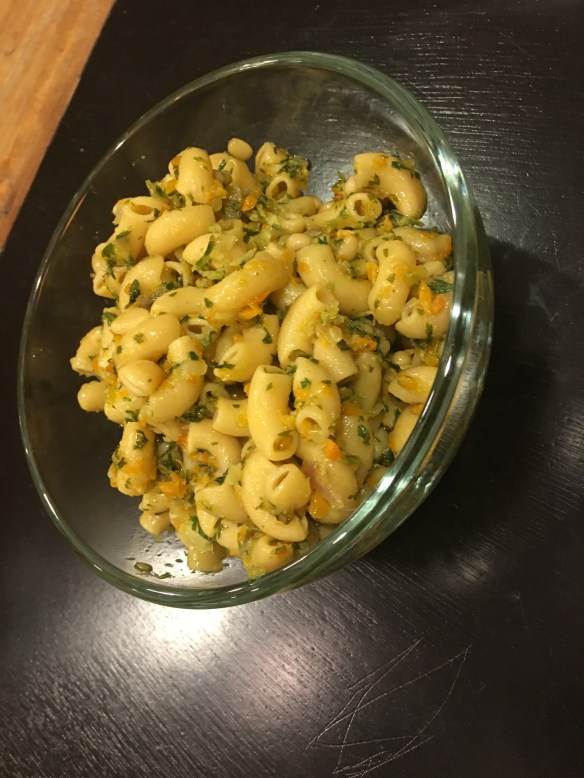
While the pasta was cooking, I heated a generous amount of oil and fried the finely minced vegetables. When they were almost done, I added onion salt and a scoop of pine nuts.

FullSizeRender 8

Finally I drenched the cooked pasta in cold water to prevent mushiness and added it to the veggie pan.

IMG_5891

The resulting dinner was pasta coated in lovely crunchy-garlicky bits. Martin said, “Oh yes, this is delicious!” and Adrian ate every last bit from the pan.

IMG_5893

Must remember—“night in a pinch” will henceforth be known as “garlic pasta dinner.”

Bound To

The autism recovery path is so jagged—so many ups and downs—that the key to longevity is managing my own emotions. Well, one key. Other keys are financial stability, a supportive co-parent, close friends, a cooperative school district, available therapies, access to organic foods, home ownership or other opportunity to create a cleaner living space, and let’s face it, we’re talking about innumerable keys. But certainly managing my own emotions is one. I struggle not to pin my mental state, any given day, to Martin’s transitory condition. Martin has good days and bad days, good weeks and bad weeks, good months and bad months. I don’t mind the elation when Martin feels well and performs well. Giving into despair when he doesn’t is a recipe for driving myself crazy.

That being said, it never ceases to bewilder me when Martin looks near-typical one day and strongly symptomatic the text, without any obvious intervening factor.

Two Fridays ago Martin earned his yellow belt in taekwondo. He didn’t perform exactly as well as the other eight-year-olds being tested but nonetheless paid attention and made the correct moves and legitimately earned the belt. We went out for sushi to celebrate, and Martin went to bed early. He spent that Saturday in New York City with his uncle Eddie. By all reports they enjoyed themselves and Martin’s behavior was stellar. Saturday evening we had dinner at home; Eddie (who eats meat, occasionally) and Martin had organic roast turkey, Brussels sprouts, and brown rice pilaf with vegetables and sprouted pecans. Martin, exhausted from his day, again went to sleep early and without incident. That night he slept 11-and-a-half hours.

Nothing changed.

Nothing, except that Sunday morning Martin was antsy in church. He rocked around during children’s time and, I learned later, disrupted Sunday school with incessant talking. That afternoon he became crabby. Sunday night, alternating between anxiety and cracking himself up, he had trouble falling asleep. I dropped off close to 11:00 pm. He was still awake.

Monday’s school report was—less favorable than one might hope.

Tuesday’s report was—disastrous. After school, Martin looked goofy and distracted at taekwondo class. At church Kids’ Klub, in front of all the children, he called the teacher a “liar” when she misspoke and said “tomorrow” instead of “next week.”

By Wednesday evening, following a trombone lesson that made me ask myself why I’m still paying for trombone lessons, Martin was running back and forth. Remember that? Run from sofa to stairs, stop, turn, space out, then jump and pa-dap-BUMP, run back to sofa, stop, turn, space out, then jump and pa-dap-BUMP, repeat. Classic repetitive behavior. Haven’t seen it in months. Months. Before Wednesday, I would have put “running back and forth” into the “so far gone” bucket.

There were other behaviors too, both at home and at school, that for Martin’s privacy I’d rather not document here.

On Thursday, Martin started to reemerge from the mystery fog. Thursday’s note from school said, “Martin had a better day. :-)” Friday, which was a parent-teacher conference day with no school, Martin had a successful play date with two friends and focused well at taekwondo. Saturday afternoon he worked three hours on a Lego project with Adrian, without complaint. Sunday he hosted a home play date for three friends.

The Friday-Sunday update is based on reports from Adrian and Samara. I was away for the weekend, with six girlfriends from high school. Some of them read this blog. Thanks, ladies. You sustain me.

So why did Martin, without any apparent external stimuli, tank for several days? I don’t know.

And why did Martin’s Wednesday ROOS, combined with a Friday parent-teacher conference about behaviors that are causing fellow students to alienate him, send me into a tailspin, albeit a short-lived tailspin? That I do know, and I’d like to find a way to change the answer.


Conversation, Y’all

In my law practice, we work with an attorney from Texas who likes to throw “y’all” into sentences, even in email. She writes, “Think y’all need to flesh out that argument,” or, “I’m going to that hearing, and y’all should too.” As a literary device, her “y’all” is most effective as a lead-in or closer, like, “Y’all, we cannot take that case,” or, “Think that one through, y’all.” The concluding “y’all” is grandiose. When this attorney ends a sentence with a comma and “y’all,” I think, Did you get that? Did you pay attention? Because she was talking to you.

Being New York born and raised, I’d sound silly if I tossed y’all around the way my co-counsel does. So when I do choose to conclude a statement, especially a mono-word declaration, with a y’all, let’s agree that it’s extra-grandiose.

Conversation. Conversation, y’all.

Finally, we’ve got conversation. The kind of conversation that involves listening and responding to the partner.

Our family employs a housekeeper who comes weekday mornings, usually arriving just before Martin and I leave to catch his school bus. One day she was surprised to find Martin playing in the family room, and me away from home. (I had an errand to run, and by previous arrangement would be returning to retrieve Martin and drop him at school; Adrian was in his home office, working.) Given that Martin has always shied away from speaking with her—until recently, he buried his head in the sofa pillows whenever the housekeeper addressed him—she was even more surprised to have this conversation with him, subsequently relayed to me:

HK: “Martin! Why are you at home? Don’t you have to go to school today?”

Martin: “I am going. My mom is coming home to take me.”

HK: “If you want, I can drive you over now.”

Martin: “No, it isn’t allowed for anyone different to drop me off.”

Martin and I are spending the coming summer in Nicaragua. (Remember this post? More details later.) One morning, over breakfast, Martin asked, “How many days will we be in Nicaragua?”, and I replied, “Sixty days. All of July and August.”

Eight hours later, in the car, without additional prompting, the following conversation ensued:

Martin: “July and August each have 31 days.”

Me: “That’s true.”

Martin: “But you said we will be in Nicaragua only 60 days?”

Me: “Good point. What is 31 plus 31?”

Martin: “Sixty-two.”

Me: “So we will be gone 62 days.”

Martin: “Mommy, is Nicaragua going to be the longest trip you’ve ever taken?”

Me: “No, once I was in India for several months. I was studying there.”

Martin: “Will Nicaragua be the longest trip I’ve ever taken?”

Me: “Yes.”

These are conversations, y’all. They involve give-and-take. They require response to what the conversation partner has said.

I’m excited, of course. And there’s a caveat, of course. Most of Martin’s conversations still revolve around what fascinates him: right now, bridges, geography, and names. So while he’s made progress thinking dynamically enough to add to a conversation, he still needs to reduce his rigidity and apply that dynamism to a variety of topics.

Y’all.

Expectations

We went skiing again, two weeks ago. I feel so incredibly fortunate to have had two separate ski weeks this year. This time it wasn’t Park City, but Beaver Creek. Adrian has skied Beaver Creek before; for me and Martin, this time was the first.

When we’re at Park City, Martin takes his lessons through the National Ability Center, which you know I love. The instructors are trained and experienced in giving adaptive lessons, they got Martin skiing for the first time, and I’ve seen them perform miracles when it comes to getting more severely affected children and teens sliding down the mountain.

At Beaver Creek, we booked a full week of half-day lessons through the in-house adaptive program. The Beaver Creek adaptive lessons were discounted from standard one-on-one lessons but still quite expensive.

When Martin was doing skating lessons in the hope—ahem, in my hope—that he could play hockey, his instructor was not trained in working with special-needs kids. He was patient, maybe too patient, and no expert at motivating Martin. This may be my own unnecessary fear, but at some point I was unsure whether the instructor even enjoyed working with Martin enough to push him. Martin may not have got as much from those skating lessons as he should have. I’ve had the same feeling about the music lessons—first his piano lessons and now his trombone lessons, both with “regular” instructors. Sometimes those who don’t work regularly with impaired children seem to have pretty low expectations of what they can accomplish.

So I was uneasy Monday morning when I discovered that Martin’s instructor, Steve—Martin was assigned the same guy for the whole week—was not a full-time adaptive instructor and instead taught mostly standard lessons. Steve had called me the night before, to go over the notes in Martin’s file, and asked questions about what to expect. Nevertheless, I feared he might not know how to handle Martin’s shortcomings like attention, coordination, or frustration tolerance. I worried whether he would value Martin’s strengths, like curiosity, and perseverance when motivated.

Those fears were relieved as soon as I retrieved Martin after Monday’s lesson. Martin was a bundle of enthusiasm as he whispered dramatically about the secret path they’d skied through trees and then demonstrated how they howled like wolves in the woods. Steve talked about Martin as if he were any kid: His parallel stance was improving and he wasn’t wedging to slow anymore, but his hockey stop wasn’t 100%, either. They’d crossed several hillsides to work on keeping skis together. When allowed to ski independently Martin was still straight-lining instead of turning. He’s eight, the instructor said. That’s what eight-year-olds do.

I have a long history of bristling when I hear “all kids do that.” On this occasion, it didn’t bother me. To the contrary, by Wednesday, after three lessons, I was convinced that Martin was improving faster with Steve than with any previous instructor, and if Steve was bothered by Martin’s shortcomings, he wasn’t dwelling on them. On Friday, during his final lesson, Martin skied his first black diamond.

The Steve situation, i.e., Martin doing better with a standard instructor than an adaptive instructor, engenders where we are now. Martin has improved again since our post-Christmas dip. At times he seems close to typical. And that raises a whole new crop of problems. Back when I couldn’t get Martin to respond to a question and trembled at the constant meltdowns, taking too long to get ready for taekwondo class would not have bothered me, at least not much. When he couldn’t hold a pencil, or when we still worried about cognitive impairment, I probably would have delighted that he was doing math homework, not fretted that he was dallying.

The expectations of Martin have become higher, and sometimes he rises to the occasion, as he did with Steve. On the other hand, I find more reasons to be frustrated when these expectations aren’t met. Which, when you think about it, is unreasonable indeed.

Here we sit, neither typical nor impaired enough to—to make a big deal out of it? I’m friendly with a taekwondo mother whose son has attention issues. Her son’s issues are slight, and always have been. She’s so skilled at rolling with the punches: accounting for her son’s tardiness, giving him “good attention” reminders, supporting him socially, monitoring his after-school activities to make sure they are meeting his needs. I’m not so good at all that, yet. I’ve spent so many years putting Martin’s shoes on for him and helping him eat that I haven’t developed the skill set to empower his independence.

Time to raise other expectations. Of me.

img_5675

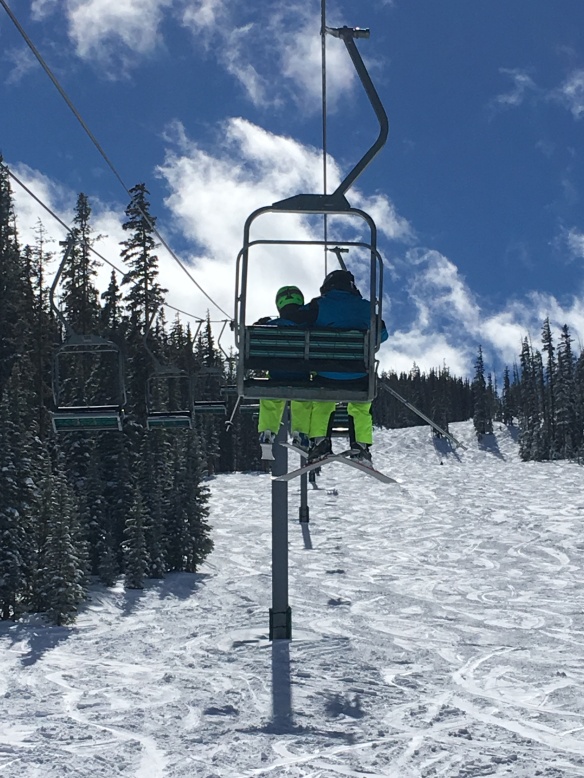
Adrian and Martin, heading up the mountain.

img_5701

Martin, enjoying a fountain view, after a long day of skiing.

I’m the Issue

Back in December, I found myself volunteering at Martin’s class Chanukah party. I read The Runaway Latkes to the class, served latkes—I’d brought Martin’s from home—, and helped Martin’s desk cluster play Chanukah bingo. I also facilitated a dreidl game. Martin played dreidl without incident, but another boy cried or complained every time he had to surrender chips, and finally refused to play any longer, instead yelling, “I’m a sore loser! I’m a sore loser!” I was reminded of when the behaviorist told me, “Martin is not the behavior problem in his classroom.” Overall, the morning went smoothly for Martin, and I felt optimistic.

While I and the other parent volunteers were packing to leave, the teacher called the kids to the rug for another story time. The kids were fussing and settling, and the teacher said above the murmur, “Children! This book is scary! You might want to snuggle up with a good friend!” Everyone squealed and began linking arms into groups of two or three. Tristan immediately grabbed Spencer. Those are two boys I know. Tristan’s mom was born in the same country as Adrian. We have done play dates with Spencer (on a parent-organized, not child-initiated, basis). Martin gravitated to them also, and sat himself very close to Tristan. A second later, Tristan pushed Martin away, and even from the classroom doorway, I heard Martin ask, “Why not? Why can’t I be?” I don’t know exactly what Tristan said to Martin, but given that it followed “. . . snuggle up with a good friend,” I can guess. When I left, Martin was sitting alone, two feet from Tristan and Spencer, listening as the teacher began the scary story.

I worry so much about Martin’s self-esteem. It’s probably what I worry about the most, even more than his attention deficit and immaturity. I wonder how many times per day his self-esteem endures hits like Tristan pushing him away and saying he’s not a friend. The ten or so kids other than Martin at his morning bus stop are all girls, except a boy named Nathan. One of the mothers is pregnant with twins and just found out she’s having a boy and a girl. When she told the bus-stop crowd, Nathan’s mom said, “Oh my gosh, Nathan, are you happy? Finally another boy around the street!” She said this while Martin was standing next to her. Perhaps she confused social challenges with hearing, understanding, inferring.

Seeing the way the world treats Martin has caused me to do some hard reflecting, again, on the way I treat Martin, and how I might also be injuring his self-esteem. Multiple times each day, I become frustrated with Martin for behaviors that are likely outside his control. On any given morning, I might say the following:

-“Martin, why did you spill all the juice? Weren’t you being careful? This is expensive juice.”

-“Martin, I told you to finish eating while I got dressed. You haven’t eaten even one single bite!”

-“Martin, why can’t you just put your shoes on? Feet. Shoes. It isn’t hard.”

-“Martin, we are going to miss the bus! Listen! Pay attention!”

-“Well, that’s it. We’re late. Again.”

Or take this very afternoon, a Monday. I’m going to be honest here, entirely honest, even if doing so brings me to tears while I’m writing: I have been frustrated with Martin since the minute he returned from school. Everything was wrong: Last night I slept only three hours, because I was working on a memo. This afternoon I ended up doing more office tasks than I planned, and my lunch date was more than half an hour late, so I still had to make dinner once Martin was at home. Let me add—Martin had a fantastic weekend. He chatted conversationally, he had no meltdowns, he focused at taekwondo class. So I expected a fantastic today. I knew today would rock. And then it didn’t. Martin cried and complained his way through 40 minutes of homework (worksheets that should have taken no more than 10 minutes), and he still wasn’t done, not even close, when I called him to get ready for taekwondo. I reserved 20 minutes to get us out the door. Twenty minutes to put on a taekwondo uniform and sneakers. And yet we were late. Like junk expands to fill a basement, Martin’s needs expand to overflow whatever time he’s allotted.

My role in all this? I’ve spent the entire afternoon being unreasonable. I’ve told Martin to stop complaining, I’ve grown frustrated, I’ve blamed him for our lateness. I’ve told him to act like an eight-year-old instead of a baby. Once or twice I’ve raised my voice. Constantly I’ve thought, “I would like a glass of wine,” and responded to myself, “A glass of wine will not solve anything,” and then argued with myself, “I think it would.”

My attitude, this afternoon and many mornings, is problematic for two reasons. First, it is unfair unfair to Martin. It’s not that Martin “isn’t being careful”—it’s that his ADHD and lingering coordination issues make him clumsy and distracted. It’s not that Martin “isn’t hurrying”—he lacks the ability to focus. It’s not that Martin is “ignoring me”—listening and paying attention go to the very heart of his disorder. To be sure, some of his conduct may be behavioral. But most of it is not, and it upsets him to be reminded of his shortcomings.

Second, my attitude pretends like I’m not the issue.

If Martin is spilling juice, I am the issue. The juice should be in a safer spot, and in a spill-proof cup.

If Martin isn’t finishing breakfast while I’m getting dressed, I am the issue. I need to get dressed before Martin eats so that I can supervise him.

If we are not getting out of the house on time, I am the issue. If 20 minutes is insufficient time to prepare, then somehow I need (1) to find more time and (2) to organize so that I have nothing to do except shepherd Martin’s preparation. One might argue that Martin needs to be developing more independence; clearly, however, the “independent Martin” strategy is failing at this time. Maybe I can leave one, and only one, task for solo performance: teeth brushing, or bag packing, or sneaker tying. For now, I need to “scaffold” massively (think “build extrastructure”) and withdraw support as Martin’s attending improves.

The truth is—and I think most biomed parents will agree with this—it is very frustrating to spend almost every waking moment working toward recovery and still get hit with waves of perseveration. Still never get out of the house on time. Still wonder why the child never listens. Still endure moments of hopelessness.

But that truth doesn’t excuse me from acting like the grown-up in this relationship.

Epilogue

I wrote this post yesterday, Monday. When Adrian arrived home, I said, “It’s been an afternoon. Will you pour me a glass of white wine?” He noted that the only white wine in the house was a bottle of questionable quality that the pool company had dropped off before Christmas. I told him to proceed. I drank two glasses. I woke at 3:30 am with a headache. I took ibuprofen and went back to sleep, propped on pillows, then managed to oversleep until 6:00 am.

Despite being rushed, I worked swiftly and organized the morning well. Martin cooperated more than yesterday. I was so proud of us when we were ready for the school bus three minutes early.

After Martin departed, I realized I’d forgotten his after-breakfast supplements.

He arrived home with a report saying he’d needed an unusual amount of prompting during the school day, and had refused to participate in Valentine’s activities. Now he’s in taekwondo again, and instead of participating, he’s jumping.

Still, the grown-up in the relationship feels okay. Must be a sleep thing.

img_5483

Martin, at Chicago’s Adler Planetarium. He’s not the issue.

On Food and Genetics, and Judgment

Time to elaborate again on a comment response I made recently.

In response to my post about Martin’s golden week, I received this comment from a reader:

We are not on a biomed path as our son’s extremely restrictive food choices preclude this. Also his autism is visible throughout our family tree and heritable traits probably can’t be eliminated entirely by an altered diet. However our son’s behaviour varies considerably depending on who is looking after him and how secure he feels. Not all sides are helpful . . . while low-sal may well be helping don’t ignore the effect of his environment out of hand. There’s a lovely book called Uniquely Human about this sort of thing [that] might be worth a look. Thanks for writing—we are on a path much more to do with movement than food due to our family’s ASD presentation but we have the same burden of analysis and choices as you seem to! Bonne Chance

This was my response:

Thanks for reading! A few thoughts on your comment: I agree that environment is also relevant, and we pay a great deal of attention to environment and behavioral assists. But seldom (in my experience, never) do they yield an immediate effect; a substitute aide does not make a great day, or week—though a new aide certainly can change the course of the year. In terms of the biomed path, I don’t know of any child whose autism was corrected entirely by an altered diet. Diet is only the foundation of the healing path. Moving along that path requires supplementation, methylation assistance, detoxification, etc., specific to the child.

Genetic and inheritable traits also play a great role in my son’s condition. I would be naïve to think otherwise. Both my brothers have immune disorders, and psychological/psychiatric conditions (which I now would call health conditions) are endemic in my family. That does not mean my son’s autism cannot be lessened, if not resolved, through biomed. Epigenetics, neuroplasticity, and all that I know about the science of healing suggest otherwise.

In terms of your son having extremely restrictive food choices—well, that brings me to a paradox. In my experience working with biomed families, children who restrict their food choices are usually the biggest beneficiaries of biomed, once it gets going. The food aversions, which often have underlying digestive causes, tend to disappear once the irritants are removed from the diet. I would encourage you to give it a try!

But even if it’s not right for your family, that’s okay too. It sounds like you are doing a lot for your son in any event, and I hope it will get him where he needs to be. Whatever approach we take, we are all in this together.

These are the three points I’d like to discuss further:

  1. Picky eating is a reason to pursue biomed and dietary changes, not a reason to discount them.
  2. Genetics don’t always get to write a child’s future, at least not every aspect of the future.
  3. If picky eating or genetics are keeping you from pursuing biomed and/or dietary changes, that’s okay.

As to point 1—“There is no way I could do a gluten-free or dairy-free diet, because my son will eat only cheese tortellini, breaded chicken nuggets, and pretzels.” “I tried a special diet once, and she didn’t eat for three days. Literally. Finally I gave in because she would pass out otherwise.” I hear these statements frequently when other special-needs parents find out that we do biomed. I also hear their corollary, the failure-to-thrive argument: “My son is so skinny and small for his age, even though he eats a ton. I have to give him milkshakes constantly just to keep his weight up.”

Years ago, I attended a presentation by Dr. Arthur Krigsman. (Yes, I know Dr. Krigsman is controversial. At this point, I find that many doctors doing research and providing non-pharmaceutical medical treatment to children with autism are called quacks. I’ve had to get past that and start making my own decisions.) Although biomed parents (as far as I could tell) filled much of the audience, Dr. Krigsman was speaking as part of a panel discussion aimed primarily at physicians, and therefore much of what he said went over my head. I think I understood him to say that many children on the spectrum exhibit lesions and inflammation throughout the digestive tract, including in the esophagus and stomach. Dr. Krigsman calls this condition “autistic enterocolitis.” These lesions, like so much of what affects our children, originate from unbalanced immune response to normal gastrointestinal action. Picky eating, or food aversions, might be a sign of pain from such digestive troubles: Kids express their hurt by avoiding the foods that exacerbate that hurt. In such a scenario, a kid who is not eating, or is severely restricting his own diet, needs biomed. Like, really, really needs biomed, or some form of medical intervention to begin healing the digestive tract.

Speaking from my own experience, when Martin was young, before we started biomed, he “postured”: He would bend forward with his stomach tight and his fists clenched at his side. He also slept with “elevator butt.” (I stole that term from one of my law school classmates, who used to scratch the base of my cat’s tail, then yell “elevator butt!” when the kitty straightened only her back legs.) Martin frequently slept with his face smashed into the mattress and his butt in the air, as if to relieve pressure on his gut. Both the posturing and the elevator butt ceased within a few months of dietary changes. Whether he actually had enterocolitis, or just some lesser form of irritation, I don’t know. But he was in pain, and a restricted diet relieved that pain.

During Dr. Krigsman’s presentation, I couldn’t help but think of “Jonas,” a boy I know with undiagnosed behavioral issues that resemble seizure-related oppositional defiant disorder. At the time, Jonas would eat nothing but processed yogurt drinks or green shakes. I searched for a way to raise the issue of entrocolitis with his mother, a single woman constantly overwhelmed with managing Jonas’s behaviors and shuttling him to various therapies, including eating therapy. I never found the right moment, or non-threatening way, to bring it up. I consider that a shortcoming.

I don’t believe that “autistic enterocolitis” is the only reason a kid on the spectrum might avoid foods. Martin’s friend Bobby, who is on a GFCFSF diet, limits himself even further because of taste and texture issues. He will not eat soft or chewy foods. Martin himself would be happy to repeat his two or three favorite foods every meal. I consider that a form of perseverative behavior. Again, these are issues best addressed (in my world view) through biomedical intervention, to resolve what’s causing the aversions or perseveration—although I don’t discount the complimentary role of behavioral therapy, such as RDI.

As to the child who allegedly needs milkshakes to put on weight, if a boy eats and eats but cannot gain weight or grow taller, plainly he has a health problem that is not being addressed. His body is not processing the food’s nutrition adequately, which means he probably isn’t getting the foods that his body can process. Which brings me to dietary changes . . . .

As to point 2—I have heard from parents who say they don’t have any reason to bother with biomed because genetic mutations are to blame for their child’s autism. I get that. I really do. Once you discover what havoc genes can wreck, it can feel almost pointless to try altering the course. Even without the genetic component, it can feel almost pointless. I’ve been at this six years, and we aren’t “there” yet, wherever the heck “there” is. But consider two factors. First, genetics are often a predisposition, not a path certain. Genetics might set the stage, but environmental factors often raise the curtain. You know my favorite environmental villains: processed foods, glyphosate, pesticides, C-sections, antibiotics, vaccines (gulp! I said it again), pollution. Carrying the silly set-the-stage analogy further—if environmental factors raise the curtain, then altering the environmental factors can change lower it again. Even if, for example, a vaccine activates an MTHFR mutation, interventions to restore the immune system can calm the mutation.

As I wrote in response to the blog comment above, I recognize the role Martin’s genetics played in his development of autism. Without going into too much detail (even though FindingMyKid is written anonymously, I feel icky about compromising privacy), my family has genetic gifts—for example, we are “book smart” and breeze through standardized exams, and we are not prone to obesity—and shortcomings. Both my brothers have immune disorders. The elder suffers from a wide range of food and environmental allergies, plus eczema and chronic bronchitis. The younger has environmental allergies. Long before I produced Martin, I myself fell victim to depression, a disease also prevalent in my husband’s family. There’s addiction on both sides of the family tree. So when it comes to immune and related disorders, genetics were not in Martin’s favor. Genetic testing has confirmed the existence of mutations that make him susceptible to autism.

As I understand the history, decades ago we might have been advised against vaccinating Martin at all, based on immune disorder in the immediate family. Let’s add that Martin’s vaccinations followed Pitocin, loss of heart rate during labor, an unplanned C-section, antibiotics in the NICU, and plenty of immune insults I don’t need to repeat again.

The way that I look at it, Martin’s genetic predisposition to immune disorder made him vulnerable to the effects of environmental factors, and now makes our path to recovery more arduous. But it is no reason to abandon him to (perceived) fate.

Then there’s the matter of epigenetics. According to this helpful webpage, epigenetics is “the study of potentially heritable changes in gene expression (active versus inactive genes) that does not involve changes to the underlying DNA sequence—a change in phenotype without a change in genotype—which in turn affects how cells read the genes.” That means that environmental circumstances can cause genes to be silenced or expressed over time. We can influence which genes express themselves, and how. I’d like to seize that power, to whatever extent I manage.

As to point 3—I’ve said this from time to time, and it bears repeating: You don’t need to approach autism biomedically to be my friend. Doesn’t that sound ridiculous? Because this is a blog about biomedical recovery from autism, and because I unabashedly favor biomed, I worry that I must come off as an intolerant person. Since FindingMyKid is written anonymously, I have to ask you to take my word for this: My blog personality and my live personality are different. By now, a large percentage of my acquaintance comprises families affected by autism. Half of those families, I estimate, are pursuing biomedical recovery. The others are not. It’s like having friends who don’t love the New York Rangers, or even hockey in general. I prattle about the Rangers, they listen kindly, and then we find connection in whatever petty topics non-hockey people enjoy. When it comes to friends who have children on the spectrum but don’t pursue biomed, I answer questions (when asked) about what we are up to, I ask what they are up to, and we find connection in the stuff we both know, like sleepless nights, IEP meetings, adaptive sports.

I had the advantage of implementing dietary changes when Martin was just two years old, when he was more malleable. Maybe you don’t want to change your child’s diet because he’s picky, or underweight, or you’re skeptical about biomed. Or maybe dietary changes are too much to manage with a large family, or small budget, or unsupportive co-parent. Maybe knowing your child’s genetic make-up has convinced you that biomed interventions would be fruitless. Maybe you are making satisfactory progress with behavioral therapies. That is totally fine.

Judgment does not become us.