My New Relationship with Food, and the Kitchen-Jar Rule

Martin’s dietary needs are leading me to a new relationship with food.

That’s a whopper (excuse the pun?) of a cliché, right?—a “new relationship with food.” Sorry. I’m not coming up with a better way to phrase this phenomenon.

I’m not an unhealthy eater. I wasn’t an unhealthy eater before this chapter, and I’m not now. I’m vegan. I watch my fats and proteins and vitamins. I love to cook and have always done plenty of it, whenever my schedule permits.

Yet until we undertook biomedical intervention and radicalized Martin’s diet, I put relatively little thought into additives, colors, and processed food versus natural. For example, I prefer to make hummus at home, because I can control the amount of tahini (just a dollop) that I add as opposed to lemon juice (plenty) and garlic (vampires refuse even to enter my neighborhood). But from a nutrition perspective, I gave little weight to the difference between (1) blender-whirring raw materials into hummus and (2) buying hummus preserved with potassium sorbate. (Wikipedia: “Potassium sorbate is the potassium salt of sorbic acid, chemical formula C6H7KO2. Its primary use is as a food preservative (E number 202).”) Nor did I consider the benefits of fresh-squeezed lemon juice over made-from-concentrate lemon juice purchased in a green-tinted plastic bottle that also contains sodium benzoate, sodium metabisulfite, and sodium sulfite.

Martin’s diet, along with its other restrictions, excludes additives and preservatives—or as I like to call them, non-food items in food. That means just about any processed food is off-limits. Even when it comes to meat: The meat we purchase must come from animals who ate unprocessed (minimally processed, at most) grains grown without pesticides.

The fact that Martin, who is so sensitive, has responded so well to the removal of non-food items from his diet got me questioning whether fresher and more natural foods would not benefit the whole family. Neither Adrian nor I suffer neurological impairment or, to my knowledge, complications with digestion or nutrient absorption. Therefore, we probably would not experience dramatic changes like Martin’s. On the other hand, what if reducing our intake of non-food items makes us sleep (a little) better, and feel (a little) more energetic, and concentrate (a little) steadier, and possess (a little) sunnier outlook? Might we not end up (a lot) healthier?

Now that I’m no longer employed, I’ve been implementing this like crazy. No more casual eating on the run. On weekday mornings, Adrian and Martin get up at 7:00 a.m. and leave home together at 8:05 a.m. to meet the school bus, after which Adrian heads to work. I, on the other hand, rise at 5:45 a.m. I cook the boys’ breakfasts; organize Martin’s supplements; prepare Martin’s lunch, beverage, and school bag; and also assemble lunch, one protein snack, and two fiber snacks for Adrian to carry to the office. (If the 5:45 a.m. thing is killing me, then at 8:06 a.m. I hop back into bed for an hour.) During the week, no food enters my guys that I have not made myself, except for Martin’s snacks and crackers baked by my mother.

My new standard for the grocery store is the “jar in my kitchen” rule. Mostly I buy fresh vegetables and bulk dried beans, i.e., unpackaged raw ingredients. (No meat or eggs at the grocery store; those I find at the farms or farmers’ markets.) As to anything I want that comes in a package, I search the label for ingredients I could not imagine keeping in a jar in my kitchen. The more ingredients I would not keep in a jar in my kitchen, the less willing I am to purchase. For example, this week I picked up the following packaged items:

•            Shim’on Ariche harissa. Ingredients: hot red peppers, garlic, water, salt. Unfortunately not organic. Still, all kitchen-jar approved.

•            Imagine creamy tomato soup. Ingredients: filtered water, organic tomatoes, organic onions, organic rice syrup, organic celery, sea salt, organic expeller pressed canola oil and/or safflower oil and/or sunflower oil, organic spices, organic garlic powder. The reference to unspecified spices gives me some pause. Homemade tomato soup would be preferable, but alas, a day has only so many hours for the kitchen. Overall, the Imagine soup is kitchen-jar approved

•            Orgran toasted buckwheat crispibread. Ingredients: buckwheat, rice, salt. Easy call.

•            NaSoya Nayonaise (vegan mayonnaise). Ingredients: soymilk, soybean and/or sunflour oil, cane syrup, vinegar, salt, mustard, apple cider vinegar, lemon juice, guar gum, xanthan gum, and sodium alginate. Caution! I was okay with everything until guar gum, xanthan gum, and sodium alginate. Not kitchen-jar approved. But in the end, I did buy the Nayonaise. I wanted it for a creamy salad, i.e., as a minor ingredient in a dish headlined by red bell pepper, pear, apple, daikon, onion, carrot, celery, and turnip. Not perfect, but some allowances must be made for tastiness.

My kitchen-jar rule is made easier by some unusual ingredients in my kitchen. Rice syrup, for instance. Though it’s not approved for Martin, it makes a gentle sweetener for my grown-up baked goods. Or lecithin. Lecithin pops up in many packaged food, and as it so happens, I do keep a jar of lecithin in my kitchen. It’s Love Raw Foods sunflower lecithin, a supplement we use for Martin, from Blue Mountain Organics.

In summary, I have Martin eating 98% fresh, 100% natural, and 99% organic. For me and Adrian, probably 80% fresh, 99% natural, and 80% organic (taking into account our weekend tendency to eat at restaurants).

There’s still the issue of our four cats. Currently, they eat Nature’s Variety canned food and dry food. I wish I could do better for them. When I was in graduate school, and had grad-student amounts of time on my hands, I made cat food at home. William the cat, who has long since died, was particularly fond of a garbanzo-based concoction I used to make with Harbingers of a New Age supplements.

Maybe someday I’ll manage a triumphant return to homemade cat food. Maybe when Martin is recovered.

Until then, alas, I repeat: A day has only so many hours for the kitchen.
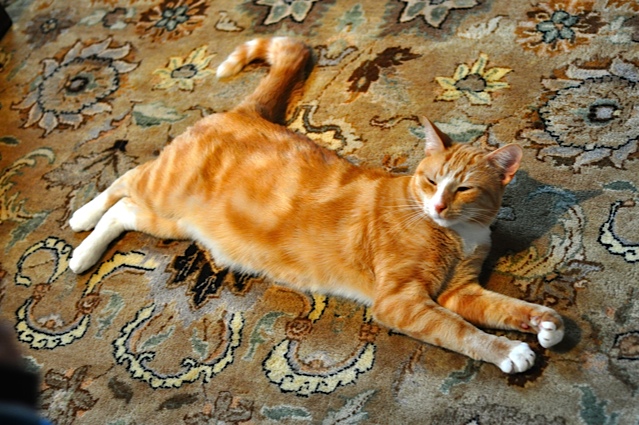
George the cat, Martin’s best friend. Actually, the only of our four cats who tolerates Martin.

The Tap

I’m middle-of-the-night posting again, via iPad from a chair in Martin’s room. He’s been up for three hours, since 1:00 a.m. I just fed him hazelnut butter on three-seed crackers (my mother makes these with her sunflour blend), in case he’s hungry, and also had him swallow a charcoal tablet, because he’s goofy and demonstrating detox symptoms.

Past middle-of-the-night posting events have sometimes reeked of aggravation and exhaustion. Not so much tonight. Sure I’m unhappy that I accomplished only 90 minutes’ sleep before Martin busted into our bedroom. Nevertheless, this marks the first bad night we’ve experienced since January 15, and only the second bad night since before the holidays. Because I’m not working anymore, I can deliver Martin to school whenever he wakes and has breakfast, then nap until I need to pick him up.

And there are two more mitigating factors. First, I think I can point to a cause of Martin’s nocturnal festivities: We just finished week two of a six-week herbal protocol designed to drive pathogens from his body, and it’s clearly working. His legs have a rash from secreting what his body does not need, and he is making daily progress in overcoming his ASD symptoms. Second—did I just mention this? —he’s doing really well. He is socializing regularly with his classmates and with a neighborhood friend; almost daily we get a report from his teacher detailing some new achievement; and even language (one of two great weaknesses remaining for Martin, along with joint attention in group settings) shows tiny movements in the right direction.

So instead of describing my aggravation or exhaustion (fascinating topics), I will middle-of-the-the-night post about our latest miracle.

Two nights ago, while Martin was eating dinner, I snuck up behind him and tapped his right shoulder.

Martin, in response, turned to look at me.

Ten minutes later, I tried the same exercise again. And Martin turned to look at me again.

Doesn’t sound monumental? Well, he’s never done it before. I suppose he just didn’t have the body awareness, or the consciousness of others and his surroundings, to sense a shoulder tap and realize that it had meaning. Now, apparently, he does.

I tapped his shoulder again at breakfast yesterday morning. No response. But at dinner tonight, I shifted from right shoulder to left and back again, tap-tap-tapping, and each time Martin craned his little neck to investigate. Good enough for me. Right now I don’t require absolute consistency, just evidence that Martin does possess the ability to engage in these neurotypical behaviors.

At Yale University, I’ve heard, undergraduates are invited to join exclusive secret societies via a “tap.” The chosen few are “tapped.”

I’m uncertain whether that means a literal tap on the shoulder. In any case, the events of these past couple days have made me confident that—should Martin choose to attend Yale, and then be selected for secret-society membership—he’ll be ready to respond to that tap.

What’s Disappeared

It’s accounting season. Adrian’s assistant has prepared a summary of what our family spent last year on recovering Martin. Supplements, therapies, unreimbursed doctor bills, plane tickets to see specialists, that sort of stuff. It does not include expenses associated with Martin’s restricted diet, like buying only organic or making weekend farm visits for meat. Nor does it include my kitchen make-over, continually purging plastics and aluminum in favor of glass or stainless steel.

Even without the foods and cookware, the total is a large number. Not astronomical. Not bank-breaking. But large.

“Did you think it would be this much?” Adrian asked me.

I replied, “I’m looking at it like this: If someone told us last January, ‘Give me this amount, and within a year Martin will respond to his name, will make eye contact consistently, will interact with friends, will move like a neurotypical child, and will speak in complete sentences,’ we would have written that check, right?”

“Of course,” Adrian said.

He seemed mildly offended that I’d asked the question. But I was on a roll.

“And if someone told us last January, ‘Give me this amount, and within a year Martin’s lethargy and toe-walking and aimless drifting and low muscle tone and sleep problems and clumsiness will be gone, and his echolalia will be nearly gone,’ we would have written that check, right? Because that’s where we are. That’s what’s disappeared.”

Adrian waved his arm in agreement, putting an end to my roll. “We would have paid ten times so much. You know that.”

“So let’s keep it going,” I said.

And we fist-bumped.

Martin’s Shoe

“I’m not happy with how he’s walking,” Samara said on Monday. She held Martin’s shoe upside down (his foot was absent) and ran her finger along the heel’s exterior tread. “See how it’s more worn here? He’s still landing too much on the outside of his foot when he steps. Shouldn’t his orthotics”—Martin wears custom shoe inserts—“correct that?”

I examined the shoe. I got excited.

“Samara, do you see this?” I asked.

“I do,” she replied. “He’s landing on the outside of his foot.”

“Forget that! Look at the whole shoe.” I pointed to the heel tip, the very end of the sole: “Deeply worn here, tread almost gone.” I pointed to the middle of the sole: “No wear here.” I pointed to the toe, where the tread curved upward: “Lightly worn here. Don’t you get it? That’s exactly the way a shoe gets worn when you walk heel-to-toe. Heel-to-toe, just like you’re supposed to. It got worn like this because Martin doesn’t toe-walk anymore.”

“Hey, that’s right,” Samara said. “He’s had these shoes for a while. It’s been months since any toe-walking.”

My mind jumped to the early days after Martin’s diagnosis, when he drifted on tiptoes despite our pleas for “big-boy walking.”

One more symptom of autism so far behind us that I don’t think about it anymore.

Samara seemed less impressed. “But what about Martin landing on the outside of his foot?” she asked.

“Oh, that.” I flipped over one of Adrian’s shoes and showed Samara the tread, deeply worn along the heel’s exterior. I shrugged. “Martin walks like a penguin, just like his father. There are worse traits to share.”

The Posting Dearth, Explained

It’s been a week, again. More than a week, without a post. I frustration posted last Tuesday, and then abandoned my readers. My own private cliffhanger.

Let me assure you that Martin is fine. We’ve started his new supplementation protocol, we’ve had ups and downs, and I’m back to—my, um, usual sunny self.

The blog dry spell occurred because I’ve been occupied with getting my business affairs in order.

I’m not dying. Not as far as I know.

Instead, I’ve quit my job.

Quit my job!

For nearly thirteen years, I’ve worked as an attorney for the same large law firm, and it’s a job I’ve always felt privileged to hold. I have talented co-workers who bring out my best efforts. I’ve been compensated well. Lawyer comprises a substantial part of my self-identification.

It seems like I should say the decision to quit was difficult.

It was not.

My quitting strikes a blow to the family finances, but not a death knell. I am very, very fortunate to be able to make the choice, and grateful for Adrian’s career to facilitate my lack of one. We determined, together, that Martin’s recovery requires (at least for a while) a parent dedicated full-time to the task. In the past months there have been too many ASD articles unread, too many tests uncompleted, too many exercises undone. I’ve been exhausted and unable to keep up. That must change.

It’s not that I am going to be unemployed. I’ve just stopped moonlighting as an attorney in order to concentrate on my day job, healing Martin—which is another job I will always feel privileged to hold.

This will, of course, leave more time for blogging about healing Martin. Please expect more regular posts. Perhaps daily posts. Perhaps too many posts. If I go a little crazy with it, let me know.

And so the next chapter opens.

Frustration Posting

Months ago, when Martin was having more trouble sleeping—if you’ve been reading for a while, you may remember this—I would sometimes draft posts during those long midnight hours, sitting in his room with an iPad. To myself, I called it “exhaustion posting,” and I knew it wasn’t a good idea. When it’s 3:00 a.m. and I’ve slept eight hours during the past 72, it doesn’t matter how much progress we’ve made overall or how bright the future looks. I will have nothing nice to say.

I’m about to do something else that the reasonable part of my brain (the part that gets overshadowed, often) knows is not a good idea. Let’s call it “frustration posting.”

Why am I frustration posting when I know I shouldn’t?

Because I’m frustrated.

We’re in the dumps again. Crapsville. The Land of No Focus. The State of Bad Digestion. Obsession City.

Autism territory.

When Adrian and I returned from vacation last week, Martin’s symptoms were, I thought, more pronounced than when we’d left. I concocted several explanations—change in routine without school, anguish at wondering if his parents would return, a stale supplementation routine—that allowed for easy solutions.

We’ve been home now six days. So far, the easy solutions have failed. (I’ll admit that I have not yet updated the supplementation. I have a call scheduled for Thursday to discuss that with Martin’s excellent Track Two doctor.) Martin’s belly is distended. He has diarrhea. He’s scratching. And the behavioral symptoms have become yet more pronounced.

Getting Martin fed and ready for school this morning was like weaving a basket from cooked spaghetti. Nothing worked. He lacked the attention to put food in his mouth, absent constant nagging. He had no language to express what he sought and reverted instead to “You wan’ you wan’ you wan, I wan’ I wan’,” without object or variation. He refused to stand long enough to get his pants down for the toilet, or to don a jacket for the New York winter; when I tried to accomplish those tasks, he threw himself against me or fell to the floor. Adrian, who takes Martin down to meet the school bus, later reported that Martin had been unable to engage in even simple conversation like providing his teacher’s name.

This evening was worse. Evenings used to be the most difficult part of my day, because as Martin grew tired, he grew unmanageable, even less able to read my signals or control himself. I thought those days were over. Today he arrived at 5:30 p.m. with a babysitter, utterly hyperactive, laughing without obvious reason, jumping on the sofa, darting from chair to stair to table. At 6:15, when the babysitter prepared to leave, Martin began screaming because she zipped her vest. That’s a special new highlight, this fixation on zippers. Once the poor sitter managed to escape, from 6:15 until bedtime was a near-unmitigated scream-and-cry fest, punctuated only by bites of dinner and senseless verbal demands. “You wan’ bath. You wan’ not bath. No. No. No. You wan’ counter. Mommy is coming back. She’s coming back. You wan’ go outside. Outside.” Every chance he got, he grabbed my cardigan and yanked the zipper down or pushed it up until it caught my hair or the skin of my neck. He left his plate and ran around. He slunk from chair to floor and refused to rise.

When I finally got him into bed he tried to insist on wearing the tight winter vest over his pajamas.

I probably should have indulged him. Instead I refused. Scream-and-cry fests diminish my empathy. Insofar as scream-and-cry fests are symptoms of something amiss within Martin, they should cause the opposite, i.e., a flood of empathy. In the world of reason, that would happen. In the world of frustration, it does not.

So there you have it. The bad with the good.

Right now I’m telling myself that we turned the tide in late November and early December, and that we can do so again now.

Right now I’m hoping for a better day tomorrow.

Right now I’m trying to breathe.

Home Again. Not Perfectly 100% Spot-On

We’re home, since Wednesday evening.

We were overjoyed to see Martin, who seemed to share the emotion. He spent Wednesday evening running excitedly around the apartment, pointing alternately to me and Adrian, exclaiming, “That’s Mommy! That’s Daddy!” He showed off some new skills, too. He’s riding a bicycle, an upright model with training wheels that my mother puchased while we were away. Martin pushes the pedals and steers and calls, “Help! Help!” when he gets himself stuck. He’s also taking pills without assistance. If I hand him a capsule and ask him to swallow it, he pops the thing into his mouth and obliges. Pretty cool stuff.

At the same time, I can’t deny that, in some areas, he’s “off.” I have to call his name several times to get a response. When he does finally answer, he maintains eye contact only briefly. He’s unfocused and difficult to control. He’s thrusting his lower jaw forward, grinding his teeth again. And he’s taken to wearing a too-small winter vest, even in the house. Even to bed. He started this while Adrian and I were in Israel. Samara speculates that he may have been associating the vest with us and therefore finding reassurance in it. I (being Debbie Downer, as I am prone to) suspect that its something more like the weighted vests often recommended for autistic kids, to help them feel secure when their senses are processing haphazardly. In any event, it’s a new behavior, and one with which we are not pleased. He just does not seem to be doing as well as before we left.

I’m asking myself what all this means.

Clearly, my mother did an outstanding job with Martin while Adrian and I were vacationing. She followed his supplement routine scrupulously, taught him to ride a bicycle, and generally loved the heck out of him. One of my brothers was here from Boston too, playing with Martin and—to needle me, his New Yorker sister—taking pictures of Martin in Red Sox apparel and posting them on Facebook. So inadequate care has nothing to do with Martin’s slight backslide. Other possibilities I’m considering are anxiety at not understanding when his parents would return; a stale supplementation routine (he’s due for some changes, which we were waiting to implement until after vacation); and the change in routine, i.e., lack of school for a week-and-a-half.

I’ve promised repeatedly not to let the day-to-day ups and downs of the process get to me. But I do, of course. Yesterday, with Martin’s attention AWOL, I tripped and stumbled into the doldrums. I blamed myself, for being gone. I felt hopeless, for losing some of our great recent progress. I … whatever. There is no sense re-hashing a bad day. Samara works late on Fridays, so Adrian and I went grabbed dinner and went to see The Iron Lady. I fell asleep half an hour into the movie and woke to the closing credits. I felt better.

Does this mean I’ll never go away again, until Martin is recovered? No, probably not. Adrian would never stand for that, anyway. He’s my sanity check. More likely it just means it will be a while.

Now is the time to figure out what’s going on with my little man. Head up. Done with feeling sorry for myself.


We’re Going Home, and I’m Hoping To Find Martin in Such Good Shape That I Have to Loosen Up

We go home tomorrow, Adrian and I. We’ve been away just over a week. I was determined to post every day this vacation, and except for yesterday, I managed. Yesterday we visited Yad Vashem, Israel’s center for Holocaust documentation, research, education and commemoration. What we saw there made my work with Martin feel almost petty by comparison. I took the night off from writing.

Today I spent longing for Martin—his scent, his charm, his antics. Apart from the alarming reports of tantrums, news from home has been upbeat. Martin has slept through every night while we’ve been away, eaten well, and achieved some new proprioception milestones. He appeared happy to return to school this morning. He may understand that he’ll see me and Adrian tomorrow night.

If we arrive home and find Martin in as good shape as we left him, I may loosen up a teeny-tiny bit. I may agree that others can manage Martin’s recovery needs, at least in short doses. Indeed, although Adrian doesn’t know yet (he will as soon as he reads this post), I have big plans involving him: If my mother could learn and accomplish Martin’s entire daily supplementation routine, Adrian can certainly master the morning routine. And if Adrian can manage the morning supplementation routine, then one weekend I can prepare Martin’s breakfast the night before, trust Adrian to administer the pills and oils, and sleep in.

Yes, maybe I can sleep in.

The dream is bold. We’ll see what tomorrow brings.

Prayers Made. Prayers Answered?

This afternoon in Jerusalem I tucked a slip of paper into the Western Wall. Scrawled on the paper was a prayer, for Martin to be healed. I made the same request, albeit in non-written form, at the Church of the Holy Sepulcher, the Chapel of the Ascension, the Church of All Nations, the Garden of Gethsemane, the Chapel of Dominus Flevit, and the Church of the Redeemer, where I attended Sunday worship.

I’m the broken record of the prayer circuit. But hey, Martin’s the one on my mind.

No upsetting messages arrived today from the home-front. Instead, Martin apparently walked on a foot-wide wall yesterday, while looking at his feet (hello, proprioceptive awareness!), ate a big dinner, and then slept 13 hours soundly. From this morning my mother texted a picture of Martin building a three-foot-tall single-column tower of blocks (“Martin’s Eiffel Tower,” she called it), entirely unassisted. Earlier this year Martin had trouble stacking three blocks on top of each other, and possessed neither the focus not the coordination to achieve any more.

That’s the report from 1 January 2012 in Jerusalem. I hope this heralds a good year. A very good year.

Missing Martin, Distressing Martin (?)

Adrian and I are ringing in the New Year in Jerusalem. It should be a great time, and it is a great time. Right now it’s also difficult, because of messages from home. Samara, who has been helping my mother with Martin while we’re away, sent this to my phone (portions translated):

Hi. How are you guys? Everything is fine at the house, but Martin misses you so much. Sometimes when he’s saying, “Mommy is coming back another day,” that’s when a tantrum starts.

Today he cried over a saxophone. He was playing with some stickers his grandma gave him as a present. There were pictures of instruments, and one of them was a saxophone. So he remembered that he has [a saxophone] and started to look for it in his toy chest and took all his toys out of the toy chest. I told him that [the saxophone] isn’t there anymore because it broke, and he started saying, “It’s coming later,” and so mistakenly I said that the saxophone is not coming later, that we need to get a new one at the store because yours is broken. He quickly responded that we should go to the store to buy a saxophone, “Vamos a la tienda a comprar un saxofón.”

I thought that was a very clever sentence. But he was really serious about it. Then he remembered that you aren’t here, either, and he related you to the saxophone and things got worse. He started to cry even more. So I took him to the toy store to look for something similar to the saxophone. Well, he saw a trumpet and got that into his head and didn’t want to think about anything else. I was going to buy it right at that moment, when I realized that I didn’t have my wallet in the backpack and—oh boy! He cried so much. He couldn’t understand that we were coming right back to pay for the trumpet. He cried all the way back to the house and until he saw my wallet, when he finally understood that I was not kidding.

Later he was the happiest boy with his trumpet, and then he got another present from your mother and he was more happy still.

Ugh. Martin has not obsessed about a musical instrument (he used to carry one everywhere) in months. Is emotional distress causing bygone habits to reemerge? Emotional distress because I am not there?

So there was that crap situation, which happened yesterday. Then this morning my mother texted: “Martin has started, ‘Mommy and Daddy always come back.’ [Your brother] leaving will be tough on Martin today.”

I’m craving my little man, craving his presence.

Me siento mal.