Darling Little Obsessions

At 8:30 Sunday morning, Martin was having a mini-meltdown. He danced awkwardly through the kitchen and family room, yelling, “No alterations! No, never! Mommy, is Daddy right? Can he make alterations? No, it’s thee scoops!”

The morning tantrum was prompted by sorbet. We planned to eat dinner at a restaurant Sunday evening. Nine hours before the event, Martin was already fixated on getting three scoops of sorbet. A sorbet order, he claimed, is three scoops. Last visit to the restaurant Adrian had “altered” the order and asked for Martin to receive just one. When Martin, at Sunday breakfast, demanded to know whether Adrian planned to alter that evening’s order, Adrian replied that Martin could ask for half-scoops of two different flavors, but it was better if he ate only one scoop total. And then Martin freaked.

Martin has two obsessions these days: food and iPad.

The food obsession worries me more, because (1) as opposed to an iPad fixation, food fixation is less common; and (2) its cause, at least in part, is the diet we follow for recovery. Martin is allergic to dairy and to red meat. He hasn’t had gluten in more than seven years. We avoid soy. Other than those restrictions, I currently let just about everything else slide when we are dining out, within reason. Martin is now wise enough to pin me down on these restrictions: “I can have anything but dairy and gluten, right?” “How much sugar can I have?” “Does gluten-free pasta have sugar? How much?” “Are French fries a treat?” He’s developed a give-me-an-inch-and-I-will-take-a-light-year approach to pushing boundaries. I made the mistake, last year, in an effort to harmonize a Sunday dinner, of allowing Martin to order a dish of sorbet for dessert. Martin immediately placed sorbet into his foods-I-can-eat column and fixated on whether sorbet is a “treat,” i.e., something he gets only in limited quantities versus something he can eat whenever. Fast forward to today: Within five minutes of awakening, routinely, he’s asking about whether and when he will get sorbet that day, the first of may food questions.

I overcompensate. I reason that the less Martin feels left out, the less he will fixate. The freezer in the school nurse’s office is stocked with GFCF cupcakes, donuts, and ice cream, in case of classroom party or event. Every Tuesday afternoon Martin shows up to church with a snack more desirable than the pretzels and cookies the others receive. I always keep supplies to conjure a GFCF pizza, on a moment’s notice. Sunday evening, at the restaurant, Adrian ordered key lime pie for dessert. (Adrian and I allow ourselves dessert only if Martin has an equally appealing option. He had his sorbet.) “What’s that? Can I eat that? Does it have gluten or dairy?” Martin asked, when the pie arrived. I replied, “That’s called key lime pie. This one has dairy, but would you like to try key lime pie that you can eat?” He said yes. I promptly rearranged my Monday afternoon schedule so that I could take two hours to prepare GFCF key lime pie. The policy letter I was engaged to write for work would have to wait. Like I said, I overcompensate.

Then there’s the iPad. Weekdays, Martin gets 30 minutes of iPad time, after homework is complete, and dammit, he’s going to make sure he gets that time. Weekends are tougher still. I try to limit the iPad to 60 minutes, but that means occupying him the remaining 12 hours he’s awake. Yes, of course I know that I’m supposed to let him be bored so that he’ll find creative ways to occupy himself. Thus far, however, the only way he’s found to occupy himself is to beg for the iPad and stage a tantrum if his wish goes unfulfilled.

I admire parents who draw the line and curb obsessive behavior by getting rid of the iPad altogether. I’m unwilling to follow their example, for two reasons. First, admittedly, I fear the weeks of meltdown and the impact on my life, which already lacks enough hours to accomplish my goals. There could be no trial period in an action like iPad removal; if we said we were getting the rid of the iPad but eventually relented and returned the device, Martin would never respect a parental decision again. Second, paradoxically, screen time is one way that Martin is able to connect to other kids. He’s made a couple school friends through Minecraft, and other games like Subway Surfers give him ready conversation topics when he finds a fellow player. He also uses the iPad to send messages to his cousin and to his uncle. I’ve decided I am okay with him having the device, with time limits. I do wish the iPad weren’t always on his mind whenever it’s not in his hands.

Martin got his three scoops of sorbet, Sunday evening. While Martin was visiting the bathroom, Adrian asked our server please to tell Martin that an order of sorbet comprises one scoop only. The server did that. Then he added: “And you, young man, may have as many orders as you’d like!” At that point, our dilemma was three scoops sorbet, or an in-restaurant meltdown (which would have been highly unusual, but Martin was having one heckuva bad day). We went with three scoops.

Then Martin accidentally broke a glass, and melted down anyway.

IMG_0444

The Remains of the D…essert. The recipe called for coconut cream, which I didn’t have. I substituted coconut butter, and the topping came out less smooth and more chunky. Nevertheless, my GFCF key lime pie was a hit.
Difficult Come, Easy Go

Two years ago, I wrote my only post ever titled in all-caps: “MARTIN MADE FRIENDS.” I described how Martin finally managed to make friends in a scenario not arranged by adults: He rode his bicycle across the street to play with the twin girls who live there. I also admitted that the friend-making appeared limited to the specific situation—the same week, Martin bombed a play date and failed to speak to another neighbor girl. I predicted that making friends might be one of those skills that pops up, disappears, and then reemerges to stay.

The friendship with our twin neighbors faded, once other kids got involved. That fall, Martin transferred to the same school as those girls, and they joined the school-bus bullying fiasco. Martin tried sometimes to make friends at recess, but his classmates rejected him, and we were left with only playmates from his social-skills group and former special-education school.

Twenty-four (long) months later, fledgling friend-making is back. A month or two ago, as Martin and I were walking to the car at afternoon school pick-up, a boy ran up and said, “’Bye, Martin! See you tomorrow.” Martin replied, evenly, “’Bye, Manuel.”

“Martin,” I asked in the car, “who was that boy?”

“That’s my friend Manuel. He just moved here from Texas.”

“Is he in your class?”

“No, I met him at recess.” Martin said this matter-of-factly, as if he were constantly making new friends on the playground.

I asked Martin whether he’d like to invite Manuel for a play date. He replied that he would.

The next afternoon, I introduced myself to Manuel’s grandmother, who picks him up from school because his mother works. The grandmother said, “Oh, you’re Martin’s mom! Manuel talks about Martin. Let’s get them together.” We arranged a drop-off play date, at our house. The play date lasted two hours, which is a long time for Martin to hold it together and pay attention to another kid, but he managed, and the affair went pretty well (some bumps, resolved with agreement to watch a spooky video together). Thereafter, Martin reported playing with Manuel at recess several times. Once he said, sadly, that Manuel had decided to play soccer with some other boys instead. I suggested that Martin consider asking to play soccer too, but he said he was sure Manuel and other boys would say he couldn’t play. The next day, however, Martin announced that he indeed asked to play soccer, and that the boys had said yes, and that he had played soccer. I was overjoyed.

Most recently, Martin invited Manuel to “bring a friend” day at his taekwondo school. I consider this Martin’s first self-generated, sustained friendship. Manuel is a cheerful and polite boy, slightly clumsy and overweight, in a mainstream classroom and receiving limited (very limited, by our standards) special-education services. I don’t envision him and Martin ever becoming the coolest kids on the playground. That’s fine by me. Adrian and I were hardly cool kids, either.

Martin plays Minecraft on his iPad. Back in February, he asked me to buy him a particular Minecraft book he’d seen two classmates reading. I did so gladly, because Martin hates reading, and I’m happy for anything that gets him looking at words. Then Martin asked for a plush Minecraft zombie, and then for a plush Minecraft baby zombie. I hesitated, as Martin is nine years old and doesn’t need any more stuffed animals, but relented on the basis that the Minecraft theme might be a way to connect with other kids. I made the right choice: Martin’s teacher and behaviorist both said that a couple boys from class asked Martin to play with his zombies, and subsequently that the three of them were sitting together talking Minecraft at lunch and snack time. Martin himself said, excitedly, that he’d played “zombie chase” at recess with his “friends.” His request for the plush toys appears to have been calculated, for the purpose of attracting positive attention. Good work.

Martin also has reported that playing more with Lucas. Martin has known Lucas since fall 2016, when they shared a desk, and we’ve attempted play dates with him before, without too much success. Now Martin says the two of them have invented a game that involves hanging upside-down on the playground slide and yelling, “Help me!” (Um, okay . . . .)

In sum, over the last couple months, Martin has cultivated a playground repertoire. He plays with Manuel, he engages in Minecraft-related activities with classmates, or he hangs out on the climbing equipment with Lucas. When none of those options is available, Martin says, he sits and reads a Minecraft book. Last year he spent virtually every recess alone on the swings. The swings have been removed due to ongoing construction at Martin’s school. I was scared of what that removal could mean for recess, but he seems to be weathering the storm. He’s made a few friends.

And now—just a few months after moving here, Manuel’s family has decided to leave. The cost-of-living in our area is too high, Manuel’s mother says, and they aren’t able to make ends meet.

Martin is losing his first real, independently found friend. He’s crushed.

So are we. Adrian asked me, “Could we lend them money? Help pay for their apartment? Anything?” He wasn’t serious, of course. We can’t go around sponsoring families to make sure Martin has friends.

Even if we might do just about anything else.

The Beginning

This is the second post in response to last month’s reader comment asking, “I’m very curious to know where you started. I have gone back and searched the blog and couldn’t find a journey type of blog. Can you write about this when you can? When did you get diagnosed, what were your earliest challenges? Where did he stand verbally when he was diagnosed?”

I’ve described from time to time Martin’s condition before we started biomed. Here I will try to rope those descriptions into a single post, divided into two parts: (1) my memories of our realization that Martin had challenges; and (2) our initial neuropsychological evaluation, completed a month after we began biomed.

All of this will be written with a caveat. That is, from ages two through five, Martin had additional biological and behavioral manifestations of his immune disorder that, for privacy reasons, I do not discuss on Finding My Kid. Although this blog is written anonymously, nothing in this on-line age can ever be completely anonymous, and so I err in favor of protecting Martin’s dignity, and our family’s.

My Memories

Martin was born early summer 2008, in circumstances that I have described elsewhere and that I am certain contributed to the immune challenges he would later face. His first 18 months out of womb raised few eyebrows. After initial trouble latching and correction of a tongue-tie (many biomed parents see a correlation between tongue-tie and autism), Martin nursed well, for 22 months total. He started solid foods at six months.

Remarkably, at just 17 days, Martin could roll over, front-to-back. He did so in front of his pediatrician, who said, “You should videotape that.”

Martin also picked up words, so many words that to us, as first-time parents, he seemed to be “advanced”—whatever that means. He could give the nouns for objects to which we pointed. He could repeat lines of dialogue from movies and television shows. Wow! Adrian and I thought. We’d never heard, at that time, of echolalia.

Looking back with the hindsight of almost eight years in the world of autism, I recognize at least four red flags before Martin turned two. First, despite his ability to say words (lots of words), Martin never began to develop any functional language. He never combined words independently. Although he learned how to say and use “no!”, he failed to grasp the concept of “yes” or “I.” Second, Martin never took interest in other kids. He never reached the level of parallel play. Indeed, he never even seemed to notice when other kids were present, never walked up to or investigated them. Third, he could exhibit extreme hyperactivity, to the point of being unable to stop moving. He ran in circles for long periods of time. I could put him into his oval-shaped crib for a nap and return to find him running tiny laps around the edge of the mattress. Fourth, the sleeping troubles started early. We sleep-trained successfully at seven months old. Within six months, that had ended. Martin began taking longer and longer to fall asleep (60 minutes, 90 minutes, two hours) and waking frequently throughout the night.

Adrian and I finally began to recognize a potential problem around the time Martin turned two, in summer 2010. Samara, Martin’s nanny, invited some neighborhood kids over for cake to celebrate Martin’s birthday. When I observed the group, Martin stood out. He didn’t appear to be part of the group. The other toddlers came excitedly to the table for cake; Samara had to chase Martin repeatedly to get him to the table. Martin wasn’t able to blow out the two candles. He couldn’t make his lips into a pucker. He appeared to have trouble focusing on the task.

In general, Martin wasn’t listening. He couldn’t follow any direction, no matter how simple. If I held out a toy and said, “Here,” he walked away without taking the toy. He participated in Soccer Superstars. When the activity was “kick the little orange cone,” a dozen toddlers kicked little orange cones. Martin bolted to the next field and tipped over a goal. Because we were starting applications for selective private preschool—this really does seem an eternity ago—we enrolled Martin in the “Twos Club” at the Manhattan-based, for-profit “City Kids Club” (not the real name). When we signed Martin up with City Kids Club, they said they could help. They wouldn’t coddle him. They’d teach him to listen and to follow directions. It didn’t work out that way. When the Twos Club let out, half a dozen toddlers would sprint from the classroom and into their parents’ arms, showing off the art projects they’d made. Martin would wander out last, appearing not to notice me, shuffling under the direction of a staff member who carried his incomplete art project. (Eventually, the City Kids Club kicked Martin out of the Twos Club, an experience I recount here, under the subheading “Whence My Anxiety?”)

I called an old friend who was working upstate in Early Intervention. We talked by phone several times over the summer and, in September 2010, she was able to make a day trip to the City. She arrived late morning, and by mid-afternoon, she said, “I know this isn’t easy to hear, but based on what I’ve seen, Martin has autism.”

Martin’s autism was never entirely regressive; the autism was classic, insofar as there were skills he simply never acquired when he should have, like language or interest in peers. On the other hand, I recognized later that, during summer and autumn 2010, Martin was regressing. He lost the ability to point to distant objects. He lost eye contact, almost violently so: His determination to avoid locking his gaze on mine would lead him to twist his neck so far in his stroller that I feared he might injure himself. The hyperactivity began to alternate with extreme lethargy, when he would lie on his side, humming and pushing a toy car back and forth. He began drifting, walking the perimeter of our apartment’s large main room, dragging his fingertips on the wall to a sing-song sound. And his sleep, already poor, degenerated to almost non-existent. He could no longer fall asleep unless physically restrained. On the worst nights, Adrian and I had to work together, one of us securing Martin’s legs and ankles while the other lay half-upon Martin’s upper body and pinned his arms. Even then, Martin would clench and unclench his hands, roll his head, move however he could. When he finally slept, it would last no more than two hours or so. There were no more naps, ever.

Martin had the habit—I don’t remember if he did this always, or if it started around two years old—of going slack. When he grew frustrated, or didn’t want to do something, he let his body collapse onto the ground and stayed there, sometimes also screaming. Transitioning (moving from one activity to another) frustrated Martin, so he spent ample time, gelatinous, on the filthy subway floor and mats around the supermarket check-out.

He bumped into everything. When he ran, his head flew side-to-side and his limbs exploded in all directions. Low in muscle tone, he sat in the W position. He toe-walked. If he did take an interest in another child, he thrust his face uncomfortably close, as if trying to discover what it is that makes humanness.

During these days, these days I’ve just described, I saw my husband cry, the only time in our 18 years together.

IMG_9989

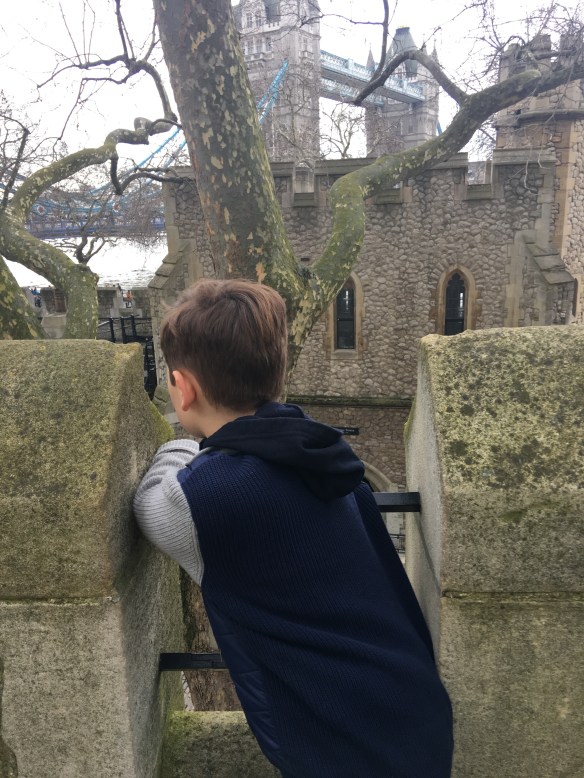
Martin observing London Bridge, from the Tower of London vantage.

The Professional Analysis

We changed Martin’s diet in January 2011 and began biomedical interventions in February 2011. The next month, March 2011, we brought Martin to the developmental neuropsychiatry program at one of New York City’s leading hospitals, where he was evaluated over four separate visits. The report, presented to us in April 2011, concluded with a diagnosis “according to the American Psychiatric Association’s Diagnostic and Statistical Manual (DSM-IV-TR, 2000): Axis I: 299.00 Autistic Disorder.”

Here are selected findings (from the two examiners, as opposed to the parent interviews), as written in the report:

  • In the area of communication, Martin used a number of single words to label and some learned phrases, such as ‘I want . . . .’ He repeated ‘No’ frequently when he did not want to do something. Frequently his expressive language was not directed at anyone in particular. He pointed directly at objects but not to show interest in an object at a distance.
  • “In the area of reciprocal social interaction, Martin did not consistently use eye contact to engage others. . . . . He did not respond to the examiner when she attempted to call his name on four attempts but did so immediately when his mother called his name, though he did not look at her. He responded to the examiner’s pointing to the remote control bunny rabbit, not to her gaze and vocal prompt.
  • “In the area of restricted and repetitive behaviors, Martin gazed at the wheels of a truck repetitively and repeated ‘Hello’ over and over as he held a toy phone.
  • “Even though his mother remained with him, Martin had significant difficulty transitioning to the examiner’s office and into the structured testing environment. During testing, he was easily distracted by specific interests, specifically with letters and numbers, and this interfered with test administration at times.
  • “Compared to other children his age in the normative sample Martin’s overall performance on the [Mullen Scales of Early Learning, AGS Edition] was significantly delayed; he performed better than 2% of similarly aged children. His Early Learning Composite score is approximately two standard deviations below and suggests some delays in his cognitive development. Additionally, he demonstrated more unevenness in his cognitive skills than would be expected. His nonverbal, fine motor skills are a particular area of weakness and very low for his age, and his nonverbal, visual reception skills are also mildly delayed.
  • “Martin’s current repertoire of adaptive skills is somewhat more limited than would be expected for his age. His Adaptive Behavior Composite of 78 classifies his general adaptive functioning as moderately low; he scores better than 7% of other children his age. . . . [His mother] notes that he is making progress and attributes it to improvements in his sleep and the DAN protocol that was started 1½ months ago.”
  • Martin’s Early Intervention teacher “completed the Achenbach Caregiver-Teacher Report Form for Ages 1½-5 based on her view of his behavior over the past 2 months. . . . Her primary concerns relate to Martin’s inattention and his passive noncompliance throughout the day. . . . Martin is noted to sometimes use scripted language and to display delays in both his receptive and expressive language. He often does not answer when people talk to him and sometimes avoids looking others in the eye. He is sometimes disturbed by any change in routine. He is somewhat upset by new people or situations and may resist entering a new environment at school. He will occasionally place play-doh in his mouth.”

At the time we received the report, April 2011, I skimmed but did not read it thoroughly. The exercise would have been too disheartening. Instead I invested myself wholly in biomedical recovery, and trusted that we could make this better.

There you have our starting point.

IMG_0005

Martin discovering his inner knight at the Tower of London.

Fish. It’s What’s for Breakfast

Fellow parents who do biomed, or are familiar with Martin’s diet, like to ask me what Martin eats for breakfast. Deep in our psyche sits a notion that breakfast, especially a kid’s breakfast, must involve cereal, porridge, toast, muffin, eggs, and milk or yogurt, and we seem to have trouble fathoming breakfast for a kid who eats none of those except eggs, which he really doesn’t like.

My idea of “breakfast foods” has expanded in our seven years of biomed. I decided to snap pictures—I know I’m not much of a food photographer, especially when I have only five-to-seven seconds before Martin sits and starts eating—and assemble a breakfast post.

Without further ado, I present seven samples of Martin’s breakfast:

IMG_9862

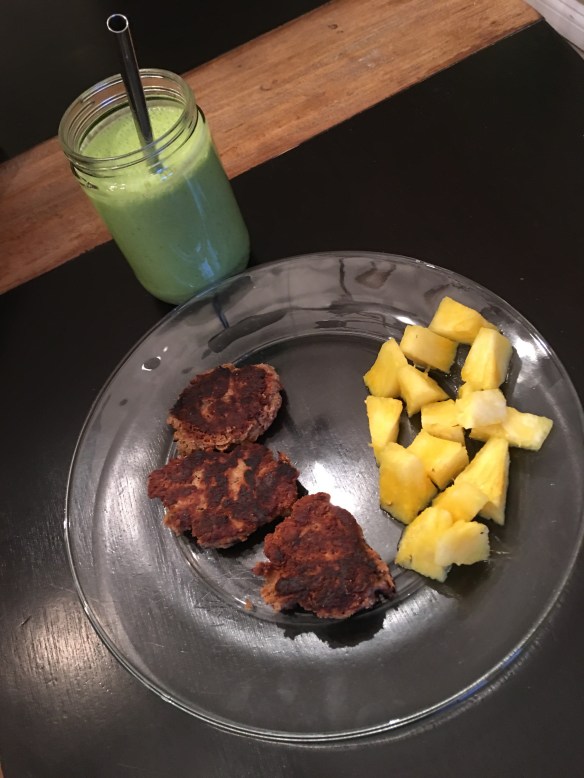
Fritters are always a popular choice. These were made with leftover spiced red beans, flattened and fried. The fritters are joined by pineapple and a green smoothie of cashew milk, coconut yogurt, dates, banana, peanut butter, and spinach.

IMG_9845

Weekend extravaganza. In order, bottom to top: rice toast, fried potato slices, egg over-easy, turkey bacon, avocado, and porcini mushroom salt. I love my fancy salt infusions. This meal was too complicated. Adrian loved the concoction. Martin was kind of—meh.

IMG_9779

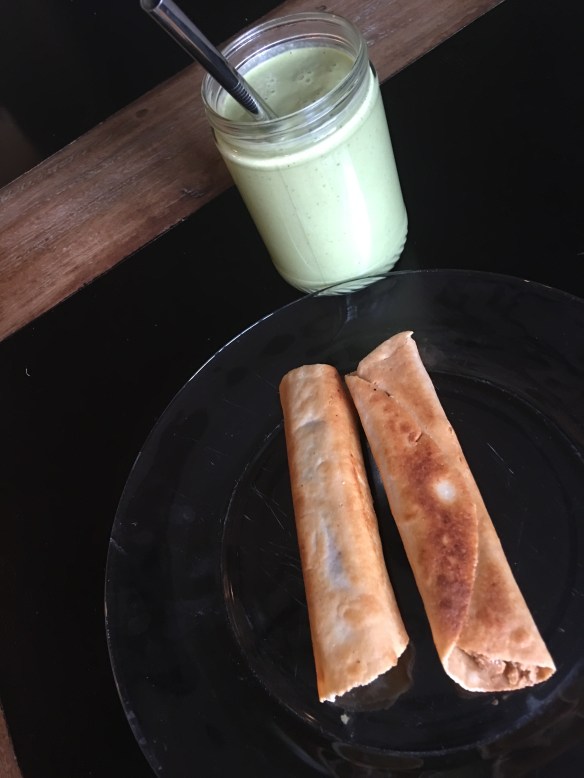
Simple weekday breakfast. Leftover Mexican-style beans wrapped in almond-flour tortillas and fried. The smoothie is cashew milk, cashew yogurt, matcha green tea powder, and a handful of salad greens.

IMG_9766

More fritters, this time zucchini and egg with carrot greens. The smoothie is coconut milk, dates, spinach, and moringa powder.

IMG_9664

Hands down, Martin’s favorite breakfast food is smoked salmon. Now that I’ve learned that freezing below -10 degrees Fahrenheit for a few days renders the fish safe (in terms of parasites), I’ve allowed salmon back on the menu. Here is is served with sweet potato hash browns. The smoothie is cashew milk, coconut yogurt, banana, almond butter, and spinach.

IMG_9623

Not the prettiest picture! But probably Martin’s second-simplest breakfast entrée (after smoked salmon with olives): banana halved lengthwise, rolled in almond-flour tortilla with peanut butter and cacao nibs, and fried.

IMG_9621

If I want to make sushi for breakfast, I will make sushi for breakfast. Here, I packed the short-grain rice into a silicon “mini-donut” mold, filled the middle with mashed avocado, then wrapped the packet in nori seaweed and sliced salmon, then rolled the still-exposed rice in sesame seeds.

IMG_9615

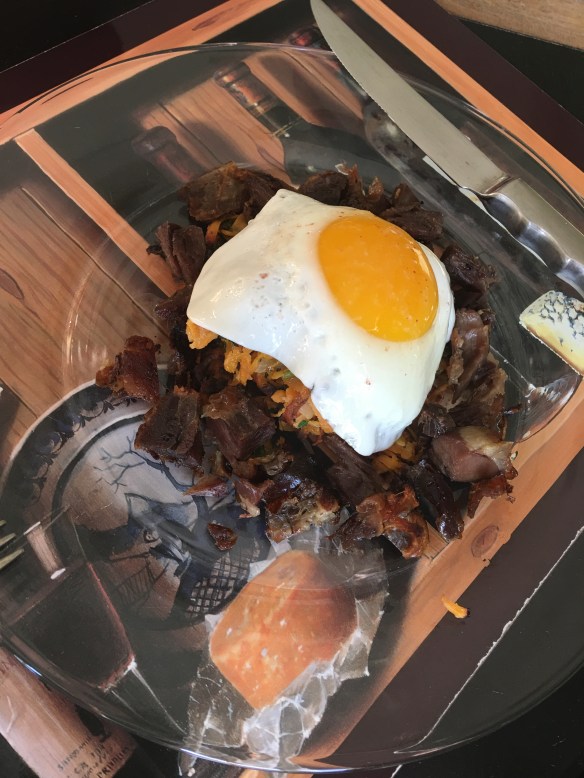
This was prepared most for Adrian (Saturday morning, pre-gym) and made him much happier than it made Martin. Bacon and vegetables under a shredded sweet potato fritter, topped with fried egg. I absolutely detest cooking pig meat. Few things make Adrian happier than bacon.

IMG_9469

This is unusual, thrown together when we were running late. On the plate are almond-flour English muffins with a thin coating of maple butter. The smoothie is coconut milk, kale, banana, and avocado.

IMG_9429

Pretty self-explanatory, for a change. Turkey bacon accompanied by fried potatoes with carrot greens. The smoothie is coconut water, avocado, raspberry, and lucuma powder.

IMG_9425

That pesky salmon again! This time with a side of garlic broccoli. The smoothie has almond milk, coconut yogurt, leftover white beans (really), matcha green tea powder, frozen banana, and salad greens.

IMG_9401

Salmon. It is a lot of salmon. Fried potato and sweet potato with rosemary. Black-rice toast. The smoothie is coconut water with pineapple, banana, mango, and avocado.

IMG_9963

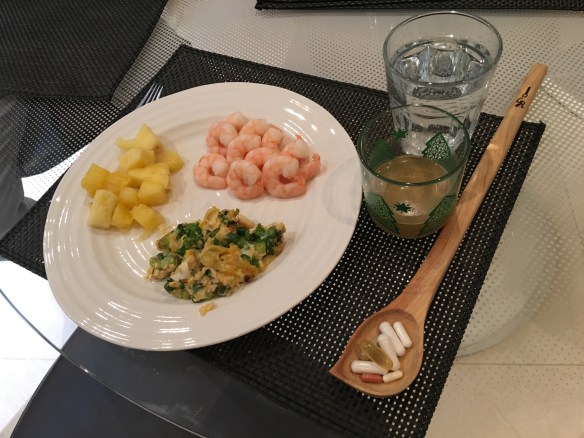
This was a plate I assembled last week while we were traveling in England. The breakfast comprises cold shrimps, pineapple, and red lentils with vegetables. In the wooden spoon are Martin’s breakfast pills. In the smaller glass is his morning “herx water.”

On Working Whilst Biomed-ing, and Yes, I Just Made a Verb Out of Biomed

Last month, in response an earlier post titled “Current Issues,” I received this comment from a reader:

Long due note:

I’m a regular here. We are sailing the same long road with my daughter who is three-and-a-half. Your overwhelm me and encourage at the same time. I feel like you are a super mom to be doing all that you do. I’m shattered most of the time and come back to you for hope and guidance. I’m very curious to know where you started. I have gone back and searched the blog and couldn’t find a journey type of blog. Can you write about this when you can? When did you get diagnosed, what were your earliest challenges? Where did he stand verbally when he was diagnosed? I know every kid with autism is different, but I see Martin as hope and would like to get some perspective on where he started to ensure I’m keeping my recovery stories aligned.

One another point of interest is how has going back to work been? I took a brief break immediately after diagnosis and came back. I absolutely love my job and the benefits that come with it to enable us in this journey but guilty nevertheless for not making the choice to stay back.

Once again, to me you are the perfect mom I wish my daughter had. Some day I will get there.

I responded:

“You . . . encourage me at the same time.” Thank you so much for this note. I write this blog to encourage others, as well as to provide the truth about when recovery isn’t going the way I envisioned it should. If at any point I’ve come off as “the perfect mom,” I apologize. I am far from that. Like you, I’m struggling to find my way along this path. I have written from time to time about where Martin started, but for you I will put together a post about exactly where we were when he was diagnosed. Just last week, I happened to be cleaning my office and ended up reviewing his heart-wrenching initial neurodevelopmental report, so I will start from there.

This kind reader is getting two posts in response to her comment. The description of where Martin started requires more time, because in order to make sure I get it right, I want to review not only my contemporaneous notes of Martin’s behavior around diagnosis, but also those first neurodevelopmental evaluations. In this post, I will answer her easier question, “How has going back to work been?”

When Martin was born, I was not working in paid employment; I was on a break from my job with a large law firm in order to complete my MFA in fiction writing. I finished that degree and then returned to the large law firm, albeit part-time, in late summer 2009, when Martin was 14 months old. Primarily, I was able to work from home. (Despite the bad reputation of large, competitive law firms, mine was, and remained, accommodating to my scheduling needs and desire to work remotely. For that, I am grateful.)

By the following summer, when Martin turned two, Adrian and I realized that his behavior was “off” and trending farther from the norm. We received a tentative autism diagnosis in September 2010. The diagnosis was made official in April 2011, after two months of neuropsych evaluation. By that time, we had already started biomed. I continued working for the large law firm, frequently exhausted, until January 2012, when I finally quit in order to focus on Martin’s recovery.

I stayed away from paid employment until October 2014, when I switched direction entirely and took a part-time gig litigating for an upstart, boutique law firm. That’s still where I’m working today. The scrappy new venture suits me (current me) much better than the white-shoe firm where I spent 13 years defending large corporations. Our little collection of lawyers represents non-profit organizations and consumers, in the areas of food safety (including pesticide residue), protection of farmed animals, greenwashing, and keeping toxins out of household products. My hours are, generally, flexible, and most of my work can be done from home; I commute only once or twice per week to our offices in Brooklyn. On those days, a caregiver picks Martin up from school and handles after-school activities, dinner, supplements/antimicrobials/etc., and bedtime. Also, Adrian and I employ a housekeeper, who comes for a couple hours each weekday morning to take care of laundry, the kitchen, and cleaning.

Despite those facts, I regret to inform you—here, I neither request nor think I deserve sympathy—that I have reached the depressing conclusion that it is not possible to do complete biomed and also work full-time, or half-time, or any more than minimal part-time. At least it is not possible for me, at 45 years old and needing the sleep that I lacked for the first years of Martin’s recovery. Although I have household help and childcare assistance, the tasks that still fall upon me include sourcing (in some cases, growing) clean food, cooking, baking snacks and desserts, trial-and-error with Martin’s diet, ordering and tracking and administering supplements and antimicrobials, coordinating doctor appointments and recovery-focused activities, research, and (this I consider important) facilitating quality time for Adrian and Martin. Regarding Adrian and Martin, I like them to be able to go to the movies or go shopping or visit a restaurant together and feel as typical as possible. Preparation for these activities entails a lot of checking menus on-line and packing snacks and sending activities like books, etc. (No, Adrian does not help with these tasks. Read this post.)

On a school day, I get up at 5:40 to heat and package lunches, prepare breakfast, organize and administer pills and drops, and shepherd Martin’s snail-pace preparation for school. Martin’s after-school activities—which include taekwondo, chess club, music lessons, psychologist visits, social-skills play group, and neurofeedback—can feel all-consuming, even before adding homework, with which he needs guidance. I keep Martin busy, because he still doesn’t have enough friends for regular play dates, and when his hands are idle he’s mostly whining for his iPad. Martin’s schedule means that, unless someone else is handling after-school activities, I have time only for finishing up the last parts of dinner preparation. Any minutes remaining after Martin is in bed I dedicate to cleaning the kitchen and prepping for breakfast, baking snacks if we are running low, putting together Adrian’s lunch for the next day, and if I’m lucky, watching a show or the news with Adrian.

Given all that, unless someone else is on duty after school, I have exactly six hours “free” per day, the time between when I drop Martin off at school and when I pick him up. During that time I go to the gym (often, this is aspirational), shower, grocery/food/farm shop, get dinner mostly prepared, set appointments, research treatments and diet, blog, volunteer time for the special-education PTA and church, and—work. Many days, not much time gets left for work. Many weeks, I try to cram all the lawyering into the one or two days I’m able to go to the office. Furthermore, when work, by necessity (lawyers don’t always have control over their schedules), spills into “Martin” time—say, when I have to take a conference call from a playground, or an emergency project precludes me from completing reading exercises—the guilt becomes oppressive. Why, I ask myself, do I even bother working? Why, when I am within the very lucky minority of biomed parents whose spouses earn enough to cover expenses, do I sacrifice any of Martin’s due for my own selfish craving for a life apart from autism recovery?

Around Christmastime, I sat down with the chairman of our little law firm and told him I need to reduce my work even more and, to the extent possible, restrict my activities to writing projects that can be anticipated in advance, in order to keep my schedule regular. The conversation followed upon a difficult November and December, during which I oversaw document discovery, dealt with witnesses and clients, prepared our office for a contentious mediation, and traveled. I began the conversation, “I think you know I’m done for.” I’ve been mostly successful, since then, at reducing the workload and increasing predictability, but it remains a struggle. The chairman wants more from me; I enjoy the intellectual challenge and the opportunity to think about something other than, say, Lyme disease and vision therapy. Still, I have been given the tremendous opportunity to let Martin’s recovery take precedence. That gift must be honored.

So there you have my ugly truth. Despite a supportive husband, a housekeeper, competent assistance with childcare, and an employer that understands my need for flexibility, I have trouble working even part-time.

Dear reader, you think I am the perfect mom? I look at my church friend G—, who fully recovered the oldest of her five children while also working part-time, by necessity, to supplement the salary of her husband, a public servant. I look at G— and think, That’s the mother my son deserves, for I fall short in so many ways.

IMG_0346

Martin following his cousin up the mountain (no path required), Triberg im Schwarzwald, Germany.

Quick Improvement

That last post left you hanging!

I actually wrote the post while sitting in the waiting room of Martin’s biomed doctor, three weeks ago. I described symptoms Martin was experiencing; most problematic among them was Martin making disastrously inappropriate utterances that he knew to be provocative. I described the behavior as “almost like Tourette Syndrome (Martin does not have Tourette)”: In addition to calling his classmate a “racist,” Martin was saying odd things like, “I think schools should be segregated again,” or, “Hispanic kids who speak Spanish aren’t as smart as other kids.” (Martin is Hispanic, and speaks Spanish, and our family does not hold views anything like he was expressing.) When asked, Martin seemed unable to provide any explanation for the statements. He said, “Sometimes words come into my head that I know I shouldn’t say, but I can’t stop them before they come out of my mouth.”

After examining Martin and hearing about these and other symptoms, the doctor surmised that parasites were at work. Martin’s doctor in New York had made the same guess, and actually had already prescribed an anti-parasitical drug, Alinia®. Given my hesitation to administer any pharmaceutical to Martin (side effects, unintended consequences, wanting to avoid synthetics for whatever we can address naturally), I held out for a second opinion from his biomed doctor. She agreed that we should consider Alinia, and she added natural measures to Martin’s protocol to keep the parasites at bay, long-term, including diatomaceous earth.

Alinia is administered in a three-day course, followed by a two-week break and another three-day course. We started the first course two days after returning from our visit to the California biomed doctor.

Remarkably, just his second day on the Alinia, Martin’s inappropriate comments virtually ceased.

Within a week of completing the first three-day course, the skin rashes and itching also eased.

Rarely do we hit the nail square on the head when it comes to Martin’s periodic symptoms, but this time I think both doctors were spot-on: Parasites were at work, and Martin needed a strong remedy.

He’s on the second course of Alinia now, after the two-week pause, and he’s also using diatomaceous earth. His reading tutor texted me this evening to say that his focus seemed improved. I’m optimistic.

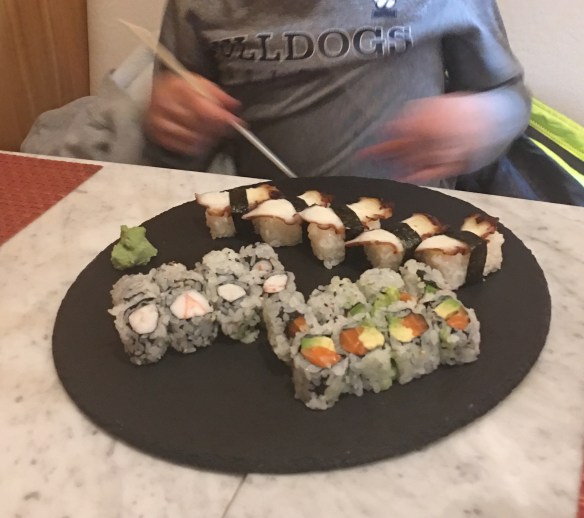
Now for the tough part: Martin’s biomed doctor recommended that Martin stop eating sushi, at least the kind with raw fish, which can contribute to parasite activity. Martin adores sushi. We eat sushi at least twice per week when we’re not traveling (I get the vegan version), and it’s a go-to food when we are. Martin likes to order six pieces of octopus sushi, one salmon avocado roll, and one steamed shrimp roll. (If that seems like a lot of food, let me mention that he consumes the entire tray in about five minutes and then, often, flags down the waiter to request more octopus sushi.) I did some research and discovered that octopus is virtually always poached when used in sushi (though the animal may be raw in thinly sliced sashimi). So the octopus is cooked, as is the steamed shrimp. So far I haven’t had much luck determining whether poaching or steaming is sufficient to kill all parasites (investigation continues!); still, I get comfort from the fact that the octopus and shrimp are, at least, not raw.

As to the salmon, which really seems to pose significant risk when raw, Adrian and I, after much consternation, have reached rapprochement with Martin: He can still eat his salmon avocado roll, but we request that the salmon be cooked. Last Sunday, on their usual weekend “boys’ afternoon,” Adrian and Martin went for sushi, and Adrian insisted that the salmon be cooked. Adrian came home and reported that the wait staff were initially befuddled by the request but then, upon discovering that their kitchen had the magic capability to cook salmon, complied. Martin, for his part, arrived home and announced, “Actually my sushi with cooked salmon was pretty good!”

Additional positive news: “[Freezing fish] to an internal temperature of -4°F for at least seven days [kills] any parasites that may be present,” although “[h]ome freezers are usually between 0°F and 10°F and may not be cold enough to kill the parasites.” Immediately upon reading this news, I checked the deep freezer in my basement and found -10°F. The $250 (or so) of cold-smoked salmon—a breakfast favorite of Martin—in that freezer should be safe for him to consume.

This vegan never thought she’d find herself checking freezer temperatures to determine parasite risk in seafood.

IMG_9356

One piece of octopus sushi already gone, but here are the remaining five, plus his salmon avocado roll and steamed shrimp roll.

Current Issues

We are off to visit Martin’s biomed doctor. I made a list of issues to discuss, which includes the following:

  • skin rashes, in the form of blemishes that Martin scratches and picks at until they bleed;
  • itchy skin overall;
  • impulsively calling out words he doesn’t mean, in a manner almost like Tourette Syndrome (Martin does not have Tourette);
  • obsession with foods, allergies, which foods he can or cannot eat, which are treats, and so forth;
  • trying to understand tough situations by putting Minions into those situations, like, “Bob [a Minion] was on the playground and another kid said he couldn’t use the swings. Is that nice?”;
  • constantly apologizing, which has been an ongoing habit.

(There were other issues on the list, too personal for sharing on the blog.)

What are your guesses, readers? Parasites? Metals? Lyme activity because we started using cryptolepis to treat babesia? A different form of the yeast beast? Dry winter air? Noticing differences between himself and other kids?

I’ll fill you in after our appointment with the biomed doctor.

And before you worry that Martin’s recovery is off the rails, I will add the following:

First, Martin’s self-awareness is blossoming. Even his teachers have noticed. After school last week, Martin confessed that he had hurt his friend Nicole’s feelings by calling her “racist.” (In light of Black History Month and Martin’s classroom unit on civil rights, our family has been doing a lot of talking about racism and our country’s legacy of segregation. I think he was angry at Nicole, and “racist” was the first insult he happened upon.) He added, “Sometimes words come into my head that I know I shouldn’t say, but I can’t stop them before they come out of my mouth.”

Second, this morning, by phone, Adrian said, “This past month or so, I’ve been having these awesome moments with him, where he’s just acting like a regular kid, and I can finally think, ‘This is it. This is the way it’s supposed to be. This is the reward’.”

We Feel Terrible That We’ve Done What We’ve Been Told Not To

This morning I lost my temper with Martin. I’m not pleased about losing by temper, but it happened.

We were in the last stages of getting ready to leave for school—which for us, 90% of the mornings, means getting ready to be late for school. I had executed the morning routine well, and despite extreme dawdling during breakfast, we managed to reserve 20 minutes to get Martin dressed, hair-combed, teeth-brushed, and jacket-clad. He took eight minutes of that time to sit on the toilet and yell, “Privacy please!” every time I knocked. Five minutes or so were devoted to dodging my attempts to get him dressed and instead asking senseless “What if?” and “Would you want?” questions: What if you’re in a restaurant and the host takes your drink order but then the waiter brings you the drink? Would you want to eat at a restaurant like that? What if two hockey teams are playing each other and wearing the same uniform so you can’t tell them apart? Would you want to watch a game like that? More time was wasted as Martin grabbed his freshly cleaned glasses by the lenses, so that I had to return to the kitchen for another lens-cleaning wipe. When I asked him to brush his teeth, he was chit-chatting instead of paying attention, so he went to the sink and washed his hands. Then he insisted on another trip to the toilet, after which he returned to the sink with his pants around his ankles. When I told him, “Pull up your pants so we can leave,” he heard only “pants” and so, without further thought, used his feet to take off the pants.

That’s when I lost it.

“Martin!” I barked. “You have got to pay attention! Sometimes you must listen! We cannot be late to school every single day!”

He laughed, which he does when he’s nervous, or overwhelmed.

I grabbed the pants off the floor and thrust them into his arms. “Put on these pants! We have got to leave!”

He clutched the pants and averted his eyes. We had passed the point of meaningful communication.

Realizing that I needed to cool down, I left Martin in the bathroom and returned to the kitchen.

Now I was the one overwhelmed.

I felt agitation. A lot of agitation.

I’ve written before that, when we are late, the problem is me. That’s true. But on this occasion—if I may plead my case—I had done everything right. I got up on time, 5:40 a.m. Adrian’s bento boxes were prepared last night; all I needed to do this morning was heat his lentils. Martin’s veggie-meatballs (turkey) were ready last night, too; all I needed to do this morning was pop them in the oven. Beans were in the coffee maker, for Adrian’s coffee; all I needed to do was add water. My Bodum pot stood ready, with Hobee’s tea already in the steel basket (I’m off coffee, stupid heartburn!); all I needed to do was add boiling water. Even Martin’s breakfast was half-prepared; I cleaned and grated the sweet potatoes for his fritters last night, and packed them in ice water. Martin was done with breakfast and in the bathroom at 7:50 a.m., 20 minutes before our scheduled 8:10 a.m. departure.

Despite all that preparation, we were going to be late for school. Again.

It took only a few deep breaths before my agitation gave way to disappointment, in myself, for having lost my temper.

Two memories came to mind.

First, a passage from Naoki Higashida’s wonderful book The Reason I Jump. The teenage author, who is mostly non-verbal and uses a keypad to communicate, writes (of himself and others with autism):

Me, I’m always being told off for doing the same old things. It may look as if we’re being bad out of naughtiness, but honestly, we’re not. When we’re being told off, we feel terrible that we’ve done what we’ve been told not to. But when the chance comes once more, we’ve pretty much forgotten about the last time and we just get carried away yet again. . . . But please, whatever you do, don’t give up on us. We need your help.

Second, an experience on a New York City subway. One night, after a theater date with friends, Adrian and I were on the subway after midnight, seated across from a woman and a toddler. This story is not meant to judge the adult (mother?) for traveling after midnight with a toddler. She may well have left a second-shift job and retrieved the girl from a sitter, or tended to a family emergency without notice. The little girl was obviously exhausted. She held herself together for two or three stops, then started to cry. The woman said, “Cut it out!” Her tone was menacing. The toddler stopped the tears momentarily, whimpered, and started crying again. The woman grabbed and shook the girl’s chin and yelled, “You ain’t got nothing to cry about.” Finally she threatened to slap the girl. Without saying anything, I stood up. I don’t know what I meant by standing up, maybe just to suggest that other adults were present and were prepared to intervene. The woman scowled and fell silent. Somehow, the little girl stopped crying, and the moment passed.

My heart went out to the girl. “She can’t help it!” I wanted to say. I should have said. What toddler could be awake after midnight and control her behavior?

That’s Naoki Higashida’s point, too, I gather: What child with autism (or in our case now, ADHD) can conform his behavior to neurotypical specifications?

The fault that we are late is Martin’s, I thought, but it isn’t his fault that he’s at fault.

Does that even make sense?

I returned to the bathroom and apologized for raising my voice. I was frustrated at being late, I said. I wasn’t angry at him. I knew he was trying. I was glad his pants were on again. How about if I helped him tie his sneakers?

Martin sought two or three assurances that I wasn’t angry. I gave the assurances.

We were late to school again. The world didn’t end.

Searching the Storm for Silver Linings

It’s 6:53 a.m. I’m sitting on the commuter train to Manhattan, where I will transfer to a subway to my office. The train, which was scheduled to depart at 6:45 a.m., has not left the station (our community is the train’s origin), because a door is stuck open. Here we sit, waiting.

This morning, the train feels like a metaphor about Martin’s recovery: All ready to go, everything operational, until something unexpected jams the trip.

Martin talks a lot these days, and he has no filter, and it’s getting him into hot water with children and adults alike. Here are the texts I received yesterday from the behaviorist at Martin’s school (edited for length and clarity):

Problem this week was really filtering. I did take Martin out of class today. He was telling some boys on the carpet they were dead. Boys said stop. Teacher told Martin not to say that, it is not funny. He said yes it is and repeated laughing. She then asked him to move his seat and come sit by her (class was on the carpet). He told her no and continued to laugh and repeat.

At that point I stood up and told him to come with me to the hallway. He said please no. I just gestured and he came. I spoke to him sternly outside.

I told him no more trying to be funny. He is saying hurtful things. I typed up the “hurtful things” he said this past week and went over them with him. The speech teacher will do that as well.

[Here she forwarded me a photo of the write-up of “hurtful things” Martin has said. The worst was telling a girl she should not be in the school because of the color of her skin. Martin doesn’t believe that (I hope). He’s been perseverating all month on Martin Luther King, Jr. and his accomplishments. I’m guessing that he interpreted his comment as funny based on the absurdity of past discrimination. Still, hearing that Martin had utter such a remark sent my emotional state tail-spinning.]

The aide who covers specials also made a very good observation. She said some of the boys who play sports together are very friendly and in gym they purposely bump into each other, play footsies, etc. Martin sees this behavior and then of course when he tries to execute it does so in an inappropriate fashion or at an inappropriate time.

So the boys are joking around. Martin observes this and then doesn’t understand why when he does it it’s not right.

Yesterday, at church Kids’ Club, I heard Martin yelling, during kickball or some other game in the gym, “Raise your hand if you’re native!” He meant Native American. The term came up this week, when Martin asked me why Northwest Territories, Nunavut, and Yukon are Canadian territories instead of provinces, and I tried to discuss former European colonies versus territories with more First Nation and Inuit influence. On some level, I know that Martin is genuinely curious about the relationship between native and colonizing populations. On a more immediate level, I am horrified that the expression of his curiosity is demanding to know who among his church peers has native heritage.

I’m at my office now. That commuter train I was sitting on—it got cancelled. The maintenance crew couldn’t fix the door. All passengers, including me, had to gather their belongings and catch the next train, scheduled 34 minutes later. The business call I was planning to take form my office at 8:00 a.m. had to be rescheduled. The later train, of course, was crowded and uncomfortable.

But at least I had a seat; by the second stop, onboarding passengers were standing in the aisles. At least I waited the extra half hour inside a train; passengers at all subsequent stops were standing outside, in the cold, on the platforms.

At least I had a home to come from, and a job to go to.

At least Martin is talking, and attending school.

Take Heart. There Is Also More Than I Can Manage

It’s been seven years since we began biomedical interventions aimed at recovering Martin from autism, and though I always wish wellness would hurry up and get here, overall I am pleased with our success. Last semester we had a CSE meeting with our school district and, at our request, reduced the special-education services Martin receives. With newfound social awareness, Martin has grown resistant to being pulled so often from his mainstream classroom. We decided that we can still meet his needs even without physical therapy (taekwondo helps) or resource room (we’ve hired a reading tutor instead), and we’re cutting speech therapy from three sessions per week to two. Outside of school, Martin recently had a successful play date with typically developing twins, albeit 17 months younger than he is. Progress, progress.

How have we reached this point? Through utter, over-the-top lunacy. By my leaving my law-firm job to work on Martin’s recovery. By moving out of New York City, and into a house adjusted to meet his needs, from electromagnetic-shielding to environmentally sensitive paint. Through a variety of specialty and highly restricted diets, all home-prepared and as organic as possible. With homeopathy and, early on, homotoxicology. Through large medical bills (on top of pushing the limits of our insurance) for a team of MAPS(-ish) practitioners, an LLMD, geneticists, traditional and nontraditional allergists, developmental optometrist, neurofeedback practitioner, HBOT therapist. By insulating Martin from the commonplace, like fluoride, chlorine, harsh cleaning agents. On the non-biomed side, through special-education settings, hippotherapy, social-skills playgroups, a psychologist. And of course, by summer relocation to Nicaragua.

From the beginning, I have had to acknowledge the privilege inherent in what I can do for Martin. We are a two-parent family with one child. Adrian’s income as a law-firm partner made it possible for me to stop working and focus on Martin, and for us nevertheless to cover the expense of biomed. We live in an area rich with resources. Adrian himself believes in the biomedical approach. While he may select restaurants without enough regard for Martin’s restrictions, or plan trips that make it difficult to adhere to our supplementation routine &c., he never questions my research or seeks to undermine.

What we do for Martin appears extreme, to a good many folks, and that’s okay. It is extreme. I’ve always said I would do anything necessary for Martin’s recovery.

Yet, more and more often, I encounter parents who do more than I do.

Example: Parents who homeschool. That’s not happening for us. I love Martin and cherish our time together, enough so that—other than cooking—I get nothing done when we’re together. I need the six-hour break when he’s in school. I need the time to work, to shop, to research, to order supplements, to breathe.

Example: Parents who truly master the science behind medical challenges and recovery. When my family makes a big decision like medical marijuana, I try to do a lot of research. I read summaries and abstracts and, where necessary, delve into scholarly articles—which is tough. I’m no good at the science component. I’m forever amazed by parents who seem able to answer extremely complicated questions of physiology or neurology at the drop of a hat. Perhaps they were doctors in their pre-autism lives. Or perhaps they just managed to complete something more impressive than “Chemistry for Non-Science Majors,” which was the class through which I fulfilled my core science requirement in college.

Caveat: One could argue that anything biomedical we do with Martin is a “big decision,” because anything has the potential to affect his health short- or long-term. True. On the other hand, my anxiety is satisfied with comparatively less investigation when it comes to, say, Vitamin C supplementation than when it comes to, say, chelation.

Caveat: There are also plenty of parents in my on-line groups who, even to my weak eye, get science and even basic facts wrong. I wasted time one evening explaining why the statement “All soy contains GMO estrogen” was untrue (in varying ways). Another occasion, I spent hours trying to track down the source of a statistic about MTHFR mutation and autism that was being thrown around as gospel. I failed, even after looking through all eight articles in the medical journal to which the statistic was vaguely attributed.

The core point is this: In the event anyone feels disheartened because s/he can’t manage what we do for Martin, know that I too become disheartened by what others manage that I cannot.

Martin needs more detox support. For detox support, he takes a few herbal remedies, does a detox bath (two cups Epsom salt, half a cup baking soda, and essential oils) several times per week, and when we have time, sweats in our infrared sauna. But he needs more. I can tell because he becomes silly and inattentive (behavior I associate with detoxing) at certain times each day, usually when his antimicrobials are taking effect. So I went searching for a supplemental detox protocol and found a post, from the excellent blog Regarding Caroline, titled, “DETOX the Die-off and feel amazing again! [our roadmap to success].”

Call up the post, if you have a minute. Read through, past the various strategies of castor oil packs, dry brushing, &c., down to that part subtitled Our Daily Detox Routine. It’s amazing! Herx water and lymph drainage massage before breakfast, cytokine and lymphatic supplements mid-morning and early afternoon, foot bath during dinner, dry brushing before shower, more lymph drainage massage in bed, so on, so forth. Martin would undoubtedly benefit from that type of detox routine. So much detox might eliminate silliness altogether, which would help so much with social skills; just this afternoon, Martin said to me, “I know I shouldn’t laugh at jokes from inside my head when I’m with friends. I can’t calm my body and control the laughing!”

So Martin needs a routine like that.

But—

But I—

I came away from this post feeling, I imagine, the way an autism-recovery newbie might feel after some time on Finding My Kid: What? How? How could I possibly do all that—do anything close to that—on top of the day-to-day grind I already endure? Martin attends school; we’ve established that. He has at least two activities after school every day, which include taekwondo practice, music lessons, psychologist appointments, social-skills playgroup, reading tutor. Then there’s homework (which still takes inordinately long, given his attention issues), trombone and drum practice, (now) chess practice, half an hour of iPad time (as a reward for completing everything else I just mentioned), dinner, two snacks, and school-mandated 20 minutes of reading before bedtime. We do his pills and drops at wake-up, breakfast, immediately after school, before dinner, during dinner, and at bedtime. When the dry brushing? When the detox supplements, which must be separated from everything else?

You may be thinking, hey, why not drop a few activities? I would love to. Here are examples of my excuses and counter-proposals:

  • The most cumbersome activity is taekwondo, which Martin does five times per week. He would attend seven times per week if the lessons were available. Most kids attend two or maybe three times per week. We indulge Martin’s habit because (1) taekwondo is one of the few activities that excite him, and (2) even coming twice as much as other kids, he still has trouble keeping up with them, and every time classmates have the opportunity to pass a belt and Martin doesn’t, the experience pains him.
  • His music lesson is a combined once-weekly trombone and drum lesson. He wants to join the school band next year, in fourth grade. He’s been at the trombone lessons for two years, and he isn’t very good. Last fall he asked to change to percussion. We don’t like him hopping around on a whim, so we allowed percussion only if he also stuck with trombone. Then he showed a knack for drums and immediately became a better percussionist than trombonist. If he’s going to succeed in band, drums are probably the key.
  • Chess is a new activity, at my urging. Our community has an active chess program for elementary kids, and I’d like to have Martin involved in at least one quiet, thoughtful activity with peers. The participants, however, have by and large been playing for a while, and Martin needs to catch up, so I have him taking a lesson once a week and practicing the other days. If I can’t have a hockey player, darn it, I will have a chess player.

The truth is, I would rather keep Martin busy. We still don’t have many play dates to speak of, and when he’s not busy, he’s whining for an iPad or for me to entertain him. Of course he needs to develop the skill of entertaining himself, but at least until he can read for pleasure, we probably aren’t there yet.

So there you have it. There are, indeed, parents who do more for their kids than I do for Martin. Far more—even excluding the subset of parents who must do more because their children are extremely high-need. I, too, become overwhelmed at the thought of all I should be doing.

I hope that a parent who reads Finding My Kid and thinks, “No way!” might nonetheless think also, “Okay, part way. I can do some of that.” So that’s the course I took. I analyzed the Regarding Caroline suggestions, took what seems do-able for us, and came up with a Martinized protocol:

  1. We will do a foot bath during iPad time at least four days per week. I prefer Martin to be seated at a table for iPad time in any event, because otherwise he hunches and puts his face too close to the screen.
  1. We will attempt dry brushing Saturday (or Sunday), Wednesday, and Friday. Those are the evenings when we tend to be less rushed.
  1. I will add herx water before breakfast and after school.

That’s it. Those are the suggestions I think I can manage.

And, mind you, the list is aspirational.