If Only I Had Decent Answers

Is Martin curious?

When Martin was a toddler, when his autism had emerged but Adrian and I did not yet recognize it, I thought he was curious about mechanics. He spent hours staring at mechanical devices. I don’t mean that as hyperbole; unless someone intervened, Martin would stare without stopping, for however long we left him. If I wanted to make dinner, I could push the upright vacuum into the middle of the living room and count on Martin to remain, indefinitely, within 36 inches of the appliance, circling to see from different angles, lying down with his head by the wheels. On the street, the only time I could be confident that he wouldn’t bolt was when we had an excavator or backhoe or other piece of heavy equipment to look at. Then he would stare. Stare. Stare.

You ask, How did we not recognize autism? I answer, First-time parents. Give us a break.

After we started autism recovery, Martin stopped gazing at mechanics, and his echolalia (which had been his lone form of spoken language) eased into perseveration. At that time, I probably would not have called Martin curious. His mind got into ruts, and he asked the same question repeatedly. He seemed uninterested in what was new. How could a boy who stuck to one topic, for weeks, be called curious?

Still, we were grateful for what we’d got. At least he put together the sentences, and later questions, on which he perseverated. That’s a step up from echolalia.

Martin still perseverates today, though less. He cycles through topics of interest. We’ve spent the last couple months on street signs. He wants to know everything about street signs. Why does the sign for “playground ahead” have only a see-saw on it? What is a shoulder? Why can’t you drive on it? Mommy, slow down! There’s a speed zone ahead. Before street signs, Martin was into phases of the moon, and facts about the moon. Before that, musical instruments.

Despite the perseveration, Martin’s real, natural curiosity is starting to make itself known, through his ever-increasing language skills. In the last few weeks, I’ve heard questions like these:

In the car, as “Fire and Rain” comes on the radio: “Mommy, what is James Brown signing about?”

Upon finding out that I would be gone for four days to attend a conference (A1!) in Chicago: “What is the conference about?”

Looking around my home office, and realizing that I have portraits of three deceased cats on the wall, when in fact I’ve had not three but four pet cats who’ve died: “Why don’t you have a picture of Tiny Rachel on the wall?”

On a lazy weekend morning, after he climbed into bed with me and Adrian: “Mommy, why did you decide to marry Daddy?”

I’ve been ecstatic about each such question. I do, however, need to add a caveat: Sometimes Martin doesn’t really listen to the answer I give him. Sometimes he poses the question, then interrupts my answer to ask another question or introduce a new topic. When that happens, I wonder whether he’s actually being curious, or whether he’s just trying to control the situation (this happens) by having me answer his choice of question. Ah, well. It is what it is.

Hey, are you wondering why I don’t have a portrait of Tiny Rachel in my home office? Tiny Rachel was my first cat. I adopted her, all five pounds of her, just after I graduated college. She saw me through my first master’s degree, law school, a total of 13 apartments, work, cohabitation, marriage, my second graduate degree, and finally, pregnancy. Tiny Rachel was whip-smart, and full of piss and vinegar. She hated everyone but me. She died three months before Martin was born, and I think she surrendered some of her spirit to him. I’ve never really been able to admit that Tiny Rachel is gone. It’s been seven years. I need a few more before I can hang her portrait.

I See Your Napkin Hand-Off, and Raise You a Call for Pajamas

Sunday morning, I lay clothes upon Martin’s bed and told him to get dressed while I showered.

Ten minutes later, after my shower, I found Martin his room, fully dressed except for socks. “Hey, what about these?” I asked.

He grabbed the socks and scampered away.

“Wait!” I called after him.

He had left his dirty pajamas on the bed. He knows that dirty clothes belong in the blue laundry basket in his bathroom. I gathered the pajamas and stepped into the hallway. Martin was 15 feet down the hall, on the floor outside his bathroom, pulling on his socks.

“You left these dirty pajamas on the bed,” I said. I wanted him to get up, walk back to me, and take the pajamas.

Instead, he kept his butt on the hardwood floor, reached his hands toward me, and danced his fingers in the air. All the while, he kept his eyes on me.

His request was obvious. The gesture was obvious. Throw them to me, he motioned. Throw me the pajamas.

Straight-up, flat-out nonverbal communication. No doubt about it.

Right away I remembered the day four years ago—before Martin could follow eye gaze or pointing, before a nick of the chin one direction or another meant anything to him—when Martin comprehended a nonverbal cue and dropped his napkin into my hand. We were a year post-diagnosis, then, and I was so pleased that he’d understood what I wanted.

Look at him now. Sitting there (literally) and motioning for me to throw him pajamas, as if it’s nothing. As if nonverbal communication is nothing at all. Sure, we may be five years into the arduous recovery, we may have our ups and downs, we may be clawing our way out of quicksand into fog, but look at him now.

I threw the pajamas at Martin. They hit him in the face. (Catching skills? Not quite there yet.) He giggled and still didn’t get off the floor. He kind of scooted and crawled into his bathroom, dragging the pajamas, and deposited them into the blue laundry basket, then returned to the task of pulling on socks.

’Atta boy.

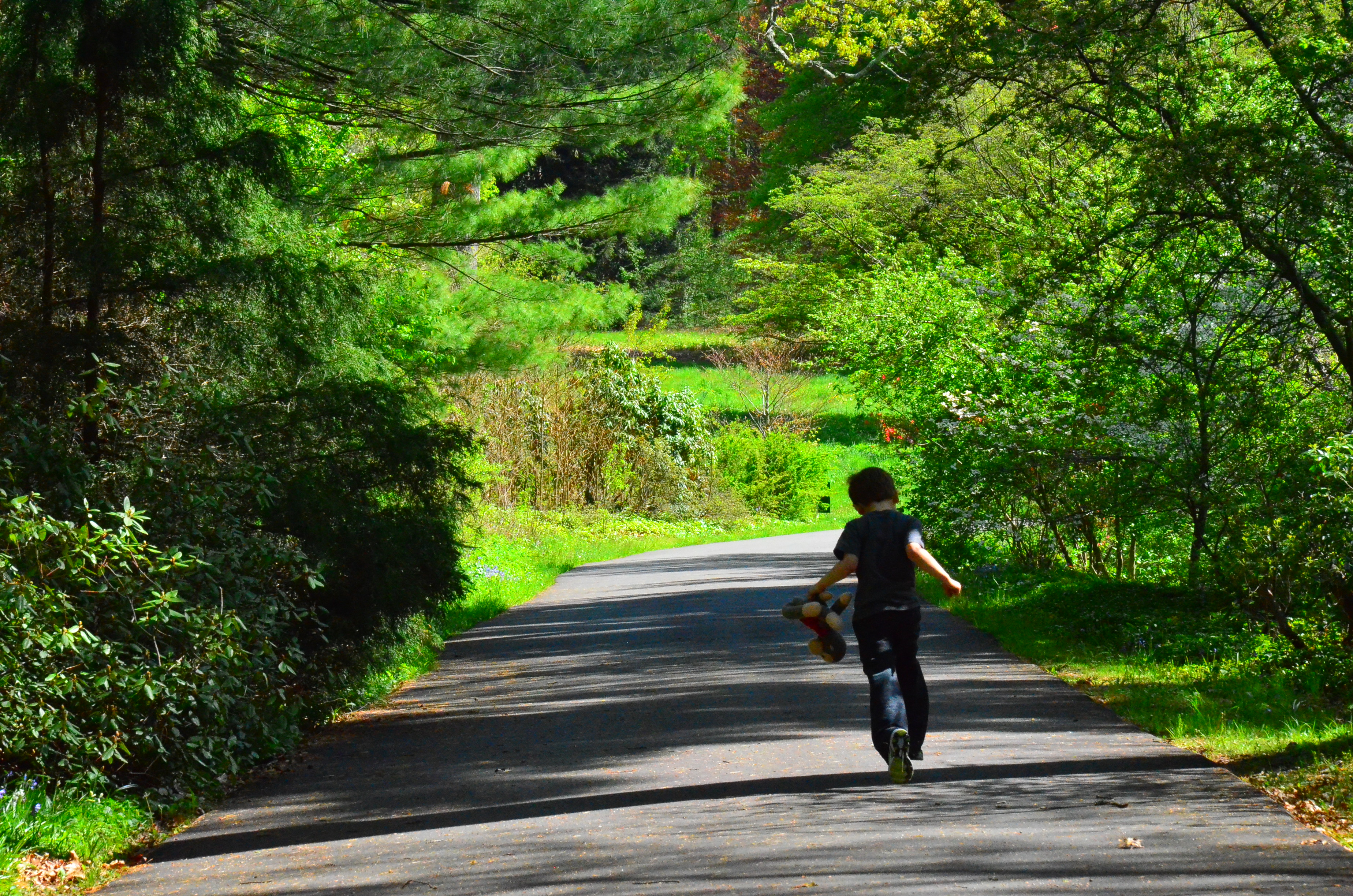
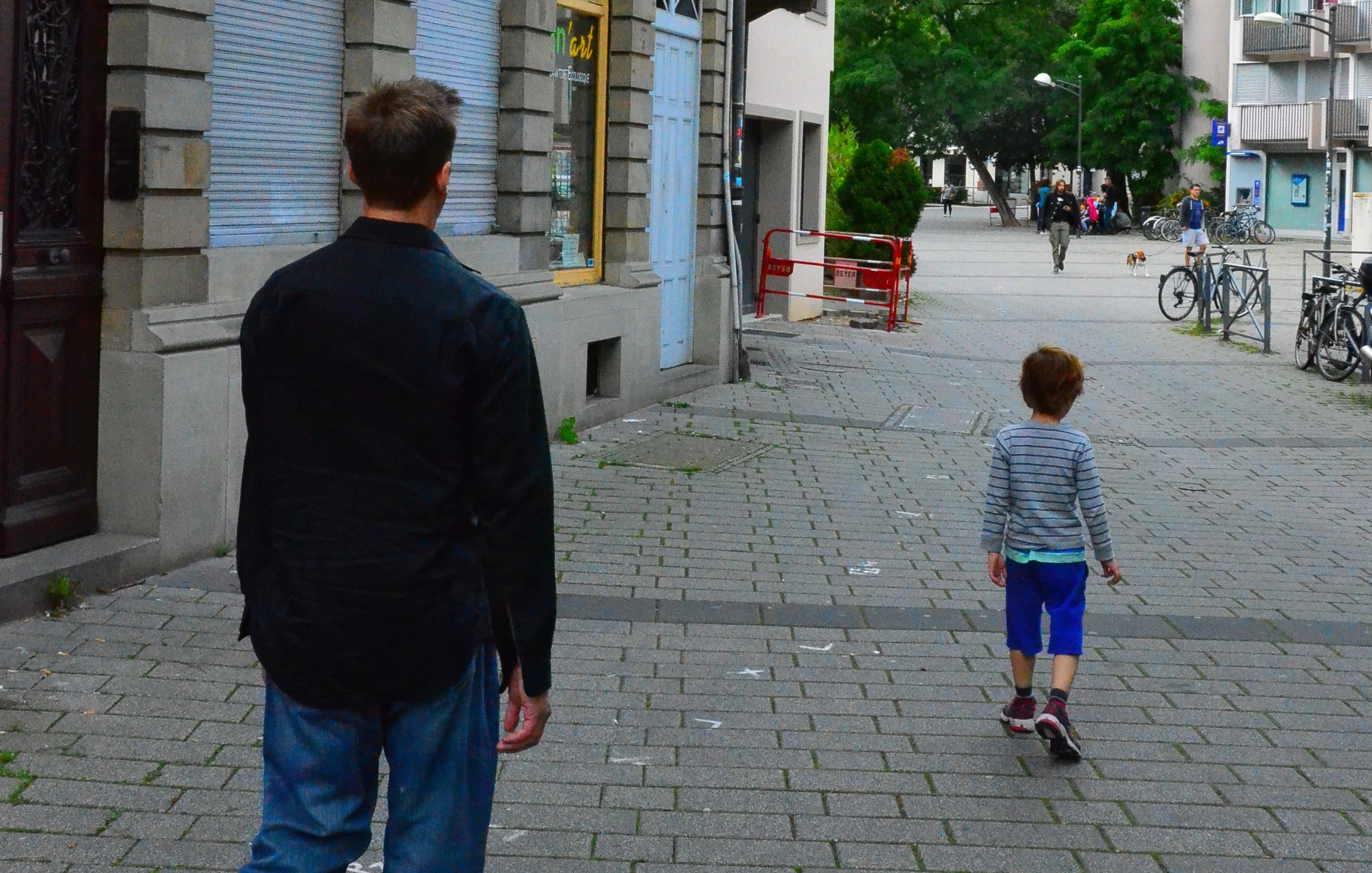
Martin behind Adrian, on a walk near our home. Learning, I suppose, to follow.

Martin behind Adrian, on a walk near our home. Learning, I suppose, to follow.

Autism One Take-Away II

In my last post, I enumerated my “for discussion” points from Autism One, the ideas that caught my interest but that I need to discuss with Martin’s doctor before I take any action.

In this post, I address two plans for immediate implementation: composting and EMR control.

I’ve had composting on my mind since we moved to the suburbs two years ago. Composting never made it past the good-intentions stage because I wasn’t planting. Composting may be generally beneficial, from an environmental standpoint. From a realism standpoint, I’m not going to do it unless I have a use for the compost. I mean, I’m not going to compost and donate the result. At least, not while I’m in the thick of fighting autism. Maybe someday, when Martin has recovered.

This spring, for the first time, I planted. I assembled an elevated, cedar garden box, in which my arugula, kale, and marigolds (co-planted for natural pest control) are thriving. I also started three “Grow Boxes,” which I’ve had since before we moved from the City and never used. (Trepidation. I haven’t been able to discover exactly what goes into the grow-boxes’ built-in fertilizer, and I have a bias against the boxes being plastic. So far, in any event, the crops in the cedar box are doing much better than those in the plastic grow-boxes.) All the seeds were organic, of course, and I also purchased (not cheap) organic soil.

In one of his A1 presentations, Dr. Zach Bush talked about the introduction of nitrogen fertilizer after World War II, the more recent introduction of glyphosate and other pesticides and herbicides, and the resulting loss of soil biome. I think a lot about human biome, especially since Martin was born by unplanned Caesarian-section and then given antibiotics. I’ve never really thought before now about the soil biome. During his presentation on The TDOS Syndrome, Peter Greenlaw argued that food, as we have altered it, is not longer “enough” to nourish us. Tomatoes have less lycopene, spinach has less iron, carrots have fewer vitamins, and so forth. We eat all the calories and then, still missing nutrients, we crave more, leading to obesity. These ideas clicked. Since I’m growing vegetables on the homefront now—I’m about to step outside and harvest a salad for dinner—I ought to insert as much nutrition into them as possible. Won’t my organic vegetable waste make ideal compost for that purpose? Plus, the very cool plumber who came recently to fix a burst pipe told me that my township offers outdoor composting kits to residents for just $50. Composting, here I come.

As to EMR, we have taken precautions already. EMR, or EMF’s, were a primary concern when we decided to move out of New York City. In our old apartment, in the city, when I ordered my computer to search for wi-fi, it routinely found two or three dozen networks. Two or three dozen! That means Martin, at home, playing, or sleeping, was bombarded by wireless frequencies. And when you live in a building with seven other families, surrounded by more buildings with more families, those signals come through pretty strong. We resorted to draping a tent of EMF-blocking fabric around Martin’s bed, with yards of the same fabric under his bed. Also, his bedroom was so tiny that his bed fit only against a wall with electrical outlets near his head and feet, or else alongside a floor-level window through which came the room’s highest EMF levels. We covered the window with clear EMF-shielding film and put the bed there. That was the best we could do.

In our new (not so new anymore) suburban homestead, we are less constrained. We have more than an acre, on a shoreline. As a result, when my computer searches for wi-fi, it finds only two networks, ours and the weak signal of one neighbor. Before we moved in, our contractor—who is the husband of Martin’s nanny, Samara, and knows why we do the things we do—applied grounded, EMF-shielding paint underneath the regular paint and even the floorboards (basement modem) in Martin’s bedroom. That bedroom is large enough that we can situate his bed away from wall outlets. We bought this house, instead of another we considered, after an environmental review of each showed the winning house to harbor lower EMR. (The other house was near a water tower; EMR travels along water pipes, and higher pressure means more EMR. Also, the main water line into that house ran diagonally under most of the main floor, creating an unavoidable field.) Along with those precautions, we don’t have cordless phones at home. So we’re off to a good start.

Here’s what more I can do:

* I never had Martin’s current bedroom windows coated with clear EMF-blocking film, even though we still have a supply of the product. I suppose I haven’t wanted to mess with his room’s view of our yard. Well, tough. For the time being, recovery trumps view.

* We have one basement water main that our consultant recommended wrapping to offset EMR transmission. With the other renovations and general chaos of moving, that never happened. It’s time.

* Adrian loves giant televisions. He is, after all, a guy. In our family room is a 65” LED television that gets turned on, maybe, twice a week, for Adrian to watch news or historical documentaries. (With my hockey and soccer and tennis and football, I am the bigger TV-watcher. I watch mainly in the kitchen, while I cook.) Once upon a time, back in the City, I turned off the power strip that fed our TV, cable, and stereo system, trying to cut ambient radiation when the devices weren’t in use. Then I discovered that if you cut power to a cable box, it takes five minutes or more to reset when you reconnect the power. On those rare occasions when Adrian wanted to watch TV, he faced a frustrating delay. So I devised a system by which everything except the cable box was fed by one power strip, and cut that power strip unless we were using the TV or stereo. Now we have “Smart TV” in our family room. I need to experiment and find the best way to cut power when not in use, without much delay upon restarting. Bonus: Savings on our electric bill.

* That stupid microwave. Years ago I stopped microwaving. Since then I’ve read conflicting information on whether microwaving really affects food properties. But nutritional value notwithstanding, microwaves emit EMR’s. I’ve still got one in my kitchen. It’s a built-in model that will leave a hole if removed. Mostly, I use it as a timer, because its timer feature is more convenient than my oven’s. Occasionally, I give in to temptation and nuke food: lentil stew for Adrian to take to the office, a vegetarian sausage for me to when the others are eating fish, even Martin’s broth when he’s let it go cold and the fat has coagulated. Why? No good reason. I’m going to find a way to unplug the thing. I will leave it in the custom cabinet, or ask our handyman if he could convert the space to something useful and attractive.

Ÿ* Get this: More often than not, I leave my computer on overnight. At some point in the evening, I abandon my laptop in order to attend to something else, like preparing meatballs or Adrian’s lunch, or driving home from the pub where I blog. (Ahem.) I think, I’m not going to shut down. Maybe I will want to use my computer later and accomplish many amazing feats. Which I never do. I go to bed, and my laptop sits unmolested, shooting and receiving EMF’s. Nice.

Ÿ* Did you think that was bad? My computer? Wait for it: Adrian leaves his iPhone—charging—powered on—next to his pillow. Just like that, he earns infamy as worst household EMF offender. He likes to use the iPhone as an alarm. He likes to be completely up-to-date on work email if he checks during the night or first thing in the morning. He likes to melt our brains. This doesn’t affect Martin, at least not as much as other household wi-fi crimes. But still. I’ve got some needling to do.

Ÿ* Overall, I may be able to make the biggest difference in Martin’s classroom. As luck would have it, two other mothers from Martin’s class—he attends a school for children with speech and language delays, many of whom also have autism—were with me at A1 and share this sentiment: We need to convince the school to do better with wi-fi. The entire school is wi-fi enabled, and every classroom has a SMART board. We probably can’t change either of those facts. Maybe we could fundraise and get EMF filters into the classrooms, or implement a policy for teachers and assistants to shut off mobile phones while inside.

We also considered trying to get the school to do better with food, but that seems more challenging. Because so many kids have food allergies, students may eat only what they bring from home, except during parties and special events. During parties and special events, no home-baked goods or even fruits are allowed. The choices are plain pizza (which I like to call “one dish with everything an ASD kid shouldn’t eat, plus almost no nutrition whatsoever”) or items from the “Snack Safely Guide” (“sugar-laden processed crap”). Ergo, during parties and special events, Martin and the other boys whose moms were at A1 have to bring their own snacks. We would love to convince the school to let us bring healthy treats for all the students. We’ve tried before. Regrettably (in my opinion), paranoia over food allergies wins the day.

Referring to “paranoia” over food allergies is in no way meant to minimize the challenges faced by our friends in that community. I know that we need to take precautions to ensure the safety of those who risk anaphylactic shock from accidental ingestion of allergens. On the other hand, it appears sometimes that, rather than doing the hard work of tailoring policies, schools prefer to blanket the food supply. Not one student in Martin’s class has an allergy to peanuts or nuts, and because of the lunchroom’s small size, his class eats together with only one other class. Yet I cannot send sprouted almonds as a snack, because the entire school is nut-free. I would much rather work with the school to devise a plan that meets the students’ actual needs, and addresses the non-nut allergies that some of them do have.

How about turning our own wi-fi system off at night? That’s usually the first step holistic doctors and EMF consultants suggest. Yet it would be the hardest for me to take. Adrian works long hours. Now that we live outside the City, we wanted to make provision for Adrian to work some days from home. He hired a network expert to enable his home office, complete with phone tied to his Manhattan office line, cable phone, and wi-fi portals. The system is so complex that it doesn’t lend itself to being shut off without significant warm-up time upon restarting, along with the chance for snafus. It’s becoming a pick-your-battles issue for me. The EMF-blocking paint in Martin’s bedroom helps. What trace EMF’s still hit him at night are offset by Adrian’s ability to work conveniently from home.

Gotta go. Lots to do.

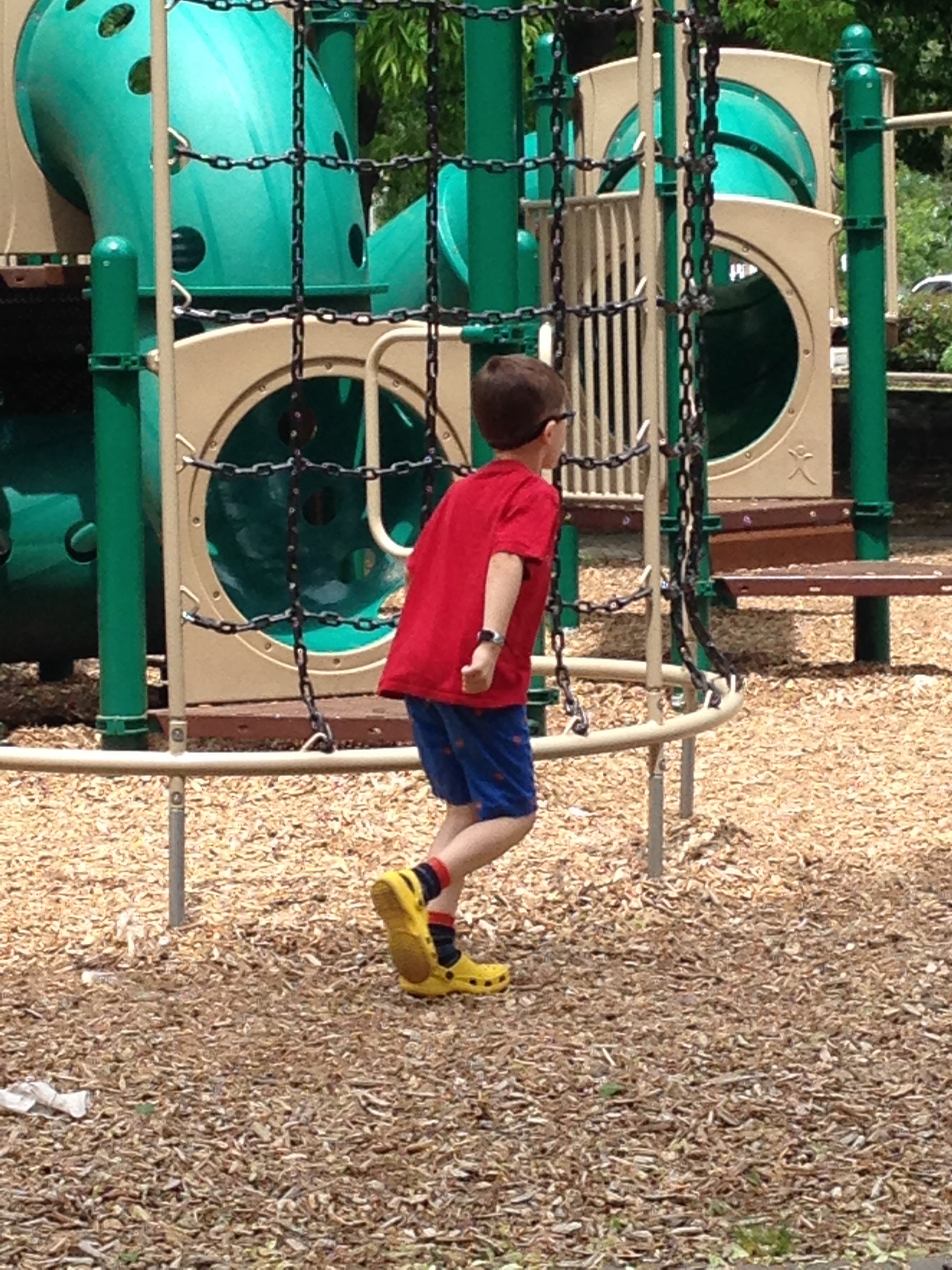
Martin doing his thing at a playground. I look at this big, big kid and think, "Is he really mine?"

Martin doing his thing at a playground. I look at this big, big kid and think, “Is he really mine?”

Beautiful, Terrifying

Here are two situations I’ve encountered recently:

At the music school again. I’m in the waiting area, with my laptop and four other adults, while Martin takes his piano lesson. A woman enters, accompanied by a teenager and a younger boy, maybe eight or nine years old. All three look alike; I assume these are a mother and her two sons. The mother approaches the front desk with questions about lessons and fees. As she talks to an employee, for a while, she turns her back to everyone else.

Immediately I see that her younger son is on the spectrum. He’s holding a small electronic device, a video game, close to his face as he paces urgent, long-stride circles, humming. He plops to the ground and focuses intensely on the video game, tapping the screen with his thumbs. He rises and recommences circling.

The teenage son, meanwhile, settles into a sofa and starts studying some sheet music. He appears comfortable with the situation, and not embarrassed by his brother. In fact, the teenager looks as if he could be a special-education professional. Magically, his eyes are on both his sheet music and his ASD brother. When the younger boy breaks his circle pattern and bolts down a hallway, the teenager follows him. They return seconds later, the teenager guiding and redirecting to the video game. When the ASD boy intensifies his pacing, then begins to disrupt objects in a sensory-seeking manner, the teenager calmly collects him in his arms and brings him to the sofa, cradling him in all-over pressure. Not once does the mother even have to divert her attention from the employee with whom she’s talking—although she, like any special-needs mom, must sense all that’s transpiring behind her.

After five minutes, the mom settles her business with the front desk, and the teenager’s music lesson is ready to begin. Before he heads off with the instructor, the teenager makes eye contact with his mother, so she knows he’s passing his younger brother’s safety to her.

It’s like watching a master-class in family ASD management.

In Texas, at an indoor playground. It’s Easter Sunday afternoon and Martin is antsy, so my brothers and I bring him to an indoor playground. Martin removes his shoes and dashes into the climbing structure, a sort of gigantic, netted jungle gym. I sit with my brothers in an ample lounge surrounded on all sides by the jungle gym.

Two men enter. They look cool. Super-cool. Sunglasses. Ample, sculpted chests, pecs, and biceps, visible under fitted polo shirts. Nice jeans and shoes. Okay, I’ll say it. They’re handsome. They have four or five children with them. I’m not really sure how many, because my attention goes directly to the one with autism. From his face, I’d say he’s ten or eleven years old, but he’s almost adult-sized. He’s tall and, like many ASD kids, with their gut problems and food issues, he’s overweight. He’s not looking at anyone, or speaking. The other children store their sneakers in the plastic cabinets set up for that purpose. The ASD boy tugs off his sneakers and leaves them on the floor. The kids disappear into the climbing structure.

The taller of the two men, in a white shirt, seems to be the one in charge of the ASD boy. I guess that he’s the boy’s dad. Almost without a pause he scoops the abandoned sneakers and tucks them in a plastic cabinet. The two men take adjacent chairs and begin talking. They seem like good friends. I’m too far away to hear what they’re discussing.

I imagine it’s the New York Rangers, because really cool, handsome men everywhere, even in Texas, like to talk about the New York Rangers.

After some time the ASD boy emerges from the jungle gym. He seems confused until he spots the two men, then runs to them and climbs onto his dad’s lap. The boy is so big that he looks absurd perched on a lap, like a teenager or even a small man curling his body onto another’s. His dad, Mr. Super-Cool, Mr. If-We-Were-in-Any-Other-Setting-I-Would-Take-Him-for-a-Childless-Playboy, continues talking to his friend while wrapping one arm around his son and using the other hand to rub the boy’s scalp. He betrays no hint of feeling awkward about the 150 pounds of kid smooshing his quads. He continues rubbing his son’s head until the boy springs to his feet and scampers back to the jungle gym.

The super-cool guys and their charges leave before we do. (My brothers and I, in tandem, are lazy caregivers. While Martin plays, for more than two hours, we’re sipping coffee and teasing each other, destitute of other ideas for filling a holiday afternoon.) As the other kids get themselves ready, Mr. Super-Cool puts shoes on his son’s feet and ties them. They’re nearer us now, and I hear him ask, “You okay, buddy?” Then, probably because his son is not verbal, he answers for the boy: “You’re okay.” They walk out holding hands.

There is a beauty to scenes like this, to a teenage brother forced to mature into vigilance, to a dude with nothing but tenderness for the child who requires more attention than the rest combined. I want to wave my arms and shout, “Hey, us, too! Autism’s got us, too! I’m proud to be like you!” I want to be counted with those who rise so brilliantly to the challenges they face.

Yet I also regret these scenes. Autism is a monster of our own making. Its incidence is rising from some combination (I don’t know which; who does?) of the dangers we humans have unleashed. Chemical concoctions disguised as food. GMO’s. Antibiotics, overused. Electromagnetic fields. Mercury and other heavy metals. Radio waves. Injected toxins. Pollutants. Pesticides. Sure, I admire the caregivers who meet autism head-on. They’re making positive choices. Where is the choice for the children with autism, who need calming, who crave sensory stimulation, who cannot sleep, cannot relate, cannot adapt, cannot ensure their own safety?

And where will they be when the brave and patient caregivers are no longer available?

We’ve got to stop this.

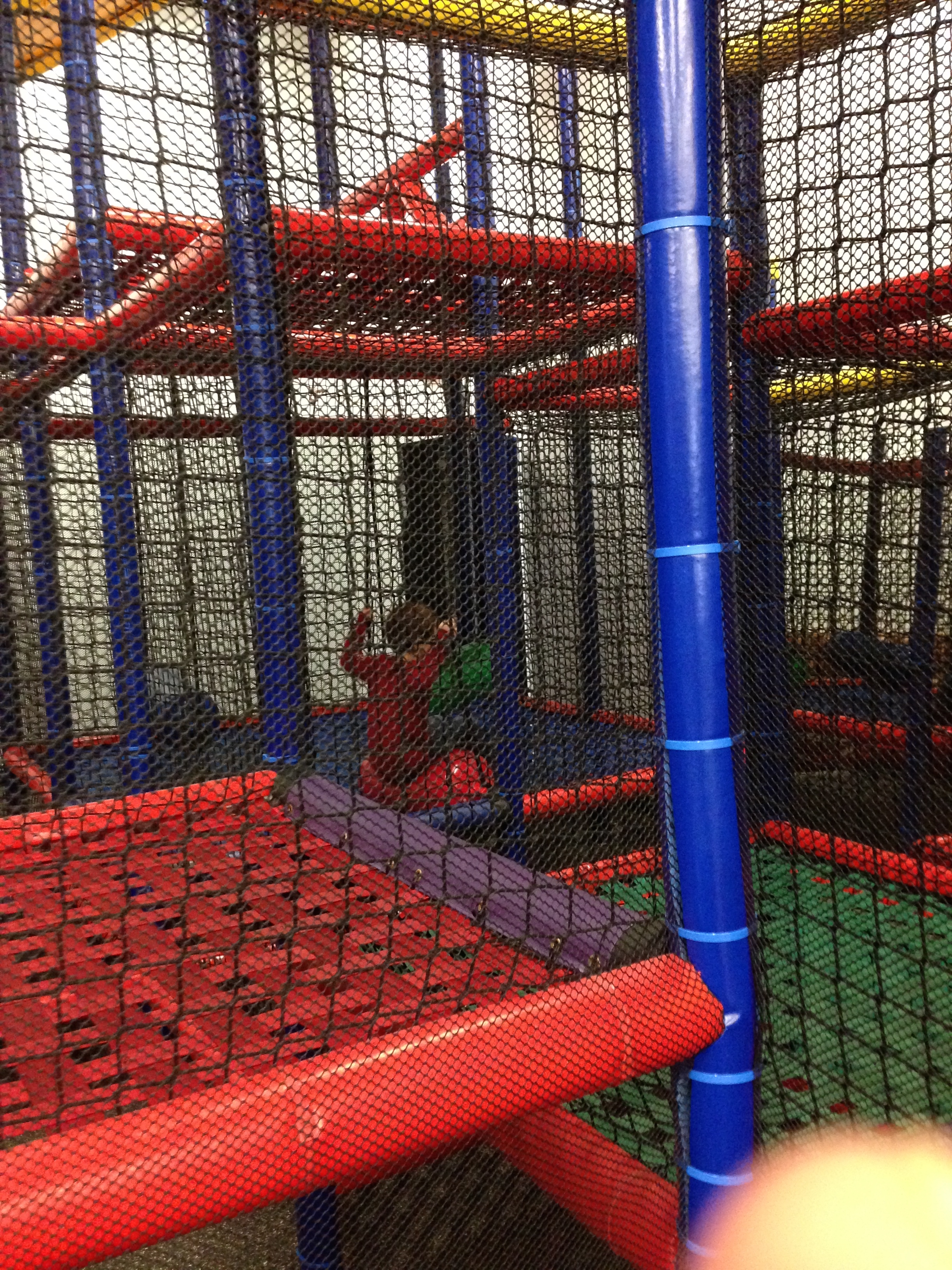
Martin, in the indoor playground, somewhere.

Martin, in the indoor playground, somewhere.

Regression, Progress, and What Does It Matter?

When Martin was diagnosed, during the time when Adrian and I were learning what autism means, Adrian asked whether I’d ever seen Martin “go backwards,” i.e., lose skills or developments that he once had.

No, I told him. No, I hadn’t seen that. There wasn’t anything that Martin had been able to do and no longer could.

He’d once made eye contact, once been interactive. I didn’t think about that. The changes were so gradual.

That’s good, Adrian replied. He’d read that going backwards was somehow worse than not having progressed in the first instance.

Oh? Well, phew. I haven’t seen Martin go backwards. I guess, on that point, we’re lucky.

Four-and-a-half years change a lot. Today I have a more informed opinion on regressive versus classic (non-regressive) autism. The idea that classic autism is somehow less threatening, wherever Adrian got that idea, must be mainstream. It must come from the school of thought that says autism is untreatable, recovery is not possible, and the best you can do is to teach a child with autism to live with his disorder, and to hope the condition doesn’t become more severe.

A few words about terminology. Regressive autism seems to appear following some insult to the immune system, like a serious illness, a vaccination, or an allergic reaction. In such cases, I believe—and I can’t say often enough that I am a non-scientifically minded lay person treading water in an ocean of evolving knowledge—the child likely has some preexisting immune shortcomings, or a genetic predisposition to these shortcomings, and whatever injury occurs throws the child’s whole system into disarray.

Classic, non-regressive autism is more of a mystery. The classically autistic child, as I generally consider Martin to be, does not acquire skills and them lose them; he simply never meets expected developmental milestones, or at some point stops meeting them. In Martin’s earliest months, we thought he was physiologically advanced. “You should video that,” his first pediatrician said, when I showed her that Martin already could turn over, front-to-back, at 17 days old. “Otherwise no one will believe you.” We marveled at Martin’s extensive vocabulary and his uncanny memory. “That is incredible,” the same pediatrician said at Martin’s 24-month check-up, when she realized that he’d memorized all the characters from the 1995 BBC version of Pride & Prejudice and was repeating their lines (hello, echolalia). But the thousands of words never came together into original sentences. The walking, a bit late at 14 months, never became running or skipping. The interest in videos gave way to obsession with wheels and mechanical parts. Martin stopped meeting expectations.

As it turns out, from everything I understand, and from all the families I’ve met who are on journeys like ours, regressive autism is more readily treatable than classic autism. Take that with a grain of salt, of course; I don’t know any form of autism that is really “readily” treatable, and certainly none that is easily treatable. Still, there appears, at least anecdotally, to be a distinction: Regressed kids, when treated biomedically, recover better.

True confession, and one I’ve made before, on this blog: Sometimes I feel disheartened when I see another family making more rapid progress healing their child than I’m making. What am I missing? I ask. What are they doing that I’m not? Then, where possible, I comfort myself by thinking, well, that boy’s autism was regressive. He was typically developing until age two-and-a-half. That’s why he’s recovering faster than Martin. These thoughts help. A little.

One school of thought holds that all autism is regressive, and the differences arise only based on when the regression occurred. For example, a pregnant mother’s (concurrent or earlier) exposure to certain pollutants or contaminants may crash her fetus’s developing system. In Martin’s case, I believe that the circumstances surrounding his birth—I was pressured to induce labor with Pitocin, leading to an un-planned Caesarian section, and then (healthy) Martin was taken to the NICU against my wishes and pumped with intravenous antibiotics—contributed heavily to the health and neurological problems that later became evidence. The injury, whatever it is, need not result from a lone tipping point, either. Many families report a series of mini-regressions following vaccinations and acetaminophen use.

If all autism is, to whatever extent, regressive, what does it mean that obviously regressive autism, cases in which a family watches language or eye contact or socialization fade rapidly, seems more readily treatable? Does it mean just that it is easier to recover skills if the child had them once? The ability to ride a bicycle or operate a manual automotive transmission, according to conventional wisdom, never disappears once acquired. Research shows that autism does not cause permanent brain injury, and that the brain can return to healthy functioning once the neural misfires and inflammation are eliminated. Perhaps a child who once spoke well can return to full language function faster than a child who never acquired spoken words. Playing catch-up for time lost is easier than starting from scratch.

Maybe all autism is regressive. Maybe there really is a difference between regressive and classic autism. Maybe regressive autism is more readily treatable. Maybe the important factor is the date of immune injury. Maybe the important factor is the extent of genetic predisposition. Maybe this, maybe that. For scientists, these questions matter. For a parent, fuhgeddaboudit. What does it matter, anyway? Keep chipping away at this monster, this autism, however long it takes.

This Vacation Brought to You by Autism Recovery

I’ve posted sporadically the last few weeks because Martin and I were abroad. Martin had the week off school for Presidents’ Day, so I packed him up for a visit to Adrian’s country of origin, in South America. We flew overnight, Friday to Saturday. We spent Saturday at my mother-in-law’s apartment in the nation’s capital. Sunday morning my mother-in-law, my father-in-law, Martin, and I flew a couple hours farther south, to the small town where my sister-in-law Cecilia lives with her children, Luke and Rosie. You may remember Luke and Rosie from an earlier post; they vacationed with us in Florida after Christmas. Adrian’s other sister, Claudia, also came south, from her summer home, with her three children.
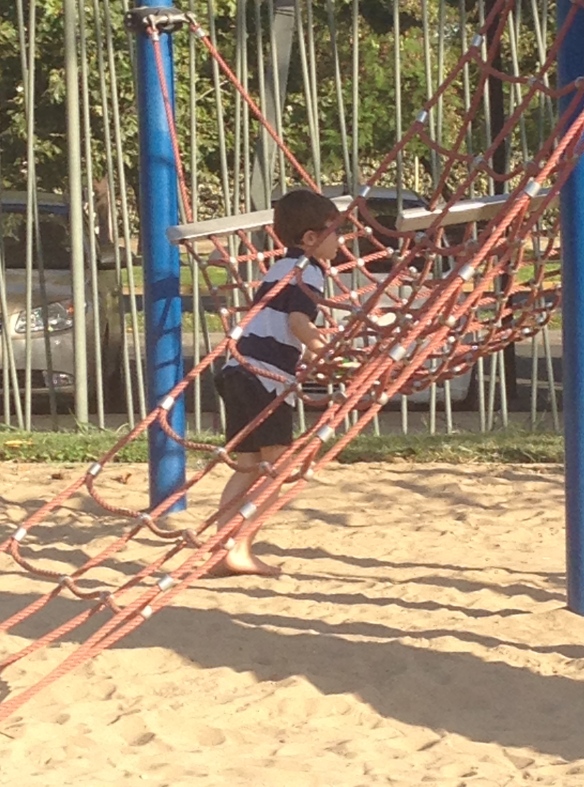
Martin plays in the sunny capital, before we headed farther south.

Martin plays in the sunny capital, before we headed farther south.

Confused? Here’s the cast of vacation characters: me, Martin, my mother-in-law, my father-in-law, my sister-in-law Cecilia, Cecilia’s children (ages 13 and 11), my sister-in-law Claudia, and Claudia’s children (ages 9, 7, and 1).

My mother-in-law, Martin, and I rented a lovely apartment with a well-equipped kitchen where I could prepare stock and breakfasts. Half a mile away, Cecilia allowed everyone else to stay in her three-bedroom home: my father-in-law, Claudia, and five children, including the two who usually reside there. Why did they all go for that arrangement? No idea.
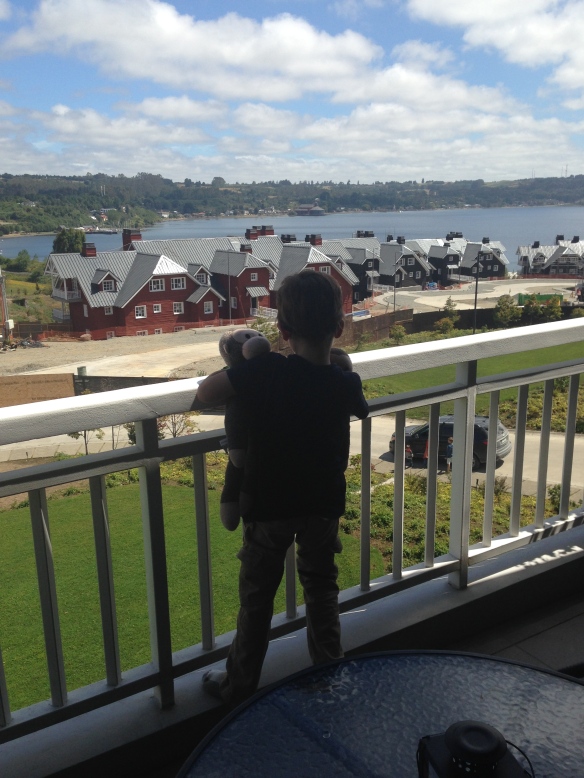
Martin and two Curious George sock puppets check the view from our vacation apartment.

Martin and two Curious George sock puppets check the view from our vacation apartment.

I anticipated challenges on this vacation, and my anticipation was not disappointed. Adrian’s parents know that Martin has autism, but his sisters and their children do not. Adrian has opted not to tell them. He explains that we don’t see his sisters often, and if Martin is going to recover from autism, as we expect he will, then there is no good reason to affix a label that, especially outside the United States, might haunt him long after its applicability. Although I don’t agree with Adrian’s logic or decision, I respect his right to handle his own family. Ergo, mum’s the word.

I could explain away Martin’s ultra-restricted diet with the catch-all “food allergies.” How could I explain his awkward attempts to play? (“Um, he’s nervous because he doesn’t speak much Spanish at home.”) How could I explain his tendency to hide his face when adults speak to him, and in response to any questions only wave backwards? (“He’s so shy! Just wait till he gets used to you.”) What about his appearing, sometimes, out of it? (“Can you imagine? He’s still so tired from the travel.”) How about the fact that he couldn’t spend the night with his cousins, as he wanted to, because I have to carry him, asleep, to the bathroom during the night to make sure he doesn’t wet the bed? I was happy that none of Martin’s South American cousins is exactly his age; the fewer bases for comparison, the better.

If Adrian’s sisters noticed Martin’s challenges—and I assume they did—they kept silent, except once: Cecilia said, “You have so much to do, with Martin.” I responded, “You mean with his food and all the time it takes?” She said, “His food, of course, and also his attention, how you need to watch him all the time.” We were in a crowd, when she said that, and when someone else came by, that conversation fell fallow. I was left wondering whether Martin’s autism will be a fact that everyone knows and no one mentions. Families have those facts.

Martin didn’t “fit right in” with his South American cousins, unfortunately. How could he? For starters, the other cousins live in the same country and see each other often. Martin’s the youngest, save for the one-year-old who doesn’t yet run with the pack in any event. Martin speaks Spanish, but without as much confidence as English, and even his English, while now conversant, remains awkward. And then there’s the autism elephant lurking. I wished I could have told at least Luke and Rosie, the oldest cousins, that Martin has autism. I wanted to see them take ownership of Martin, count him as one of their own and defend him against, for example, the 10-year-old named Valentín who hung around our group and treated Martin poorly. (¡Cállate, cállate!, he complained, pushing Martin away whenever Martin tried to share.) If Luke and Rosie knew why their little cousin is different, I reasoned, they would be more likely to look out for him. We might even have obviated the moment when Martin, in frustration, shut a door on his baby cousin because his seven-year-old cousin said everyone could come into the bedroom except Martin.

Forget all that. Let’s talk about what went right. Over a week-long vacation, Martin had virtually no meltdowns. Not when the horse-riding instructor brought sandwiches for everyone and, because I hadn’t realized we’d be eating, I had nothing for Martin. Not when a neighbor barbecued sausages for the children and, because I couldn’t verify the source or ingredients, Martin had to have a steak instead. Not when we rented bicycle-carts and Martin, as the youngest, had to ride in the front basket seat instead of pedaling. Not when he didn’t get a sleep-over with his cousins. Not even when my mother-in-law was late so I made him walk with me the dusty half-mile to Cecilia’s house.

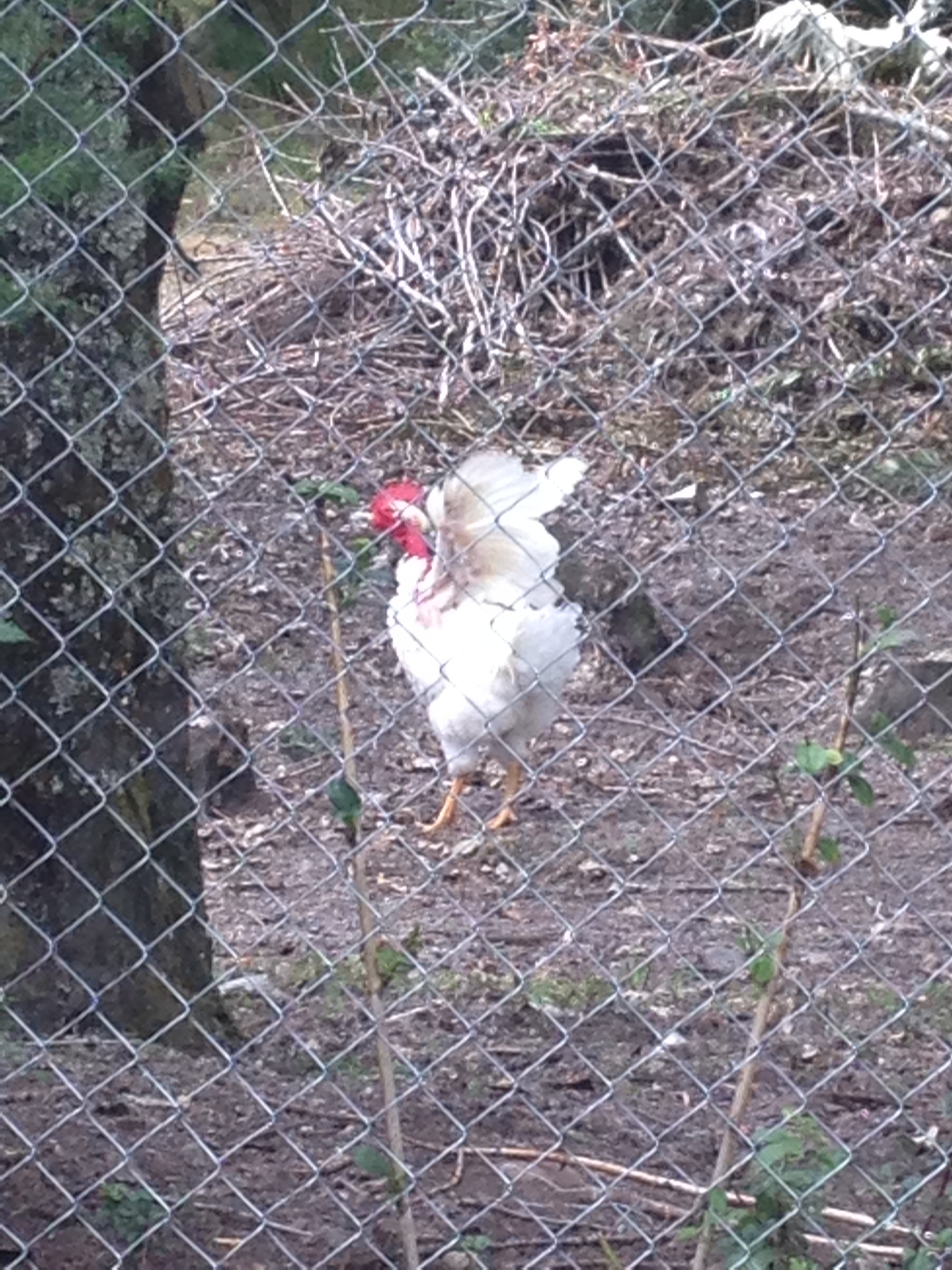
Totally unrelated to autism. Just a chicken that I saw in someone's yard on my way to my sister-in-law's house and really liked.

Totally unrelated to autism. Just a chicken that I saw in someone’s yard on my way to my sister-in-law’s house and really liked.

I attended a concert, a German trio, with my sisters-in-law and mother-in-law. Of the cousins, only Martin and nine-year-old Matías opted to come. Martin took his cue from Matías. He mimicked everything Matías did. When Matías rose from his chair and sat on an aisle step instead, so did Martin. When Matías moved back a step, so did Martin. When Matías played with the cable barrier, so did Martin. When Matías inexplicably made a fist and shoved it in his mouth (I’m serious), so did Martin. At intermission, when Matías decided to leave and go find the other cousins in the theatre café, so did Martin. Admittedly, that terrified me. Martin, for an hour, in a food establishment with a dark, railing-less outdoor deck on a lake, attended only by one-to-13-year-old cousins, none of whom knows Martin has autism and might need extra supervision? What could have gone wrong? Everything could have gone wrong, and nothing did. After the concert we reclaimed all kids and went to an Italian restaurant, where Martin ate GAPS-compatible fish with capers, showed off how he could cut the meal himself, and didn’t complain that the other cousins had pizza. That night Martin chatted by phone with Adrian—read that again: Martin chatted by phone with Adrian—and renewed my fears by saying, “In the café, Luke gave me a bar to eat.” A bar? A what? Crap! The next day, however, I learned from my sister-in-law Claudia that she’d slipped Luke a pre-approved fruit-and-nut bar in case Martin wanted something. Good, thoughtful in-laws.
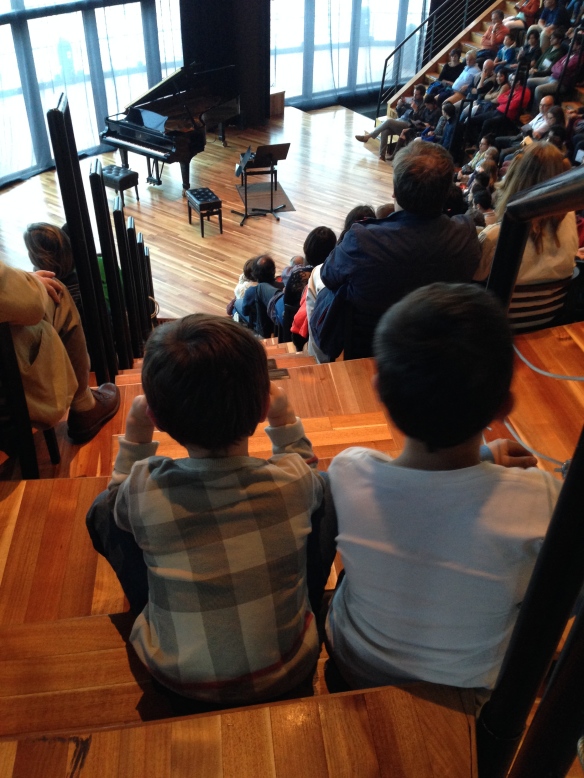
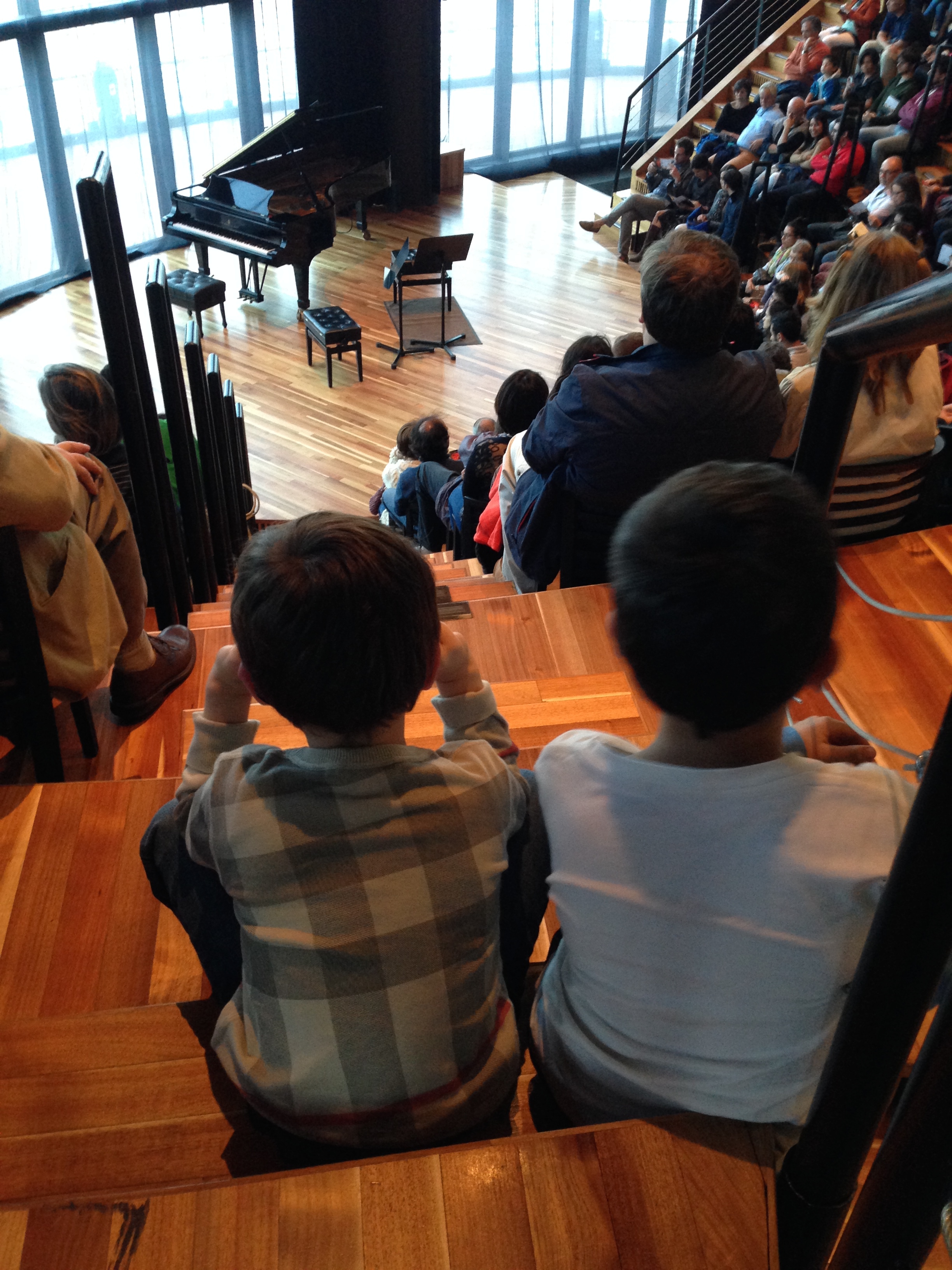
Martin and his cousin Matías prepare to enjoy a concert.

Martin and his cousin Matías prepare to enjoy a concert.

Martin went horseback riding with his cousins. The seven-year-old cousin was able to ride by herself. For Martin, the instructor had to tether Martin’s horse to his; Martin was too distracted to hold the reins and guide his horse. Still, Martin went, and happily. The first expedition, I was looking for some exercise and hiked alongside the riders. The second expedition, I had a massage scheduled and left Martin and the other cousins to ride on their own with the instructor. A couple hours later, in post-massage haze, I was at a café, sipping coffee with Cecilia and my mother-in-law and musing about whether we should go find the children, when the whole gaggle of them entered, with Luke holding Martin’s hand. They’d finished up riding, surmised that we were probably at the café, and come to find us. Martin took no issue with the uncertainty and evolving plans.
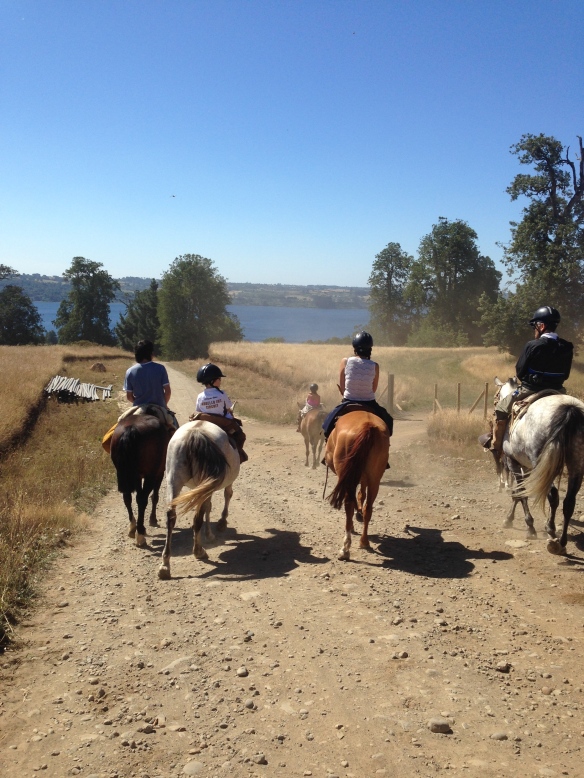
Martin riding with cousins and friends. Happy trails.

Martin riding with cousins and friends. Happy trails.

Our vacation site was two hours’ time difference ahead of New York, and South Americans keep late summer hours. We rarely ate dinner before 9:00 or 10:00. Martin hit the sack at midnight or so, and slept peacefully until 10:00 or 11:00 am. He tried new foods. (Among them was horse jerky. My bad. I should have read the label more closely.) When I forgot his swimsuit, he swam in his underwear. He watched television, which we don’t really do at home. He relished drinking fresh juice from a hippie-van-cum-juice-stand parked on the beach. He had a good time. Not an autism-accommodated good time. Just a good time. The kind of good time that might not have been possible if we still dealt with sleeplessness, limited language, meltdowns, and the absence of social interaction.

I’ve been bugging Adrian to ask his sisters, or at least one of them, for impressions on how the week went, and how Martin did. So far, no luck getting him to do so.

The last day, before we started the 16 hours of flights home, I asked Martin what had been his favorite part of vacation. He didn’t even hesitate:

“When I rode horses with my cousins the second time and you didn’t come.”

He wanted to be with his cousins instead of me. One cool thing about being an autism parent is that you can find an achievement in any insult.

P.S. As to Valentín, the 10-year-old who didn’t like Martin and showed it, eventually, when no one else was listening, I told him off. “Valentín, Martin is only six years old. He’s a guest in this country, and he doesn’t speak Spanish well. All he wants is to play with you and his cousins. So enough with the ¡Cállate!, got it?” He got it. Even if Martin’s cousins don’t defend him yet, I can.

Turn and Face the Strange

Sorry for my lack of blogging these two weeks. Circumstances got in the way.

Let’s start with last week. I have two fabulous women who assist with Martin’s care. On Tuesday afternoons, Janine—four years ago, she was one of Martin’s EI providers, and she’s been with us ever since—accompanies Martin to our church’s kids’ club and facilitates his participation, then brings him home and does dinner and bedtime. I use the time to write. On game days, I take my notebook computer to a pub to watch the Rangers play. Other days, the computer and I hole up at the town diner or the pizza joint. (When we lived in the City, I wrote at a wine bar. Suburbs change everything.)

Thursdays and Fridays, Martin’s nanny Samara comes. Thursday is “my night out.” I meet a girlfriend for drinks or dinner, or I write. Friday is date night, reserved for Adrian.

Last Tuesday, Janine had a migraine, so Martin and I were on our own. On Thursday, Samara’s husband came down with the flu. She wanted to take care of her husband, and also didn’t want to share the virus, so she stayed home and Martin and I were on our own again. And when I say “on our own,” I mean it. Adrian was skiing in California. You’re welcome, Adrian.

What about the daytime? you ask. Why didn’t I blog while Martin was at school?

Well, on Monday the dishwasher went kaput. That might not sound all-encompassing, so keep this in mind—on an average day, I run the dishwasher three times, and every load is full. That’s right. Around 9:00 a.m., I run the dishwasher with the breakfast dishes, any pans leftover from the previous evening, coffee tools, cat dishes, and whatever bowls I’ve used to assemble quick snacks. Mid-afternoon I pack the appliance with the utensils I’ve used to prep dinner (1:00-3:00 are my sous-chef hours) and assemble Adrian’s lunch for the next day, my own lunchwares, more cat dishes, gym water bottles, and the et cetera that clutters my counters, like flower vases, kombucha vats, gym water bottles, juicer parts, and (every second or third day) broth pots. Before bed I load the thing again, this time with dinner cooking vessels, dinner dishes, the bowls and utensils I send to school with Martin, more cat dishes, bakeware from muffins and grain-free breads, and glass storage containers emptied from the fridge, which are many because I will not waste food given by an animal.

If that array makes your head spin, then picture me washing it all by hand. So there went last week.

And this week? A blizzard hit our area. For sure, it wasn’t half the blizzard the weather folks forewarned. But it was enough to get the schools released early on Monday, cancelled on Tuesday, and delayed on Wednesday. Let’s just say that Martin and I got to spend ample time together, which is not conducive to writing. Meanwhile, Adrian, fresh from the airport, appeared at home Sunday evening for a dinner party we threw, then departed again Monday morning (pre-“blizzard”) for the Midwest, and my good friend Coleen (you’ve met her before) was staying with me, to cater the aforementioned dinner party. Because of the weather, Coleen couldn’t go home to Upstate New York, Adrian couldn’t return from the Midwest, and Martin and I endured a continually evolving schedule.

I accomplished nothing.

Actually, Coleen and I washed a lot of dishes, by hand. Other than that, I accomplished nothing.

That’s a lot about me, right? No worries. I’m about to circle this post back to Martin.

Because guess what? Martin has had a tough couple weeks. Yeast flare, discomfort, blah blah blah. And yet—he did fine. Confronted with change upon change, he held steady. Nary a meltdown. When Janine couldn’t come, Martin had to skip the church kids’ club and run errands with me instead. He complained, like a six-year-old. He didn’t cry. We survived. When Samara couldn’t come, Martin said he was sad, and then spent too much time on his iPad. We survived.

I’m not ready, yet, to relegate meltdowns to the “so far gone” list. They still happen, or “kinda” happen. This morning, for example, Martin didn’t finish his breakfast in time to choose which dishes and utensils I would send for his school lunch. (We love incentives! If breakfast is done by 7:30 a.m., the choice is his. If he dawdles until after 7:30, I pick.) Upon learning that he had missed his deadline, Martin started to cry. I said, “I don’t think you have anything to cry about. Cut that out, and let’s get ready for school.” And then he was done.

Not long ago, if Martin said he wanted to change the radio station in the car, I had to undertake this analysis: “If I change the station, I’m giving into his rigidity, against my RDI instincts. If I don’t, he’ll have a meltdown, and I’ll have crying and distress on my hands.” Not anymore. Now I ponder something more like, “He wants a different station. How much do I like this song? Should I just change it, or should I listen to this song and let him choose the next?” That’s a world of difference.

There was a time when last week and this week would have been nightmares. We’ve come far enough that, now, they were just pains in the neck.

This morning the dishwasher was repaired. Right now, the Rangers are playing the Canadiens.

So here I sit. Writing.

Happy.

Year 2014 in Review

A year ago, I woke up on New Year’s morning with the conviction that 2014 would be a banner year in Martin’s recovery.

It’s time for a look back at 2014.

Martin and a boy he played with on the beach, Florida Keys, New Year's 2014.

Martin and a boy he played with on the beach, Florida Keys, New Year’s 2014.

We started several interventions to which, for a change, Martin plainly seemed to respond. (I write “for a change” because these were some of the few times when I was able to isolate particular interventions that helped. More often, it’s just something in “the whole package.”) When I posted in late July about five treatments that were “working now,” I also posted my frustration in jumping to conclusions based on initial positive results. I’m going to report now that at least two of those five “what’s working now” treatments, six months later, still are kicking autism’s butt: camel milk and Candex. Martin’s language took off immediately following the introduction of camel milk, and it hasn’t stopped since. Did you Tuesday’s post about the conversationalist? How cool was that? As for the Candex, Martin still has yeast flares. (I’ve come to accept that candida overgrowth may be a battle we fight for many years. Therein may lie our war.) Since we started using Candex, however, those flares have been milder and of shorter duration. They’ve been manageable.

Martin with his cousin Mandy in the snow, February 2014.

Martin with his cousin Mandy in the snow, February 2014.

And the other three “working now” treatments, the GAPS diet, Enhansa™, and MitoSpectra? We are still on all three. I modified the GAPS diet by adding quinoa and reducing Martin’s meat consumption to one meal per day. (The reduction of meat isn’t particularly a “modification,” I suppose, though it felt that way.) I think Martin’s gut health is better than ever, though I wish he weren’t still prone to yeast flares. As to Enhansa, Martin’s chronic inflammation appears to have eased; I can’t say whether the Enhansa is responsible, or general improvement in gut health. I may stop the Enhansa, as an experiment, and see what happens. I plan to keep the MitoSpectra, for the time being. I reduced Martin’s dosage when a blood test revealed high levels of carnatine, and I feel like I could be doing more for his mitochondrial functioning (hence the quinoa). I’m keeping the MitoSpectra because I haven’t yet discovered that next best thing.

Martin at Planting Fields Arboretum State Historic Park, Oyster Bay, New York, Spring 2014.

Martin at Planting Fields Arboretum State Historic Park, Oyster Bay, New York, Spring 2014.

In the second half of the year, after my “What’s Working Now” post, we started vision(-ish) therapy with Dr. Deborah Zelinsky; Heilkunst homeopathy with Rudi Verspoor; and a weekly facilitated social group with local kids. So far, I give all three a big thumbs up. We are in another period when “things are going well” but I’m not totally sure why. I may be observing a slight uptick in Martin’s eye contact and attention span. I’ll give that development to Dr. Zelinsky. Martin had a fever and apparent healing reaction over the Christmas break. That goes to the Heilkunst. As for the social group, that’s a confidence-builder. Martin is happy to have friends of his own. Last week, for the first time, he asked to bring a game that everyone could play—the lovely wildlife bingo set his uncle Eddie gave him.

Martin rock climbing at a birthday party, July 2014.

Martin rock climbing at a birthday party, July 2014.

Did I make mistakes in 2014? Of course I did. I think the straight-up GAPS diet had too few carbs to meet Martin’s mitochondrial needs. I know there is debate on this point. For my child, I should have known; way back in 2011, when we first went grain-free, Martin showed signs of mild ketoacidosis, and we had to add a few gluten-free grains back in. This time around, I should have guessed that he would need more carbs than GAPS allows.

Martin with his uncle Rudy, Strasbourg, France, August 2014.

Martin with his uncle Rudy, Strasbourg, France, August 2014.

I rushed treatments. The mother who launched our biomedical journey cautioned me against the urge to do everything at once. Nevertheless, when I find an intervention that excites me, I might move too quickly. Even today, four years into Martin’s recovery, I’m prone to that amateur mistake. Other times, I just fail to pay attention and mistakenly start two treatments together. C’est la vie.

Martin looking over St. Bartholomá church, on the Königsee, Berchtesgadan, Germany, August 2014.

Martin looking over St. Bartholomá church, on the Königsee, Berchtesgadan, Germany, August 2014.

Despite my tendency to rush, though, I think honestly I can peg 2014 as the year when I internalized “marathon not sprint.” Sure, for years now I’ve parroted the mantra. Autism recovery is a marathon, not a sprint. Autism recovery is a marathon, not a sprint. But what kind of marathon did I really envision? In my “banner year” post, last January, I wrote, “I now understand ‘the long haul,’” and “I no longer fear that some mythical window will close while Martin is five . . ., or seven, or any age.” Even after I wrote that, however, the notions took some time to sink in. It wasn’t until November, when I wrote the “Journey” post, that I finally abandoned the idea that this process will have an end date. Striving for better health may well be a perennial task, one that Martin needs to continue even after he becomes responsible for his own care. Autism recovery is not a sprint. It isn’t even a marathon. Autism recovery is a lifestyle.

Martin hiking in the Adirondack mountains, near the Great Sacandaga Lake, August 2014.

Martin hiking in the Adirondack mountains, near the Great Sacandaga Lake, August 2014.

Behavior-wise, in 2014 Martin took new interest in socializing with other kids. Although he still isolates himself when he becomes overwhelmed, for the most part he wants to be near his friends, even if just to play side-by-side on iPads. Late in the year, Martin also (finally) made progress on nighttime potty training. He wakes now when he needs the potty, and yells for me. “Thanks, kid.” Language-wise, in 2014—well, wow. Martin has been asking “why” questions (like, gazillions of why questions) for a long time now; in 2014, he started answering them, coherently. He’s become conversational, staying on point for multiple exchanges. He can talk on the phone. This afternoon he’s going to call Uncle Eddie and wish him happy birthday! And the perseveration has decreased. Did I mention that the perseveration has decreased? Yeah, the perseveration has decreased. Such a relief.

Martin, on the left, with his cousin Luke, in the Florida Keys, New Year's 2015.

Martin, on the left, with his cousin Luke, in the Florida Keys, New Year’s 2015.

I am pleased to conclude that 2014 was a banner year in Martin’s recovery. All signs point to significant improvement in health, and corresponding changes in behavior.

May it be one banner year among many.


So Here’s Something Else New We’re Doing

We have started Heilkunst, a form of sequential homeopathy. We’re working with Rudi Verspoor of Ottawa’s Hahnemann Center.

Four years ago, when we started the process of recovering Martin from autism (as opposed to helping him live with autism, through traditional therapies), Adrian and I resolved not to go too far “out there.” The first MAPS doctor we brought Martin to is a graduate of Harvard College and Yale School of Medicine, and completed her residency at Massachusetts General. These credentials were important to us, because we didn’t want to be dealing with, as I put it, “a graduate of the Pacific School of Holistic Touchy-Feely Medicine.” (Let me also add that Martin’s first MAPS doctor is empathetic, intuitive, and utterly knowledgeable, and that we switched doctors only because that one moved to California.)

We’ve been through a lot in the years since Adrian and I resolved not to go too far “out there.” We’ve used two homotoxicologists, one in New York City who did not work out well—part of the problem could have been me not understanding homotoxicology at the time, and her not explaining the process in a way I could grasp—and for the last two years Lauren Lee Stone in Connecticut, with more success. Martin has participated in craniosacral massage, muscle testing, naturopathic assessment of food allergies. He’s drinking camel milk daily. He’s slept on a grounding sheet, inside an RF-blocking tent.

I suppose I’ve strayed pretty far “out there” with Martin, and Adrian hasn’t stopped us. When your son stops running in circles, and starts talking, and stops thrashing around in his bed, and starts realizing when you’re in the room with him, then you pretty much go where the journey takes you, and go gratefully. I still care, a lot, about credentials and science, but you could say my horizons have expanded.

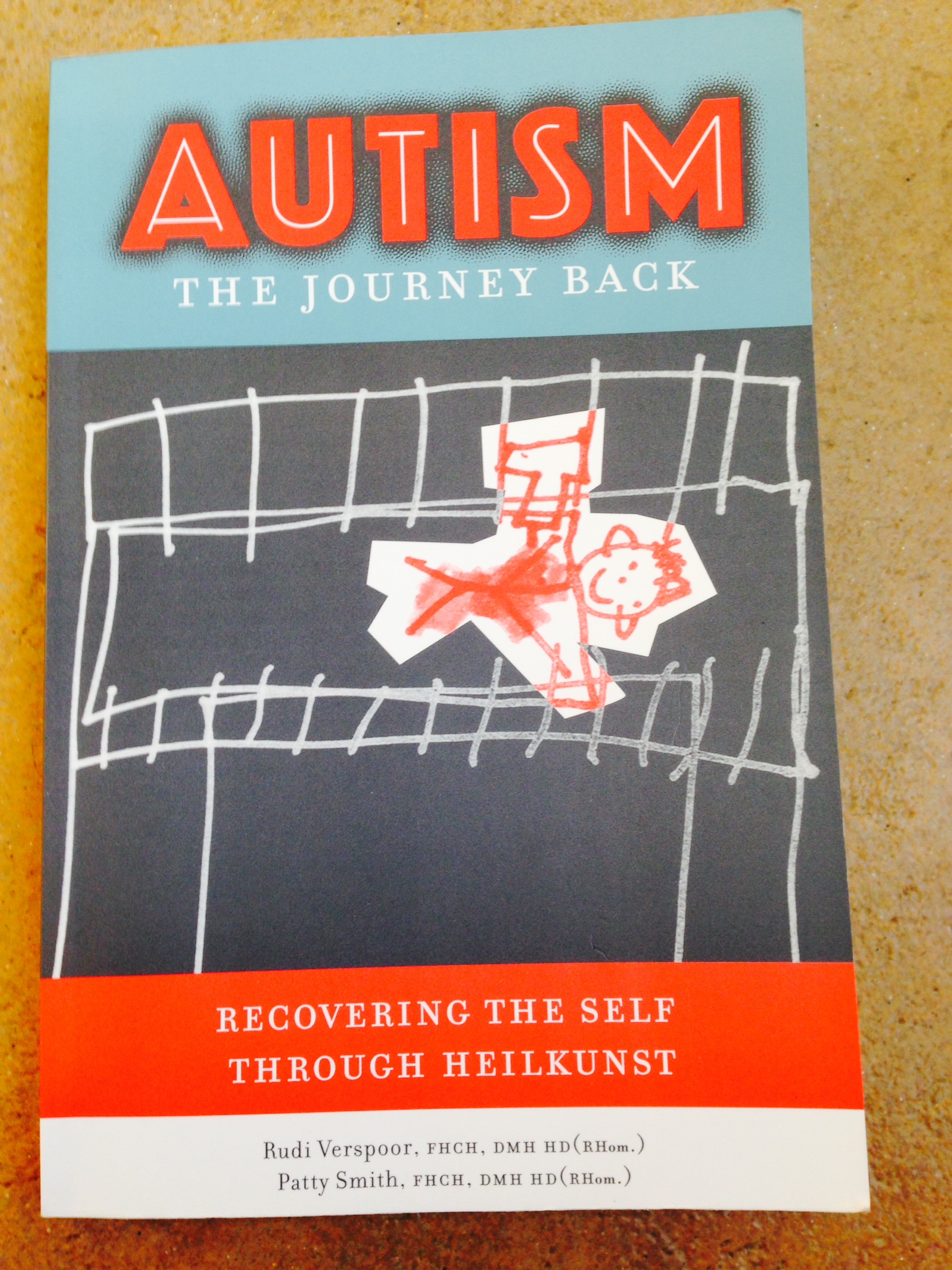
On an “out there” scale of 1 to 10, with 1 being ABA and MiraLAX® for autism, and 10 being having Reiki vibes telepathically sent from Mongolia, I would put Heilkunst at about an 7.73. In their book Autism: The Journey Back, Rudi Verspoor and Patty Smith describe Heilkunst as a “comprehensive, integrated system of Western medicine based on the principles of natural law regarding the removal of disease (cure) and the restoration of balance in our functioning (healing).” As I understand the process, Martin will progress through a series of homeopathic “clears,” one every two or three weeks, to alleviate the insults to his immune system, from pre-natal development through today. The insults to Martin’s immune system have been many, from his traumatic birth to vaccinations to living in a home under renovation. I had to list all this out in order to begin Heilkunst. It was not a fun process.

Now, let me add this: Scoring Heilkunst an 7.73 on the “out there” scale does not mean I don’t have faith in the process. To the contrary, Heilkunst is energetic healing, and I am administering it to Martin, and I think my faith therefore is necessary to its success, and I would not have proceeded if I didn’t expect results. I’ve talked to many families whose children have progressed with sequential homeopathy. I’ve witnessed their progress. Plus, sequential homeopathy makes sense to me. I know many of the factors that affected Martin’s immune functioning; I’m eager to help him work back through what happened.

I’m also glad we did not start Heilkunst sooner. We needed first to get the biggest stuff under control: his digestion, his ability to rest, his communication skills to participate in the process.

And we had some mental blocks to remove. Mine.

photo-10

Snack Drawer

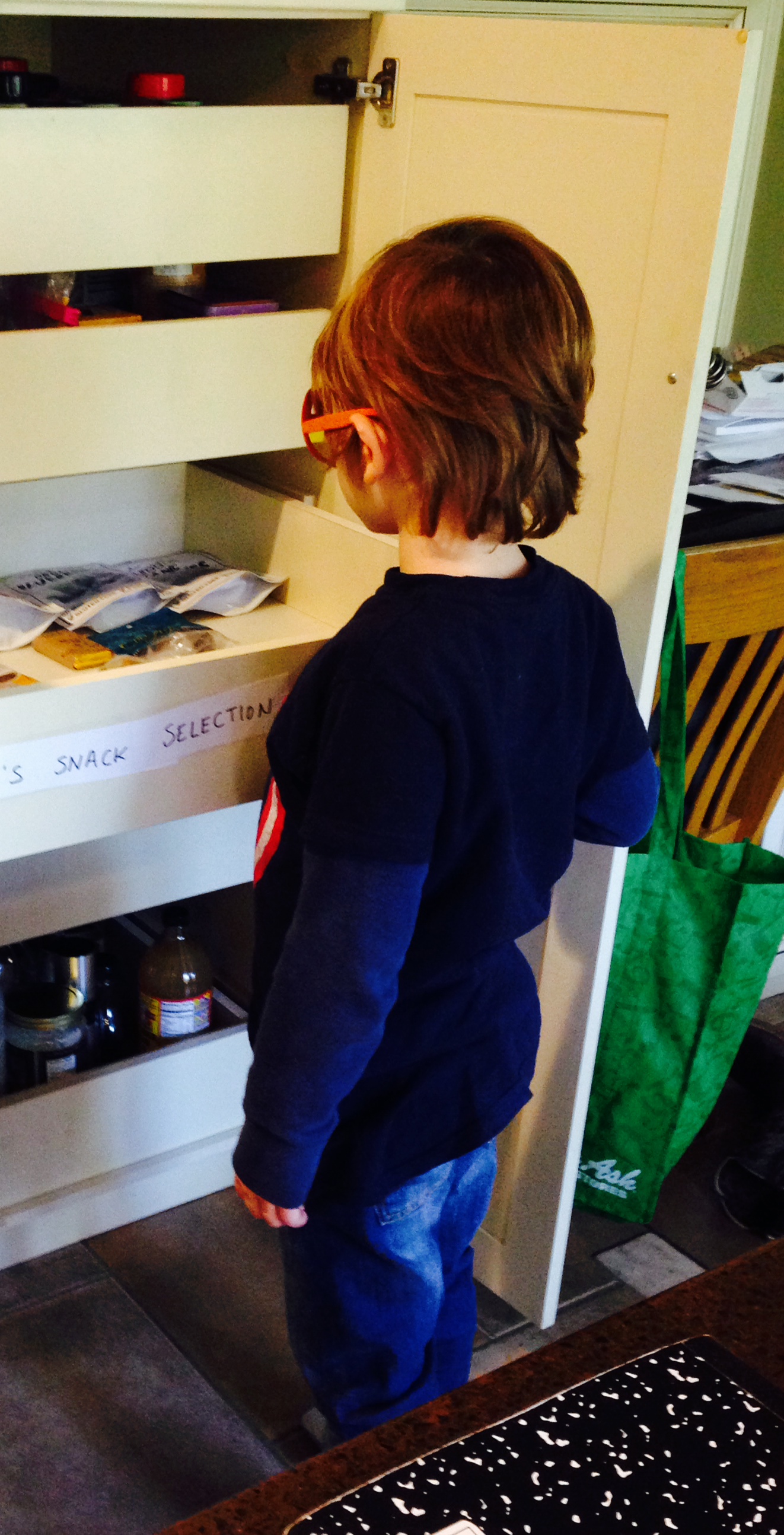
For the past six months or so, I’ve kept Lärabars and other snacks for Martin in the second drawer of our pantry. That drawer contains other foods, too: nut butters (including peanut butter), non-gluten flours, cacao nibs, hemp seeds, Adrian’s chocolate stash, stuff like that. A variety, only some of which Martin can eat.

I never thought Martin paid much attention to where I keep his snacks, until one afternoon two weeks ago. That day, Martin came home from his school, took off his shoes, opened the pantry, and started rummaging through the second drawer in search of a snack.

To me, that seemed like reasonably typical kid behavior and, for Martin, a new independence that I should foster. The second pantry drawer is somewhat too high for Martin to access comfortably (though with the way he’s growing taller, next week that might not be the case). Also, it seemed unfair that he should have to push aside stuff he cannot eat—e.g., peanut butter, or Adrian’s chocolate—to reach his own treats. Therefore, I emptied the third drawer of the pantry and redistributed those items in other drawers (a challenge in my snugly packed pantry!). Then I filled the third drawer with after-school snacks and taped labels on the front: “Martin’s snack selection” and “one snack per day!”

photo 2

The contents of the drawer reflect a preference Martin has (again, typical, I think) for store-bought, packaged goodies over what I prepare at home. I make protein bars, truffles, and macaroons similar to what’s pictured here; Martin wants the colorful, the prettily wrapped, “what you buy at the store!” (The homemade items I send to school.) Note also that not every product in the drawer is 100% GAPS-compatible. A few contain agave and, for whatever reason, have slipped through my control.

The snack drawer has been a big success. Martin loves to pore over its contents and select the perfect “snack of the day.” This weekend, when he was allowed to pick a snack to take to his activity program, he removed five different snacks, lined them up on the kitchen table, took a few minutes to decide which he wanted, then returned the other four to his drawer. When he wasn’t looking, I snuck in and rearranged the returned snacks into the appealing, every-snack-visual format. That’s me.

photo 1

I’m inspired now, to try to display Martin’s clothes in a way that makes him want to pick his own outfits. I like to dress him in the sports jersey of my choice, but I suppose I need to focus on his autonomy, too. The pumpkin glasses he’s wearing in that photo count as autonomy, I guess.